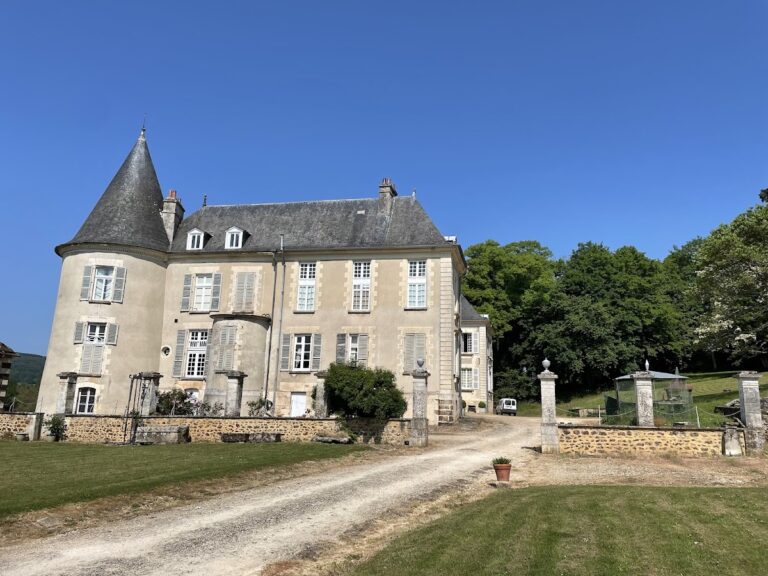
Menetou-Salon Castle: A Medieval Fortress Transformed into a Neo-Gothic Residence


Site at a Glance
- Rating
- 4.5
- Popularity
- Low
- Country
- France
- Primary era
- Modern
- External website
- Open
- Eras represented
- Medieval, Early Modern, Modern
- Civilizations
- French
- Site type
- Domestic
- Remains
- Castle
On this page15 sections
History
Menetou-Salon Castle is a former fortress in Menetou-Salon, France, with origins in the medieval period and a present form shaped by nineteenth-century Neo-Gothic architecture. The lordship of Menetou is mentioned from the eleventh century, when Sarlon Le Riche, a local lord of Norman origin, built a fortress here. The castle is also broadly dated to the twelfth century.
Medieval lordship
During the thirteenth century, the Counts of Sancerre gradually withdrew from the fortress and established a more refined residence on the site of the present castle. They had succeeded the de Vesvre, lords of Mehun, and the lords of Vierzon. Menetou therefore developed from a fortified stronghold into a residence associated with the region’s medieval nobility.
In 1448, the estate was sold to Jacques Cœur, a major fifteenth-century financier and royal treasurer of King Charles VII. Charles VII later confiscated the property and granted it to his mistress, Antoinette de Maignelais, a French noblewoman.
Ownership from the sixteenth century
In 1513, Artus de Villequier, the son of Antoinette de Maignelais and André de Villequier, sold the land of Menetou for 20,500 livres to Jeanne de Malet de Graville. She was the widow of Charles d’Amboise and the daughter of Admiral Louis Malet de Graville. Menetou then passed to her nephews, the de Balzac d’Entragues family, and later in the sixteenth century to the d’Urfé and Pot de Rhodes families.
Claude d’Urfé became lord of Menetou in 1532 through his marriage to Jeanne de Balzac d’Entragues. He was a royal household official under François II, who reigned from 1559 to 1560. After Claude’s death in 1559, his brother-in-law Jean Pot, lord of Rhodes in Lower Berry, purchased the châtellenie, a feudal territorial jurisdiction associated with a castle, from Jacques d’Urfé.
The first major building campaign took place at the beginning of the seventeenth century under Guillaume Pot de Rhodes, Grand Master of the Ceremonies of France. This senior court official was responsible for organizing royal ceremonial events, and his works at Menetou included the construction of the Henri IV pavilion.
In 1590, the seigneurie of La Chaintre and the area around the castle known as the Pot Fief were united. La Chaintre depended directly on Boisbelle, while Menetou-Salon depended on Mehun-sur-Yèvre and therefore on the king. Their jurisdictions had different systems of taxation and military obligation, and the inhabitants of the Pot Fief benefited from particularly favourable conditions.
From the eighteenth century to the present
In 1755, Élisabeth-Pauline de Gand-Lauraguais brought the castle to her marriage with Louis-Léon de Brancas, Duke of Lauraguais, as her dowry. Their only daughter, Louise Antoinette Pauline, married Louis-Engelbert d’Arenberg in 1773.
The French Revolution heavily damaged the castle and dismantled the seigneurie. The property was returned to the Duke of Lauraguais during the Restoration, the period when the Bourbon monarchy was restored after Napoleon’s fall. Following his death in 1824, his grandson Pierre d’Alcantara-Charles-Marie d’Arenberg took responsibility for the castle with his wife, Alix de Talleyrand-Périgord.
The castle also provided emergency shelter after a fire struck the town on 27 April 1840. The Prince of Arenberg accommodated some of the 500 people left homeless by the disaster.
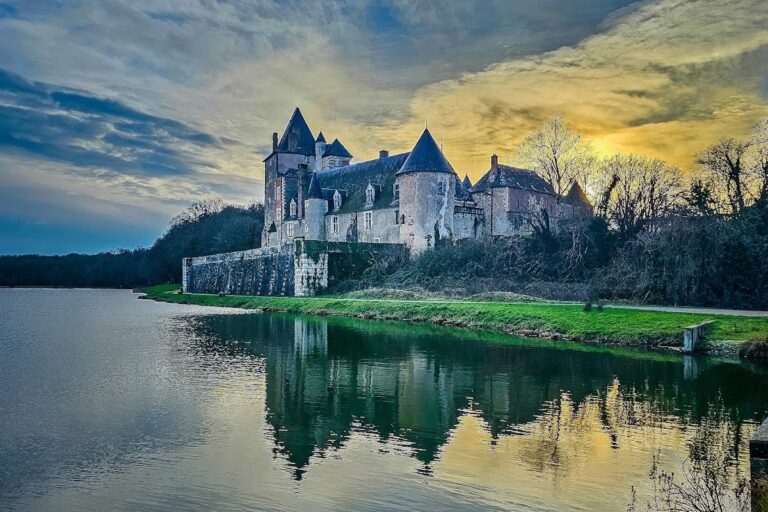
Between 1884 and 1890, Auguste Louis Albéric d’Arenberg, who presided over the General Council of Cher, commissioned extensive enlargements from the architect Ernest Sanson. The works created the castle’s present form while retaining its Gothic character. Menetou-Salon Castle remains a private residence and was registered as a historic monument in 1989.
Remains
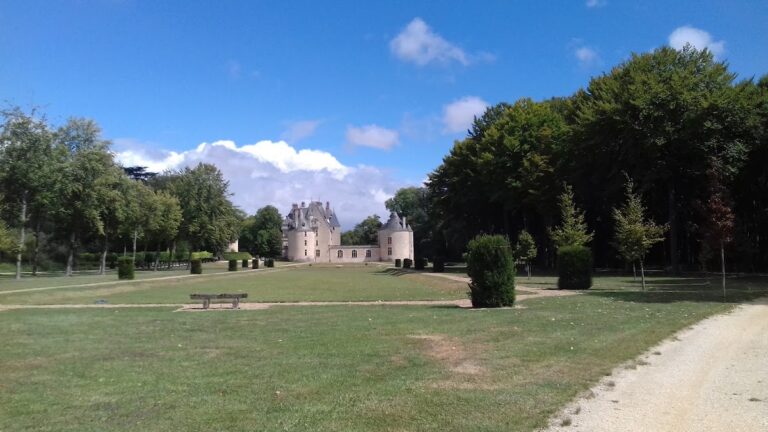
The surviving complex combines the fabric of a former fortress with extensive nineteenth-century additions. Its south and east sides were remodelled in the Neo-Gothic style, a nineteenth-century revival of medieval Gothic forms, while the north and west sides retain a more classical appearance. The enlargements added dormer windows, gables, and pinnacles. The building contains 24 fireplaces and 297 windows, and its interiors were refitted after the Second World War.
Principal interiors
Entrance hall
The entrance hall is a large room containing a statue of Agnès Sorel, a fifteenth-century noblewoman who became a favourite of King Charles VII.
Dining room
The dining room occupies the medieval wing, whose façade dates from the fourteenth century. Its decoration includes ceramics reproducing motifs from Giuseppe Arcimboldo’s Seasons.
Billiard room
The billiard room contains painted and photographic portraits of members of the d’Arenberg family. A red carpet covers the floor, with its colour described as that of the princes of the castle.
Library
The library holds 12,000 volumes. Oak panelling lines the room, which also contains an Italian-style fireplace made of grey and white marble.
Ancillary buildings and grounds
Chapel and tack room
The castle complex includes a chapel and a tack room, as well as a collection of automobiles and horse-drawn equipment.
Dovecote
The dovecote houses white peafowl, identified as Pavo albus. Their white colouring is attributed to leucism, a genetic condition that reduces pigmentation without being the same as albinism.
Park and vineyard
The park consists of meadows and woodland. A small garden is accessible to the public, while the remainder of the park is private. Opposite the castle, the Clos de la Dame vineyard is the only vineyard in the centre of Menetou-Salon. Along with other parcels around the village, it produces the red, white, and rosé Prince and Duke of Arenberg cuvée.
Automobile collection
The automobile collection includes a 1937 Rolls-Royce Phantom III, of which 300 examples were produced, a 1912 Turcat-Méry described as the only surviving example, a 1923 Hispano-Suiza, and a Bentley.
Nearby sites