Schloss Winsen: A Castle and Administrative Seat in Germany


Site at a Glance
- Rating
- 4.4
- Popularity
- Low
- Country
- Germany
- Primary era
- Early Modern
- External website
- Open
- Eras represented
- Medieval, Early Modern
- Civilizations
- Holy Roman Empire
- Site type
- Military
- Remains
- Castle
On this page12 sections
History
Origins beside the Luhe
Schloss Winsen is a castle in Germany that developed at a crossing of the Luhe and was later adapted for administrative use. A document from 1315 names the castle, while another from 1277 indicates that it probably already existed. An oak pile discovered in the area of the former rampart had been felled around 1190, during the presumed foundation of Winsen and the expansion of its harbour.
The harbour became more important after Bardowick lost its trading site through destruction in 1189. Schloss Winsen therefore probably served chiefly to protect harbour operations as the settlement and its waterborne connections developed.
The Grand Bailiwick of Winsen
At the beginning of the Lüneburg War of Succession in 1371, Duke Magnus II transferred the Grand Bailiwick of Lüneburg to Winsen. A Grand Bailiwick was a high-level territorial administrative office. The castle then became the seat of the Grand Bailiwick of Winsen, which governed Welf possessions in the northern part of the Principality of Lüneburg. The Welfs were the dynasty that ruled Brunswick-Lüneburg and related territories, while the Principality of Lüneburg formed one territory within the wider Duchy of Brunswick-Lüneburg.
The castle and its associated lands were repeatedly pledged during the fourteenth and fifteenth centuries. The Council of Lüneburg held them from 1374 to 1389, and they passed to Hamburg and Lübeck in 1396. Lüneburg regained them intermittently from 1434, while the Electors of Saxony held them from 1493 to 1523.
Dorothea’s residence and the early modern castle
From 1593 to 1617, Dorothea of Brunswick-Lüneburg, the widow of William the Younger and a member of Denmark’s royal lineage, lived at the castle as her retirement residence. She administered the Amt of Winsen, a smaller administrative district governed by an appointed official. Several witch trials took place there during this period, and about 40 people are estimated to have been condemned as witches and burned outside the town gate.
Dorothea ordered the castle chapel to be remodelled, and the tower received a clock and two bells. The smaller bell was surrendered for Germany’s First World War metal collection in 1917, while the larger bell remains in the tower. During the Thirty Years’ War, the major European conflict of 1618 to 1648, the Catholic commander Tilly stayed at the castle for several weeks in 1627 while recovering from an injury.
Administrative use and modern conservation
After the Thirty Years’ War, Schloss Winsen became the seat of the officials governing the Amt of Winsen. The Winsen district court moved into the building in 1852, followed by the district administration in 1885. The 1932 administrative reform dissolved the District of Winsen into the Harburg District, and the district administration moved to the formerly independent city of Harburg.
Wartime destruction damaged the administration’s building in Harburg, so the administration returned to Schloss Winsen in 1944 and also occupied four barracks in the castle park. It remained until 1961, when it moved into a new building immediately beside the castle. The cadastral office stayed at the castle for a time before moving to its own building in the 1990s.
The State of Lower Saxony now owns Schloss Winsen, and the Winsen district court is its sole institutional user. A small museum has operated in the castle tower since 2008. The chapel is used for cultural events, including concerts, and can also be rented for civil weddings. Extensive renovation of the north and south wings and a new-build element took place from 1994 to 2016. The tower lantern and spire were renovated in 2022.
Remains
Layout and construction
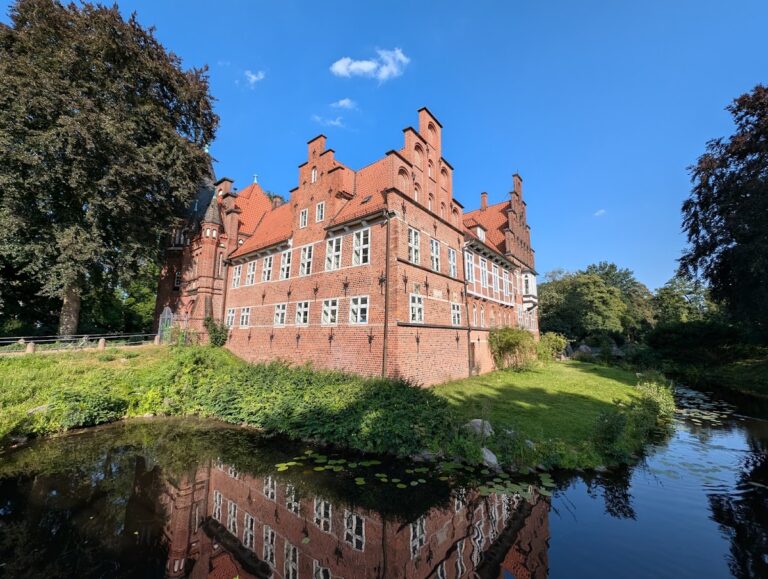
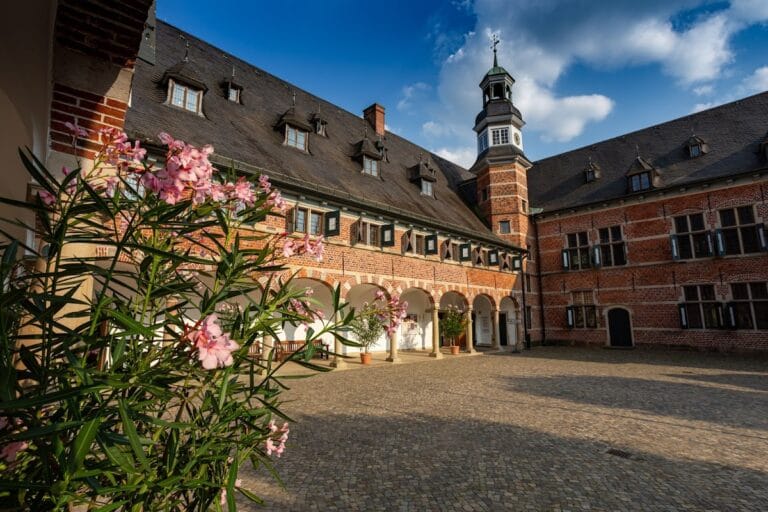
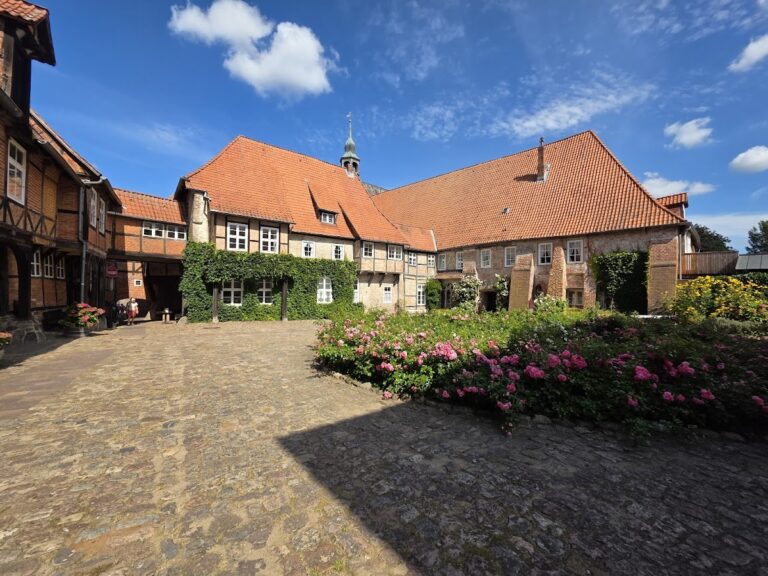
Schloss Winsen is a brick building with half-timbered elements, standing within a pond formed by damming the Luhe. Its irregular plan has three wings arranged around an open courtyard. A fourth wing once enclosed the western side and was probably demolished after a fire in the eighteenth century.
The former fortifications have been removed, but the surviving building retains a strongly defensive character. Most of its components date from the Renaissance, the European architectural style that followed the Gothic period. The entrance front is marked by the castle tower and an ornamented gate, while the other exterior facades are comparatively plain. Renaissance alterations also included adapting the castle to contemporary taste, inserting a gallery into the courtyard, and adding decorative improvements.
Castle structures
Castle tower
The tower rises above the entrance front and is topped by a lantern containing the surviving bell. Above the lantern are a finial ball, a weather vane bearing the date 1836, and a star. The basement retains a Gothic star vault from around 1500. This is a ribbed vault whose ribs form a star-like pattern.
Chapel and administrative rooms
The building contained more administrative rooms than courtly reception rooms because it served for long periods as the seat of government. The chapel furnishings provide the principal surviving indication of the period when Dorothea maintained a court at Winsen. The chapel continues to accommodate cultural uses.
Bell and courtyard cannon
The larger striking bell weighs about 450 kilograms and hangs in the tower lantern. Iron bands attach its crown to a wooden yoke, which is firmly connected to the cross-beams. The bell bears the date 1596 and a bronze relief of Dorothea’s coat of arms. A hammer striking the rim from outside has produced pronounced wear at the point of impact.
A two-line inscription identifies Dorothea as being of royal Danish descent and as Duchess of Brunswick and Lüneburg at Winsen in 1596. A second inscription on the rim urges people to watch and pray because the time of the Lord’s coming is unknown, drawing on Matthew 24:42. Floral marks, rosettes, and heraldic devices separate the words and sections. A cannon in the courtyard was manufactured in Liège in 1863 and placed there as decoration in 1917 by district administrator Friedrich Ecker; it was never used to defend the castle.
Park and surrounding townscape
The area of the former fortifications became a landscape park and kitchen gardens. A moat once surrounded the grounds to prevent entry. Until 1918, the park was closed to the public and reserved for the town’s highest official, the castle’s Amtmann and district administrator.
Amtmann Julius Tolle planted a lime-tree avenue connecting the town with the castle in 1717, and three of its trees remain. In 2006, the castle park was incorporated into the Winsen State Garden Show as “Dorothea’s Garden.” The park borders the fortified Schlossplatz to the east, a square used for markets and events.
The town hall, St. Marien Church, and the large half-timbered Marstall stand within sight of the castle. The Marstall now houses the town library, tourist information office, and a museum.