Schloss Pottendorf: A Moated Castle and Aristocratic Estate in Austria


Site at a Glance
- Rating
- 4.7
- Popularity
- Medium
- Country
- Austria
- Primary era
- Early Modern
- External website
- Open
- Eras represented
- Medieval, Early Modern
- Civilizations
- Habsburg, Holy Roman Empire
- Site type
- Domestic
- Remains
- Castle
On this page10 sections
History
Schloss Pottendorf is a medieval moated castle in Austria, first recorded in 1130 in connection with Rudolf von Pottendorf. The Lords of Pottendorf had probably established a water fortress there around 1100, and the original complex was Romanesque. Its position made it an important border fortification between Austria and Hungary and part of the defensive line along the Leitha River.
From Pottendorf Fortress to Imperial Possession
The Pottendorf family controlled the fortress during its early history. When Friedrich IV von Pottendorf died in 1488, the family became extinct and the lordship reverted to Emperor Friedrich III. Hungarian troops commanded by Matthias Corvinus, the fifteenth-century king of Hungary, temporarily captured the castle in 1490, but it soon returned to imperial control.
In 1495, Emperor Maximilian I granted Pottendorf as a fief, a landholding bestowed in return for service, to the brothers Heinrich and Sigismund von Prüschenk. Heinrich later became Count of Hardegg. The Zinzendorf family owned the castle until 1606, followed by Ludwig Freiherr von Königsberg and, after the Königsberg line became extinct, several subsequent owners.
Aristocratic Residence and Decline
Pottendorf was imperial chamber property from 1670 to 1702. The Starhemberg family, a major aristocratic house in the Habsburg lands, then held it for exactly a century before selling it to the Esterházy family in 1802. Under Gundacker Thomas, Count of Starhemberg, the medieval castle was transformed into a palace, and its original role in territorial defence was abandoned.
The complex survived the wars with Ottoman forces without damage. During the Second World War, the global conflict of 1939 to 1945, it was used first as a hospital for the German Luftwaffe and later as a hospital for Soviet occupying forces. A relatively minor bomb hit in 1944 was followed by looting and devastation, while the Red Army occupied the site in 1945.
The Esterházy family recovered the castle in 1955. A tragic accident within the owning family contributed to the complex’s subsequent neglect. In 1967, Manfred Schönborn, the owner family’s son-in-law, renewed the roofs of the towers and chapel. The roof structure of the residential wing collapsed soon afterward, and the castle was left to decay.
Municipal Ownership and Conservation
The Municipality of Pottendorf acquired the castle ruin and park from Katalin Landon, née Esterházy, in 2006. The purchase included the ruin, a mill, and a hunting lodge within an estate of 211,000 square metres. An associated agreement provided for payment to the seller if parts of the park were rezoned for building during the following 25 years.
A restoration plan was developed and carried out with the participation of the relevant authorities. From 2008, the park was revitalized with attention to nature and monument protection and reopened to the public on 15 August 2009. A feasibility study for restoring the area beyond the Fischa was prepared in 2014.
The chapel was ceremonially reopened on 1 September 2018. Its original altar was expected to return from Forchtenstein in 2019 but remained there. The castle itself remains inaccessible, and its future is uncertain. Plans included renovating the two deteriorated castle towers and possibly installing a viewing platform.
The castle, chapel, and park are protected as historic monuments. The park became a natural monument in 1979, was included in monument-protection legislation, and was added to the monument list in 2014. The castle is also listed under artistic-heritage protection number 33153.
Remains
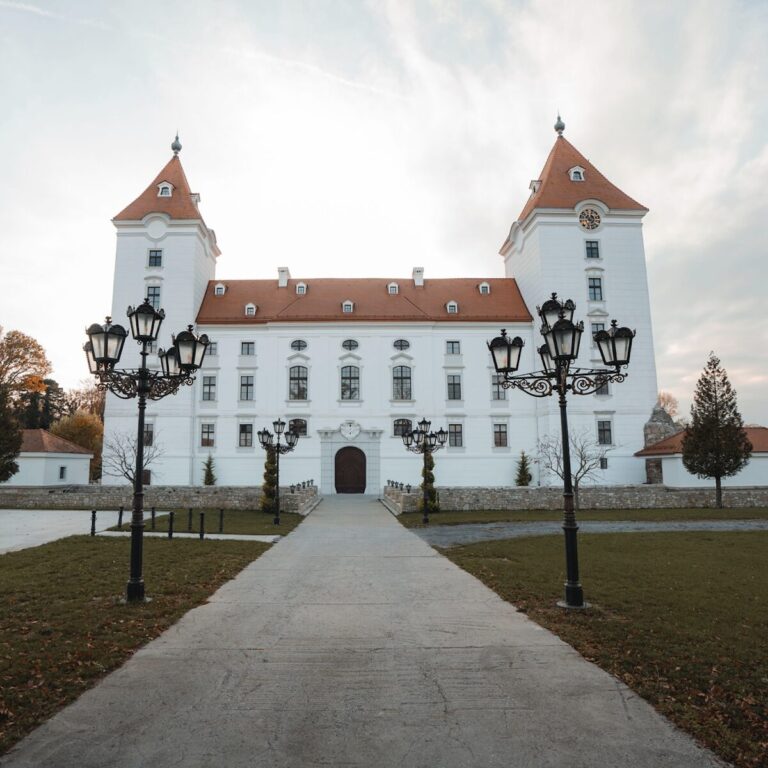
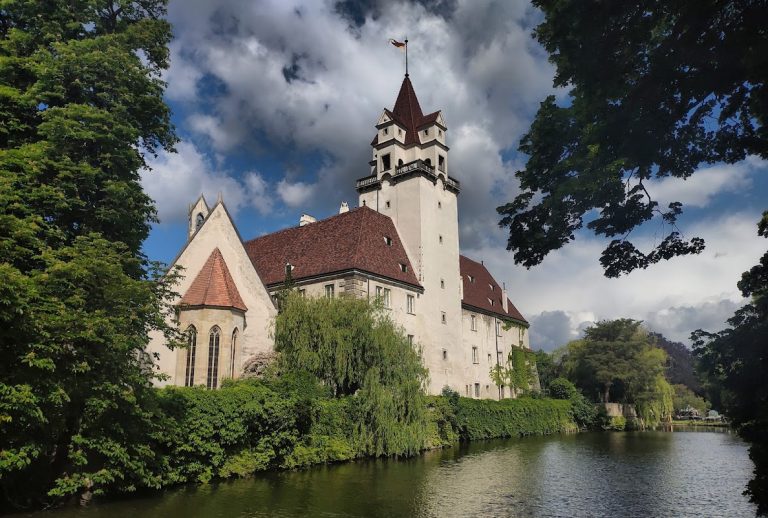
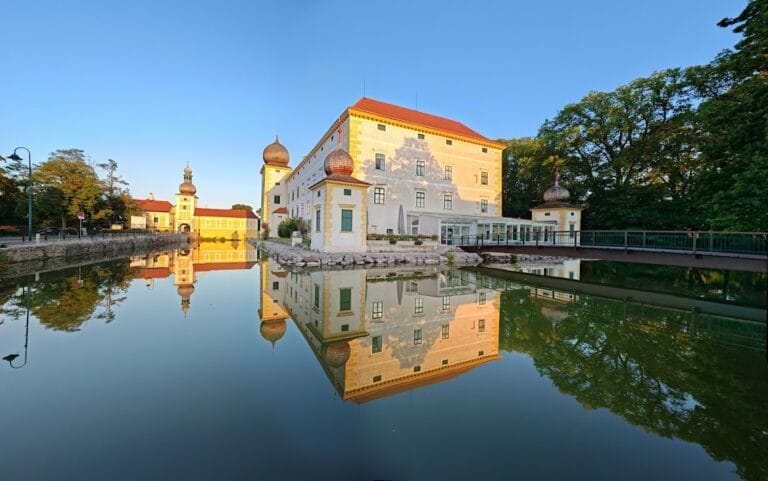
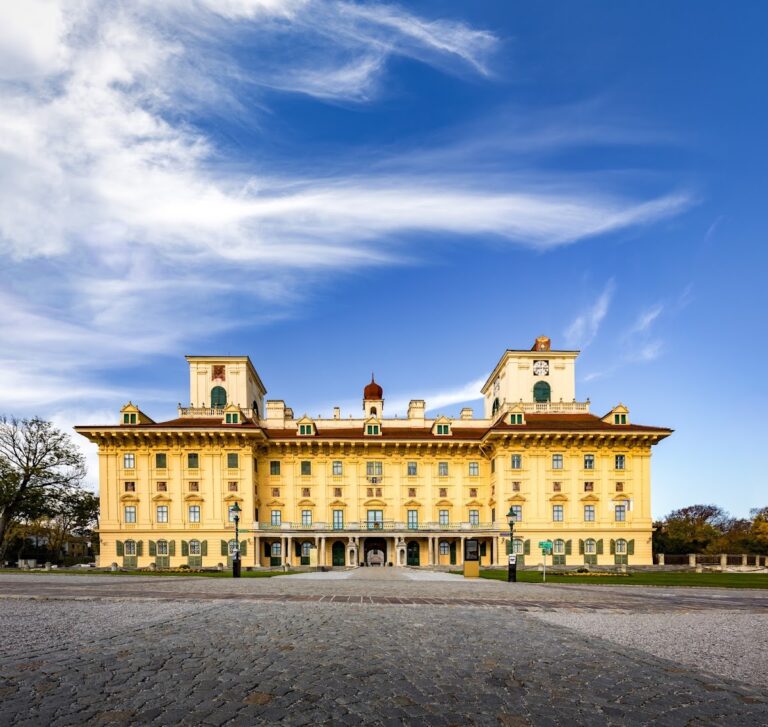
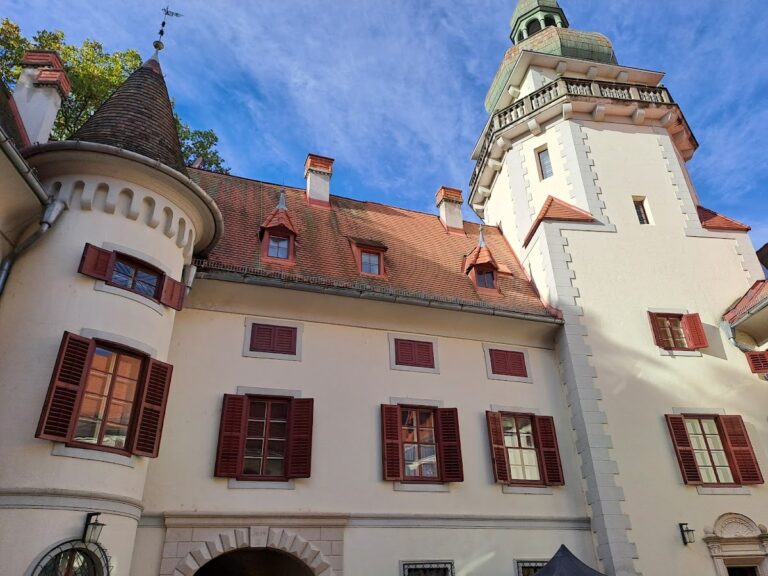
Schloss Pottendorf is a three-storey water castle arranged around an approximately square courtyard. Its original Romanesque fabric was remodelled during the Gothic and especially the Baroque periods. The surviving moat system remains a defining part of the complex, while the bridges that once crossed the moats have been demolished. The castle is partially ruined, with collapsed roofs and a residential wing whose roof structure failed after the 1967 repairs.
Castle Buildings
Towers and Entrance
Two powerful Romanesque corner towers and a gate tower from the thirteenth century were incorporated into the complex during rebuilding in 1737 and 1738. On the southern façade, a stone monumental portal with a round arch retains the coat of arms of the Esterházy family. The towers have deteriorated, and their renovation was planned as part of the site’s uncertain future.
Chapel
The chapel stands on the eastern side of the castle complex. It was originally freestanding but was joined to the main building in 1519. Its structure is largely late Gothic, with three naves, while its Romanesque bell tower has a square base and paired-arched windows. The chapel was formerly largely destroyed and was later renovated. Its original high altar is preserved at Forchtenstein, and the restored building was reopened in 2018.
Paintings and Tomb Slabs
Late-fifteenth-century frescoes survive inside and outside the castle, although they are now difficult to recognize. A historical engraving by Georg Matthäus Vischer preserves an image of the palace before its decline. Restoration work in 1988 recovered the remains of old tomb slabs, which were secured by Austria’s Federal Monuments Office. Four damaged slabs remained intact. One identified as the tomb slab of Friedrich IV von Pottendorf was restored and placed in the local-history museum at Kirchschlag, while other slabs are held in the local museum in Pottendorf.
Park and Estate Features
The castle park is crossed by the Fischa and covers 19 hectares under protection. It was formerly regarded as one of the most important landscape gardens in Lower Austria. The park’s restoration removed vegetation from the castle, allowing the building to contribute again to the architectural character of the grounds. The estate also contains a mill and a hunting lodge.
A very old lime tree stands southeast of the castle and is protected separately as a natural monument. It was placed under protection in 1928.
Nearby sites