Cantacuzino Palace: Beaux-Arts Residence and George Enescu Museum


Site at a Glance
- Rating
- 4.4
- Popularity
- Medium
- Country
- Romania
- Primary era
- Modern
- External website
- Open
- Eras represented
- Modern
- Civilizations
- Kingdom of Romania
- Site type
- Domestic
- Remains
- Elite Residence
On this page7 sections
History
Construction and Early Role
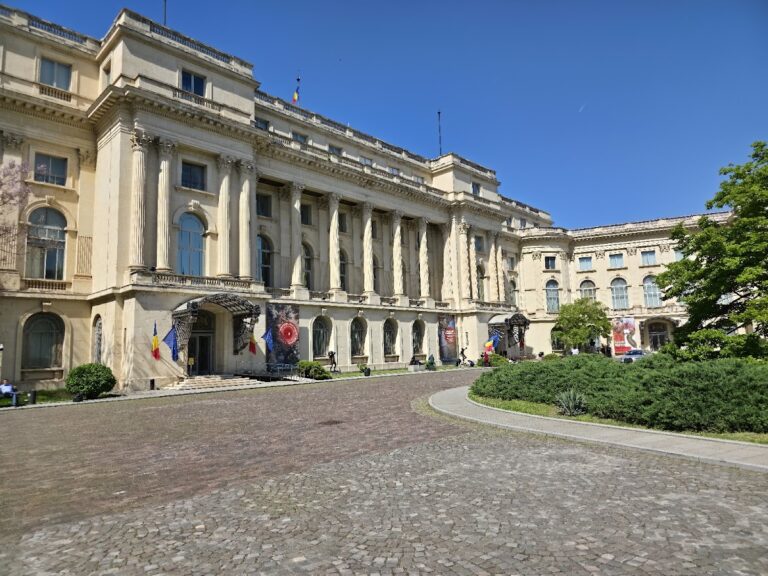
Cantacuzino Palace is a palace in Bucharest, Romania, built in 1901–1902 for Gheorghe Grigore Cantacuzino, a Romanian political leader who served as mayor of Bucharest and prime minister. The architect Ion D. Berindey designed it in the French Beaux-Arts style, an academic approach known for formal planning, monumental composition, and richly detailed classical decoration.
Gheorghe Grigore Cantacuzino commissioned the interior decoration from George Demetrescu Mirea, Nicolae Vermont, and Costin Petrescu. The palace soon became a notable venue for balls and formed part of Bucharest’s social life. Its formal architecture and elaborate interiors expressed the building’s role as an important aristocratic residence and public setting.
Political Events and Family History
On 10 August 1913, the Treaty of Bucharest was signed at the palace. The treaty ended the Second Balkan War, a conflict among Balkan states whose conclusion was formalized in Bucharest. On the eve of the Second World War, the building also housed the Presidency of the Council of Ministers, the office of Romania’s central executive government.
After Gheorghe Grigore Cantacuzino’s death, the palace passed to his son, Mihail G. Cantacuzino, who died in 1929. Mihail’s widow, Maria, married the composer George Enescu in December 1939. Enescu was a Romanian composer, violinist, conductor, and pianist, and his connection with the palace later shaped its cultural purpose.
The George Enescu Museum
After George Enescu died in 1955, Maria Enescu stated in her will that the palace should house a museum dedicated to him. The National Museum George Enescu was established there in 1956, giving the building a new commemorative role while preserving its association with the Enescu family.
Cantacuzino Palace is a Romanian state-level cultural monument. The museum closed in 2021 for a restoration planned to last two years and remained closed as of 2026.
Remains
Exterior and Entrance
The palace combines a Beaux-Arts exterior with a formal entrance arrangement. Two lions stand at the entrance, while the gates and fences follow the Louis XIV style, contributing to the building’s princely appearance. A glass-and-metal entrance leads into an interior organized around richly decorated rooms and circulation spaces.
Interior Decoration
Most of the rooms continue the Beaux-Arts treatment, while several are decorated in the Rococo Revival style. This style reinterprets the asymmetrical and highly ornamental vocabulary of eighteenth-century Rococo interiors. Surviving details include decorated doors, Rococo Revival stucco, and a fireplace chimney with festoon ornament. One salon has an elaborately decorated ceiling.
Nicolae Vermont created six oil-on-canvas medallions that were embossed on the walls. Three bear his signature and the date 1907, while five are positioned above doors in the hallway leading to rooms on the right of the entrance. Shepherd with Sheep and Peasant Woman with Vessel were directly inspired by the work of Nicolae Grigorescu, the prominent Romanian painter whose influence shaped Vermont’s art.
About five rooms are used for the museum, while the remaining rooms are occupied by various institutions. These surviving decorated spaces preserve the palace’s combination of formal French-inspired design, Rococo Revival interiors, and artistic commissions from the early twentieth century.