Mogoșoaia Palace: A Brâncovenesc Summer Residence in Romania


Site at a Glance
- Rating
- 4.7
- Popularity
- High
- Country
- Romania
- Primary era
- Early Modern
- External website
- Open
- Eras represented
- Early Modern, Modern
- Civilizations
- Principality of Wallachia
- Site type
- Domestic
- Remains
- Palace
On this page14 sections
History
Mogoșoaia Palace is a palace-and-park complex near Bucharest, Romania, built for Constantin Brâncoveanu, the ruler of Wallachia. Construction was underway by the late seventeenth century and was completed on 20 September 1702, according to an inscription on the palace’s eastern side. The Brâncoveanu family had begun acquiring land in the area in 1681. Intended as a summer residence, the complex became an early and important example of the Brâncovenesc, or Romanian Renaissance, style, which brought together Romanian traditions with Venetian, Dalmatian, and Ottoman influences.
The Brâncoveanu Estate
The palace remained in the Brâncoveanu family for approximately 120 years. After Constantin Brâncoveanu was executed in Constantinople in 1714 together with his sons, Ottoman authorities confiscated the family’s wealth and converted the palace into an inn. Prince Ștefan Cantacuzino later bought the property back and returned it to Brâncoveanu’s grandson, Constantin Brâncoveanu.
Ottoman forces devastated the complex during the Russo-Turkish War of 1768–1774 because the great ban Nicolae Brâncoveanu supported the Russian side. Further damage followed during the 1821 revolution, when the last Brâncoveanu descendant, Grigore Brâncoveanu, fled to Brașov and pandurs occupied the building.
The Bibescu Succession
After Grigore Brâncoveanu died in 1832, the estate passed to his adopted daughter, Zoe Mavrocordat. Through her marriage to Prince George Bibescu in 1826, the property entered the Bibescu family, a Romanian princely family that retained and maintained the estate. The Bibescus later moved to the nearby Villa Elchingen, leaving the palace uninhabited.
Nicolae Bibescu restored the palace between 1860 and 1880, built the Bibescu family tomb in the park, and constructed Villa Elchingen. In 1911, Marie-Nicole Darvari sold the palace to her cousin George-Valentin Bibescu, who gave it to his wife, Martha Bibescu. A Romanian princess, writer, and patron of the palace’s restoration, Martha Bibescu began a major programme of work in 1912.
Twentieth-Century Restoration and Nationalization
German bombing during the First World War damaged the palace and interrupted Martha Bibescu’s restoration. Work resumed after 1920, and the palace reopened in 1927, while interior improvements continued until 1935. During the interwar period, it became a meeting place for politicians and international high society. In the Second World War, the palace was rented to the Swiss mission in Romania for several months and served as a meeting place for Allied diplomats.
George-Valentin Bibescu was buried in the church on the grounds in 1941, and Elizabeth Bibesco was buried in the Bibescu family vault in 1945. After 6 March 1945, the communist government forcibly nationalized the estate. Martha Bibescu secured recognition of the palace as a historic monument, but she left Romania permanently in September 1945, transferring her rights to her daughter Valentina and Valentina’s husband, Dimitrie Ghika-Comănești. The palace itself was nationalized in 1949, and Valentina and Dimitrie were arrested.
By 1957, the palace had been emptied, looted, and deprived of much of its art collection. That year it became the headquarters of the feudal department of the National Museum of Art, whose holdings included seventeenth- to nineteenth-century furniture and domestic objects, icons, paintings, and historical documents. Restoration began in 1977. The complex now houses the Brâncovenesc Art Museum of Mogoșoaia. Twentieth-century rebuilding and alteration changed parts of the ensemble, while substantial older fabric survived. Since 2010, Martha Bibescu’s legal heirs, who live in the United Kingdom, have pursued the return of the complex or appropriate compensation.
Remains
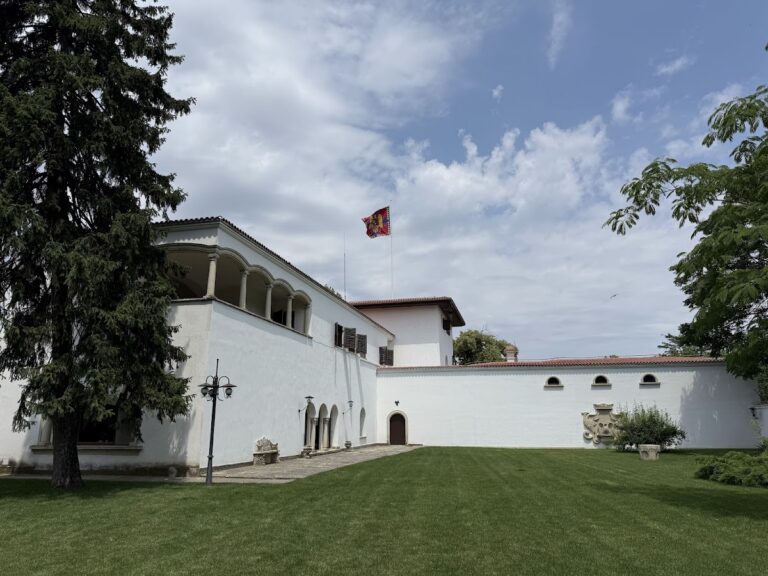
The surviving ensemble includes the principal palace, its courtyard, an entrance gate and guard tower, Brâncoveanu’s kitchen, Saint George’s Church, the Bibescu chapel and family tomb, greenhouses, an icehouse, parkland, and associated tunnels. The palace stands beside Mogoșoaia Lake among old oak trees. Its arrangement combines residential, service, religious, and estate buildings around the principal courtyard and grounds.
The Palace and Courtyard
Principal Palace
The palace’s upper floor contained the princely family apartments. An exterior staircase led directly from the courtyard to a balcony on the facade, providing access to these rooms. Service rooms occupied the lower floor, while the basement contained a cellar with a ceiling formed by four domes. On the side facing the lake, a Venetian-inspired loggia has a sequence of arched openings. These features belong to the complex’s Brâncovenesc character, which combines local forms with Venetian and Ottoman elements.
Kitchen and Entrance Tower
Brâncoveanu’s kitchen stands within the palace courtyard and has four ventilation stacks. The gate tower guards the entrance to the courtyard and is reached by an exterior staircase. Martha Bibescu restored both the kitchen and the tower between 1922 and 1930.
Religious Buildings and Burials
Saint George’s Church
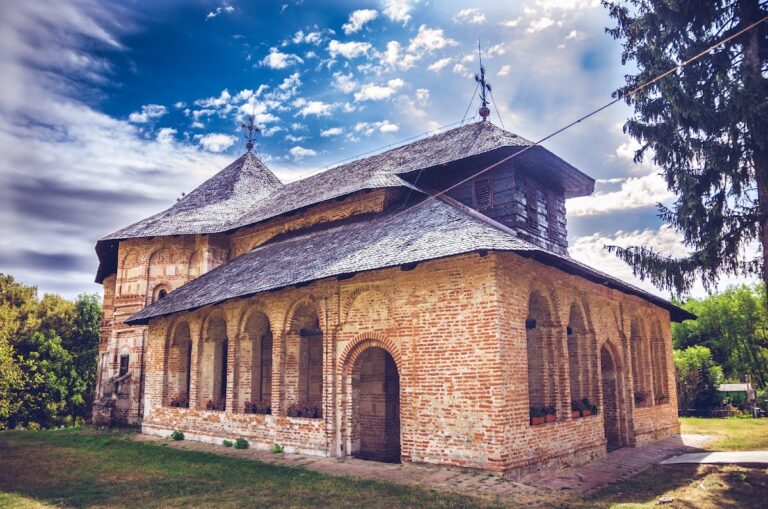
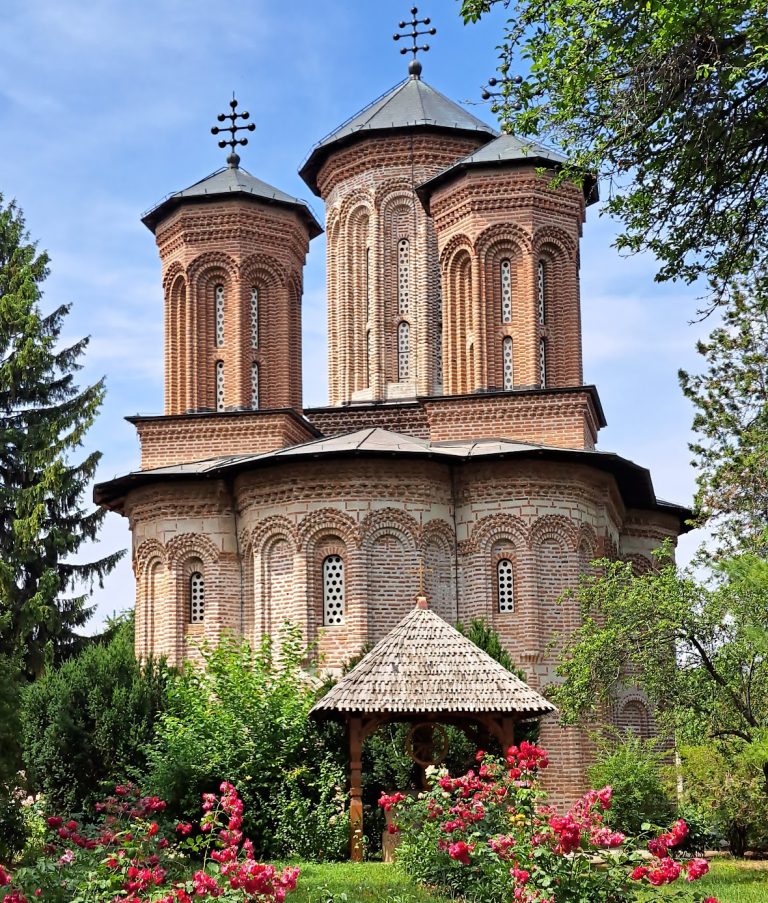
Saint George’s Church stands outside or immediately behind the palace enclosure, beside the entrance tower. Founded by Constantin Brâncoveanu and completed in 1688, it contains frescoes, including a votive painting of Brâncoveanu with his four sons. A votive painting is a religious image commissioned or dedicated by a donor, often showing the donor and family before a sacred figure. The church porch contains the tomb of George-Valentin Bibescu, a pioneer of Romanian military aviation.
Bibescu Chapel and Family Tomb
A chapel built after 1880 contains Bibescu family burials, including those of Prince Mihai and George Basarab-Brâncoveanu, aviators who died during the Second World War. A separate family tomb was built in the park during the Bibescu period, adding another burial structure to the estate’s grounds.
Park and Estate Structures
Greenhouses
The greenhouses were built after 1890 by French architects. They have been restored and are used for growing flowers and as an art workshop for children.
Villa Elchingen
Villa Elchingen stands near the palace and was constructed for the Bibescu family by Nicolae Bibescu. The villa belongs to the later Bibescu development of the estate, alongside the restored palace and the family tomb in the park.