Palazzo Spinola di Pellicceria: A Genoese Aristocratic Residence and National Gallery


Site at a Glance
- Rating
- 4.6
- Popularity
- Medium
- Country
- Italy
- Primary era
- Early Modern
- External website
- Open
- Eras represented
- Medieval, Early Modern, Modern
- Civilizations
- Genoese, Italian
- Site type
- Domestic
- Remains
- Elite Residence
On this page15 sections
History
Palazzo Spinola di Pellicceria is a late-sixteenth-century Genoese aristocratic residence in Genoa, Italy, commissioned by Francesco Grimaldi and completed by 1593. Built on medieval foundations, it was created after six houses were demolished to clear the site and form the small piazza in front of the palace. Its later history linked the building to several prominent Genoese families, while its inclusion in the Rolli system placed it within the Republic of Genoa’s arrangements for ceremonial hospitality.
The Grimaldi and Rolli palace
The palace entered Genoa’s Rolli system in 1599. The Rolli were official registers of aristocratic residences that could be selected to accommodate distinguished visitors during state visits. Palazzo Spinola di Pellicceria initially belonged to the first class of residences, before being reassigned to the fourth class in 1664. It remained in the system until that year. Peter Paul Rubens, the Flemish Baroque painter and diplomat, included the building in his 1622 publication on Genoese palaces, which featured an etching of its facade.
Tommaso Grimaldi inherited the palace in 1606. The building stayed with the Grimaldi family until the middle of the seventeenth century, when it passed to Ansaldo Pallavicino, Tommaso’s brother-in-law, as settlement for a debt. This was the only recorded sale in the palace’s history. Subsequent changes of ownership took place through inheritance or marriage among the Pallavicino, Doria, Tolot, and Spinola families.
Family collections and the Spinola name
Ansaldo Pallavicino began forming the palace’s art collection through a series of acquisitions, with particular interest in works by Giovanni Benedetto Castiglione, known as Grechetto. His father had been among the earliest Genoese patrons of the Flemish painter Anton van Dyck, who painted two portraits of Ansaldo. The palace passed to the Doria family through the marriage of Anna Maria Pallavicino and Gerolamo Doria.
In the early eighteenth century, Maddalena Doria’s marriage to Niccolò Spinola brought the palace into the Spinola family. Maddalena inherited it in 1732 or 1734, and Niccolò became doge of the Republic of Genoa in 1740. This union gave rise to the name Palazzo Spinola di Pellicceria.
Rococo transformation and wartime damage
Between 1734 and 1736, Maddalena Doria-Spinola commissioned a Rococo refurbishment. Rococo was an eighteenth-century decorative style known for light ornament, curved forms, and rich decoration. The architect Bartolomeo Orsolino directed the renovation, while Sebastiano Galeotti, Giovanni Battista Natali, and Lorenzo De Ferrari were associated with its painted interiors. The work principally altered the facade and interior decoration.
During the Napoleonic occupation, Paolo Francesco Spinola was forced to sell many works of art from the palace. The building later suffered severe damage during Allied bombing in the Second World War, the global conflict fought from 1939 to 1945. The upper part, including the third floor, the decorated rooms of the piano nobile, the second-floor apartments, and Lazzaro Tavarone’s fresco of the siege of Zierikzee, was destroyed or badly damaged. The affected upper floors were subsequently reconstructed.
State museum and heritage site
In 1958, the marquises Paolo and Franco Spinola di Tassarolo donated the palace and its accumulated furnishings, artworks, silverware, ceramics, etchings, and books to the Italian state. The donation required that the character of the aristocratic residence be preserved after its conversion into a museum. The Italian state established the National Gallery of Palazzo Spinola in the building. The two lower floors retain their historic residential character, while the reconstructed upper floors function as museum spaces. The museum has housed the National Gallery since 1993.
Italy placed the palace under architectural heritage protection from 1912 onward. In 2006, Palazzo Spinola di Pellicceria became one of the 42 palaces included in the UNESCO World Heritage Site “Genoa: Le Strade Nuove and the system of the Palazzi dei Rolli.”
Remains
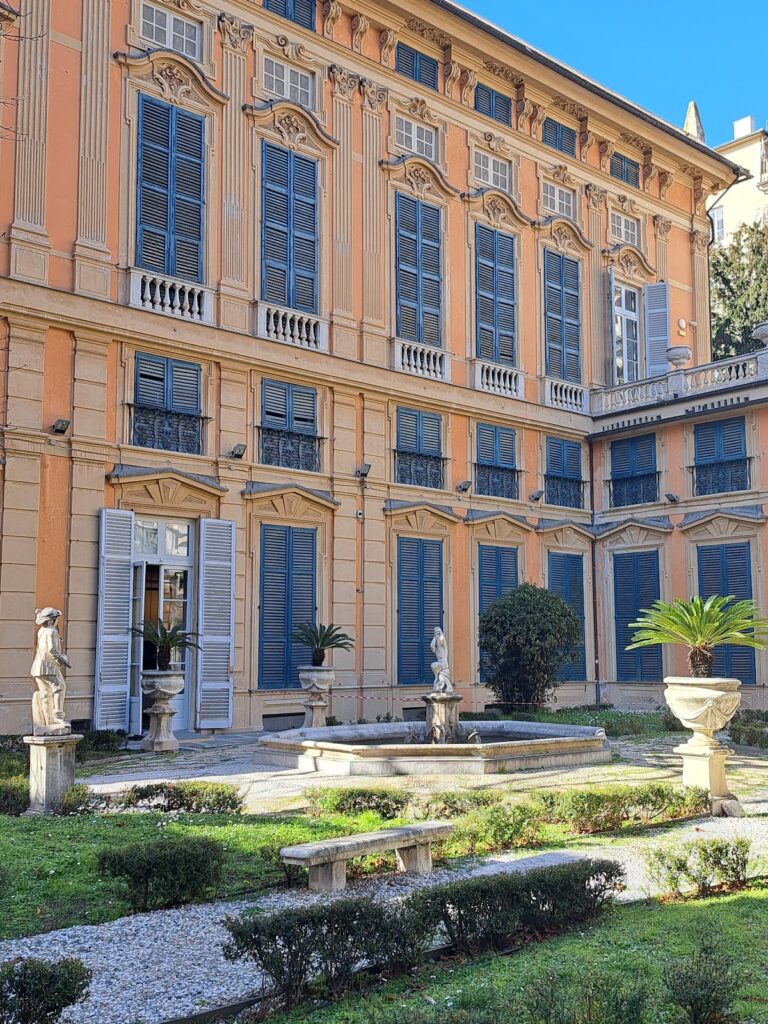
Palazzo Spinola di Pellicceria survives as a late-sixteenth-century urban residence organized around an entrance hall, a stair system, an inner courtyard, and a loggia, a roofed open-sided gallery integrated into the building. It faces Piazza di Pellicceria and also retains an older entrance on the lower part of the piazza. The present building combines original residential spaces on its lower floors, later decorative work, reconstructed upper levels, and museum installations adapted to the historic plan.
Facade and residential layout
Rococo facade
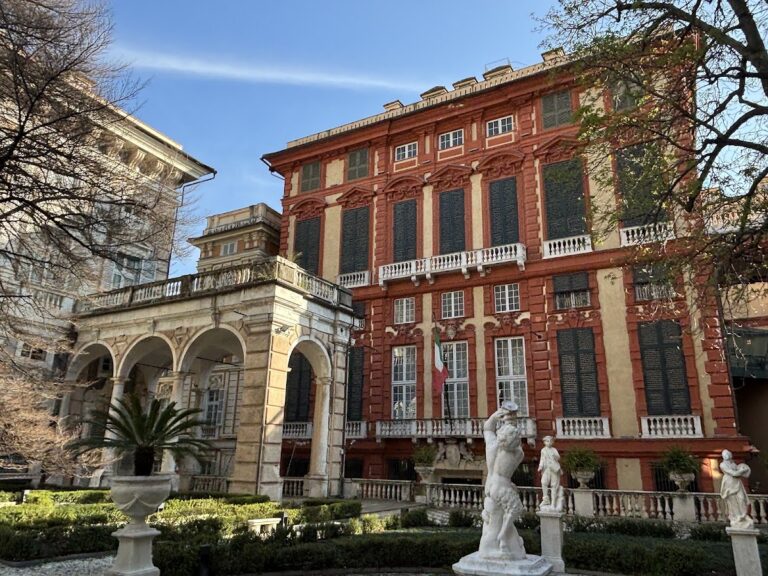
The facade principally reflects the refurbishment commissioned by Maddalena Doria-Spinola between 1734 and 1736. Earlier painted quadratura, an architectural painting technique using illusionistic frameworks and perspectives, was replaced by Rococo stucco decoration. The new treatment gave the exterior a more unified architectural appearance than the facade shown in Rubens’s 1622 publication.
Picture gallery
Ansaldo Pallavicino closed the open first-floor loggia and converted it into a picture gallery. The Spinola family later enlarged the gallery, which remains substantially preserved. Its survival helps explain how the palace’s residential architecture was adapted to display a growing aristocratic art collection.
Painted interiors
Tavarone’s frescoes
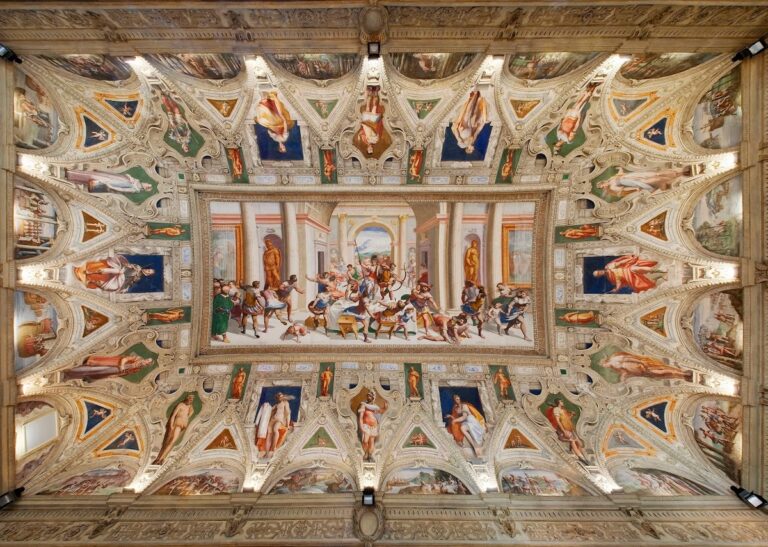
Lazzaro Tavarone decorated the piano nobile, the principal ceremonial residential floor of an Italian palace, with frescoes. The principal vaulted salon on the first floor contains a depiction of Lisbon besieged by the army of the Duke of Alba. The floor above includes scenes showing the triumph of Renato Grimaldi and the siege and liberation of Zierikzee. The Zierikzee subject relates to Raniero Grimaldi’s leading role in the 1304 action against the Flemish fleet.
Gallery of Mirrors
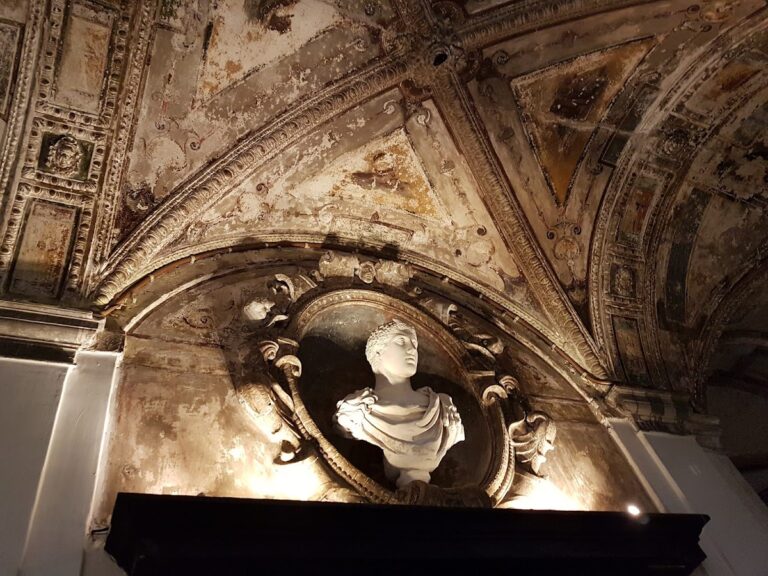
Painted and decorative schemes associated with the eighteenth-century renovation are attributed to Sebastiano Galeotti, Giovanni Battista Natali, and Lorenzo De Ferrari. De Ferrari is particularly associated with the Gallery of Mirrors, an exceptional interior formed by joining two wings of the palace. The lower floors preserve original residential decoration, furnishings, and gallery arrangements.
Museum collections
Paintings and sculpture
The picture collection includes works by Antonello da Messina, Luca Cambiaso, Bernardo Castello, Bernardo Strozzi, Gregorio De Ferrari, Giovanni Benedetto Castiglione, Guido Reni, Luca Giordano, and Joos van Cleve, together with paintings by other Ligurian, Italian, and Flemish artists. Identified works include Joos van Cleve’s Praying Virgin, Luca Giordano’s Allegory of Peace and War, Bernardo Strozzi’s portrait of a nun, Antonello da Messina’s Ecce Homo, and Peter Paul Rubens’s equestrian portrait of Giovanni Carlo Doria.
The collection also contains Giovanni Pisano’s statue of Justice and Putti for the Grimaldi Chapel by Giambologna and Pietro Francavilla. Angelica Kauffmann’s 1794 portrait of Paolo Francesco Spinola is displayed in the palace.
Decorative arts and reconstructed rooms
The museum displays the Spinola family’s porcelain and maiolica, a brightly decorated tin-glazed earthenware, as well as a textile section formed from local collectors’ holdings. Furnishings, silverware, etchings, and books were also part of the donated contents. The reconstructed upper floors were adapted as museum rooms, with displays shaped by aristocratic collecting practices, Genoese picture galleries, and the furnishings of seventeenth- and eighteenth-century residences. An elevator was installed in the inner courtyard during this adaptation.