Palazzo Brancaleone Grillo: A Rolli Palace in Genoa


Site at a Glance
- Rating
- 4.9
- Popularity
- Very Low
- Country
- Italy
- Primary era
- Medieval
- Eras represented
- Medieval, Early Modern
- Civilizations
- Genoese
- Site type
- Domestic
- Remains
- Elite Residence
On this page9 sections
History
Palazzo Brancaleone Grillo, also known as Palazzo dei Serra, is a historic palace in Genoa, Italy, commissioned in the mid-fifteenth century on the site of an earlier family domus magna, or great house. Its patron, Brancaleone Grillo, served as an ambassador of the pope and the king of Spain. The building later became part of Genoa’s Rolli, the official registers of palaces selected to accommodate distinguished state guests on behalf of the Republic of Genoa.
From the Grillo family to the Rolli
The palace was acquired by Luca Spinola in 1496. The Spinola were one of Genoa’s prominent noble families, and the building entered the Rolli registers in 1576 under Nicolò Spinola. Inclusion in these registers placed the palace within a state-managed system of aristocratic hospitality, in which selected residences provided accommodation for high-ranking visitors during official visits.
Expansion and later protection
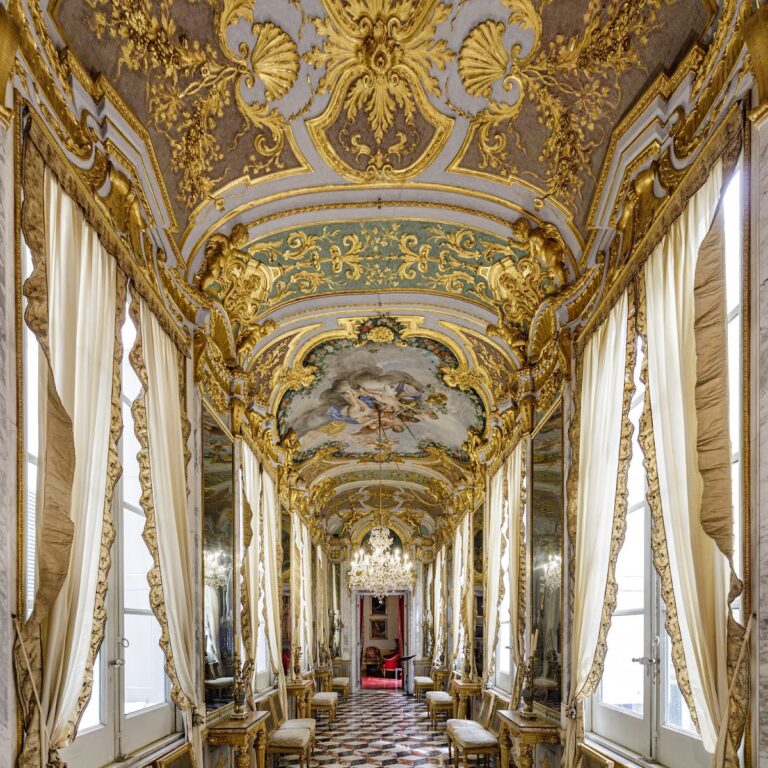
Later work enlarged the piano nobile, the principal ceremonial residential floor traditionally positioned above the ground floor, along Vico delle Mele. The apartments were also decorated, changing the appearance of the palace. Some of the frescoes were subsequently whitewashed, partly concealing the earlier interior decoration.
Heritage authorities placed the building under legal protection in 1923. It continues to serve residential and office purposes, retaining its place within the historic fabric of Genoa’s old town.
Remains
Courtyard and circulation
Palazzo Brancaleone Grillo is unusually large by the standards of late-medieval Genoa. Its plan brought the surrounding houses together around an angular courtyard, creating a unified building from structures that had previously formed part of the family property. A loggia staircase, whose lower structural body permitted greater access to air and light, belongs to the palace’s innovative design. Comparable arrangements appeared in contemporary palaces of the Doria, Spinola, and Centurione families.
The cohesive character of the Lombard stoneworking tradition can be seen in the moulding around the portal, the balustrade of the staircase, and the rings of the columns supporting the courtyard arches. The staircase preserves a rare original fifteenth-century balustrade made with colonnelli, small pillars fitted with capitals.
Portal and courtyard sculpture
Saint George portal
The portal carries a bas-relief of Saint George and the dragon. Federico Alizeri stated that the work was commissioned from the Gagini brothers during the palace’s construction. Later studies by Aldo Galli attributed the portal instead to the Caronesi masters Filippo Solari and Andrea Da Ciona. The Caronesi were craftsmen associated with the stoneworking tradition of Carona, while the Gagini were an Italian Renaissance family known for marble sculpture and architectural reliefs.
Courtyard Madonna and Child
A possibly copied Madonna and Child is placed in the courtyard. The building also preserves a pre-sixteenth-century façade bas-relief showing Saint John in the Desert presenting the family to God. Together, these sculptural elements connect the palace’s domestic architecture with the devotional imagery associated with its occupants.
Frescoed apartments
The apartments contain frescoes by Luca Cambiaso, a Genoese painter of the sixteenth century. Among them are The Marriage of Cupid and Psyche and Stories of Mark Antony. Lazzaro Tavarone, a Genoese painter active in the late sixteenth and early seventeenth centuries, painted The Gathering of the Manna. These works represent different phases of the palace’s interior decoration, including the embellishment associated with the later enlargement of the principal residential floor.