San Siro: Genoa’s Former Cathedral and Baroque Parish Church

Site at a Glance
- Rating
- 4.5
- Popularity
- Very Low
- Country
- Italy
- Primary era
- Early Modern
- Eras represented
- Medieval, Early Modern, Modern
- Civilizations
- Genoese, Italian, Kingdom of Sardinia
- Site type
- Religious
- Remains
- Church
On this page12 sections
History
San Siro is a Roman Catholic parish church in Genoa, Italy, occupying an early Christian site whose foundation is traditionally placed in the fourth century, although a sixth-century date is considered more probable. Dedicated to St. Syrus of Genoa, one of the city’s early bishops, it became Genoa’s first cathedral and was later rebuilt in the Baroque period. The church is commonly called a basilica, though it does not formally hold that title.
Early Christian church and cathedral
The church stands on the site of an earlier place of worship dedicated to the Twelve Apostles. St. Syrus was buried there, and the church was subsequently rededicated to him. Its position outside Genoa’s medieval walls exposed it to attacks by Muslim raiders, helping to encourage the transfer of the episcopal seat to San Lorenzo, Genoa’s cathedral.
The date of that transfer is debated. One historical tradition places it in 985, while other historians place it in the early eleventh century, possibly after a period in which San Siro and San Lorenzo both retained cathedral status. The relics of St. Syrus were also transferred to San Lorenzo. The traditional feast of St. Syrus is celebrated on 7 July, an anniversary associated with the translation of his relics in 1019.
A legend associated with the church tells how Bishop Syrus expelled a basilisk, a legendary serpent-like monster, from a well beside the building. In the San Siro tradition, the creature represented Arianism, a Christian theological movement rejected by the Catholic Church. Medieval and early-modern images of the event connected the story with the church and its patron saint.
Benedictine abbey
In February 1007, Bishop Giovanni II converted the former episcopal church into an abbey and entrusted it to the Benedictines, a Western Christian monastic order whose communities followed the Rule of St. Benedict. Donations made during the eleventh and twelfth centuries supported the construction of a large Romanesque basilica and encouraged the growth of the surrounding urban district known as the Burgus.
The Romanesque church was solemnly consecrated on 9 August 1237 by Archbishop Ottone II, in the presence of senior ecclesiastical authorities including Geroldo of Lausanne, Patriarch of Jerusalem. The Benedictines remained at San Siro until 1398. After a period of decline in the fourteenth century, the church was placed in commendam, meaning that its title and revenues were assigned to a commendatory abbot who did not necessarily lead a resident monastic community. Oberto Sacco was the first holder of that position.
Theatines and Baroque rebuilding
On 5 August 1575, after the last Benedictines had departed, Pope Gregory XIII transferred San Siro to the Theatines. This Catholic clerical order was active in the religious renewal of the sixteenth century. The title of abbot passed to the bishop of Genoa and remains attached to the serving archbishop.
A fire destroyed the southern wing in 1580. The Theatines responded with a complete reconstruction in Baroque forms associated with Counter-Reformation architecture, the Catholic renewal that followed the Protestant Reformation. Work began in the 1580s, the principal masonry was completed in 1613, the first solemn Mass was celebrated in 1610, and the dome was finished in 1619. The architect remains uncertain. The project has been attributed to Andrea Ceresola, known as Vannone, the Theatine Andrea Riccio, or Daniele Casella, with Giacomo Besio possibly collaborating.
Genoese patrician families, including the Centurione, Grimaldi, Invrea, Imperiale, Lomellini, Pallavicini, Pinelli, Serra, Spinola, Cybo, Gentile, and Grimaldi-Cebà families, helped finance the rebuilding. In return, they received patronage rights over chapels and other parts of the church. The Theatines also constructed a convent, cloister, and garden beside San Siro.
Parish church and later history
The opening of the Strada Nuovissima, now Via Cairoli, reduced the size of the Theatine convent, cloister, and garden during the eighteenth century. In 1798, the Ligurian Republic suppressed religious orders, forcing the Theatines to leave. San Siro passed to the diocesan clergy and became a parish church.
The present principal facade was built between 1819 and 1821 to a design by Carlo Barabino, a major nineteenth-century Genoese architect associated with public buildings and urban planning. The earlier facade had remained unfinished. A design connected with the rebuilding appears in a plan recorded by Rubens in 1622, but it was apparently never executed.
The eleventh-century Romanesque bell tower was demolished in 1904 because dangerous cracks threatened its stability, and it was not rebuilt. San Siro suffered serious bombing damage during the Second World War. Two chapels on the left side and the altar of Our Lady of Providence were destroyed, after which restoration took place in the immediate postwar years. Further restoration of chapel and presbytery decorations and frescoes was carried out in 2007 and 2008.
Giuseppe Mazzini was baptized at San Siro on 23 June 1805, one day after his birth. The church is administered by the Oratorians of the Congregation of Genoa, communities of secular priests associated with the spiritual tradition of St. Philip Neri.
Remains
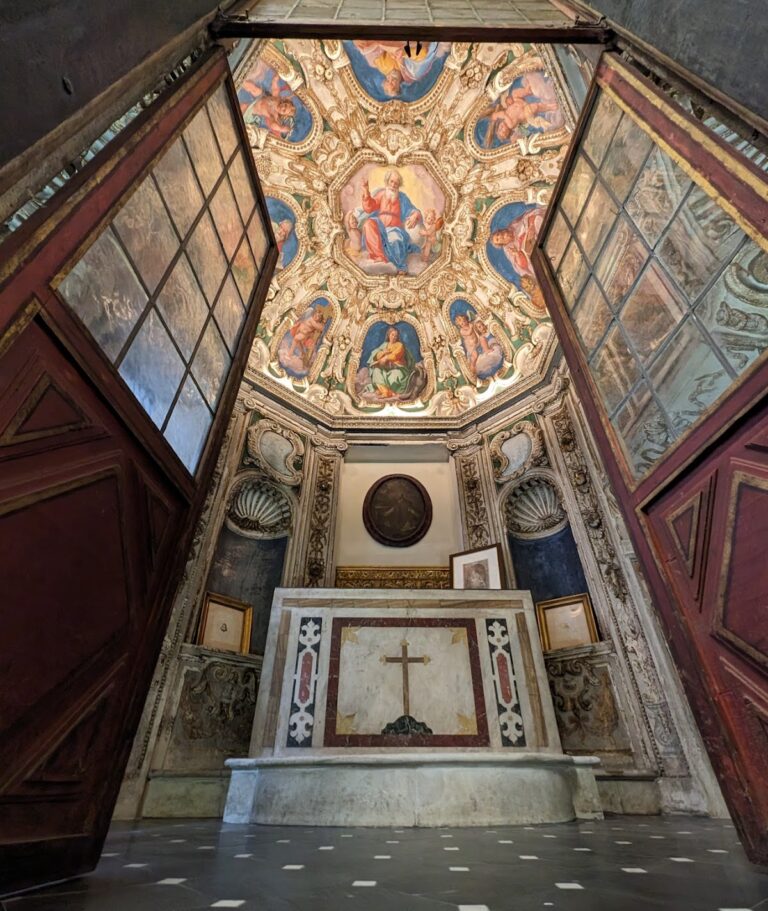
San Siro is a three-nave Baroque church with a single dome over the crossing of the nave and transept. Paired columns support the nave arcades, while large windows in the nave and apse light the painted and sculptural decoration. The main facade is Neoclassical, and the surviving interior combines architecture, frescoes, stucco sculpture, painted altars, and family chapels developed through the seventeenth century.
Facade, nave, and painted decoration
Beside the entrance portal stand stucco statues of Faith by Nicolò Traverso and Hope by Bartolomeo Carrea. Reliefs beneath the pediment depict episodes from the traditional life of St. Syrus. Inside, Taddeo Carlone produced many of the sculptures, including stucco Apostles set in niches along the lateral aisles and works for several chapels. Giovanni Battista Carlone painted much of the nave, dome, choir, and presbytery, with Paolo Brozzi supplying quadratura, an illusionistic architectural painting technique that makes flat surfaces appear to open into elaborate spaces.
Giovanni Battista Carlone’s frescoes include the Basilisk Miracle in the choir vault and the Glory of St. Syrus in the presbytery vault. Other scenes show episodes from the life of St. Peter, including his calling, martyrdom, and the fall of Simon Magus. The painted program also includes the Capture of Christ in the Garden of Olives, the Beatitudes, the theological and cardinal virtues, prophets, and celestial hierarchies. Much of this decoration was produced between the mid-seventeenth century and the 1670s.
The transept vaults contain Constantine Adoring the Cross and Emperor Heraclius Returning the True Cross to Calvary. The dome shows celestial hierarchies contemplating the Cross. Domenico Fiasella, Domenico Piola, and Gregorio De Ferrari contributed additional frescoes to the vaults and chapels.
Lateral chapels
Chapels of the right aisle
The Chapel of the Santissima Annunziata, formerly associated with the Dispute with the Doctors, belonged to the Grimaldi-Cebà family. It contains Orazio Gentileschi’s Annunciation, dated 1624, along with eighteenth-century paintings by Giovanni Luca and Girolamo Celle. The Lomellini family patronized the Chapel of St. Gaetano of Thiene, where a wooden group of St. Gaetano with the Child and the Virgin is attributed to an artist connected with the Maragliano workshop. Domenico Piola painted St. Gaetano in Prayer, the Apparition of Christ, St. Gaetano Helping Christ Carry the Cross, and the Glory of St. Gaetano in the vault.
The Cybo family was associated with the Chapel of St. Andrew Avellino, built by the Theatines for Alberico Cibo. It contains Domenico Fiasella’s Death of St. Andrew Avellino, scenes by Orazio De Ferrari showing the saint attacked by demons and his death, and Gregorio De Ferrari’s Glory of St. Andrew Avellino in the vault. The Chapel of Our Lady of the Guard, formerly dedicated to Our Lady of Grace, was patronized by the Spinola family. Its altar is attributed to Tommaso Carlone, while its paintings include the Birth of Mary by Aurelio Lomi and the Decapitation of St. John the Baptist by Carlo Bononi. Pupils of Giovanni Battista Carlone painted the vault frescoes.
The Centurione family patronized the Chapel of the Sacred Heart, which has a polychrome marble altar and a modern painting of the Sacred Heart. Its other paintings, the Miracle of St. Nicholas and St. Nicholas Distributing Alms, are attributed to Giovanni Battista Carlone. At the end of the right aisle, the Chapel of St. Anthony belonged to the Pinelli family. Taddeo Carlone and his workshop made sculptures of St. Gregory, St. John the Baptist, St. Francis of Paola, and St. Charles Borromeo. Giovanni Domenico Cappellino painted the Crowning with Thorns and Flagellation, and Aurelio Lomi painted St. Anthony Healing a Sick Person.
Chapels of the left aisle
The Chapel of St. Matthew, formerly dedicated to the Dispute with the Doctors, belonged to the Imperiale family. Its Martyrdom of St. Matthew by Agostino and Giovanni Battista Montanari was damaged during the Second World War and later moved to the Chapel of St. John Bosco. The Invrea family patronized the Chapel of St. Pius X, formerly the Chapel of the Pieta. It contains F. Torsegno’s 1958 painting St. Pius and the Children. Bernardo Castello is associated with its vault frescoes, and the prophet sculptures are attributed to the Carlone workshop.
The Chapel of St. John Bosco, formerly dedicated to St. Matthew, was patronized by the Gentile family. A modern statue of St. John Bosco stands within it, while paintings and frescoes describe episodes from the life of St. Matthew. These include Giovanni Battista Carlone’s Preaching of St. Matthew, with other works associated with Ventura Salimbeni and the Montanari brothers.
The Centurione family also patronized the Chapel of St. Catherine of Siena. Its paintings, attributed to Cesare and Alessandro Semino, include the Mystic Marriage of St. Catherine, St. Jerome, and St. John the Baptist. Giovanni Battista Carlone and his pupils painted scenes from the saint’s life in the vault. The Lomellini family held the patronage of the Chapel of the Nativity, which contains Cristoforo Roncalli’s painting of the Nativity of Jesus.
At the end of the left aisle, the Chapel of Our Lady of Providence formerly carried the dedication to the Assumption and belonged to the Serra family. Taddeo Carlone and his collaborators produced its architectural sculpture, wall reliefs, and statues. Its paintings are associated with Francesco Campora and Andrea Semino.
Presbytery, apse, and sacristy
The main altar stands at the center of the presbytery. Pierre Puget designed and built it in 1662, and it was inaugurated in 1670. Made of black Promontorio marble and gilded bronze, its freestanding altar table functions as a visible, four-sided reliquary, a structure designed to hold or display sacred relics. It contains the relics of the Genoese bishops Felice, Romolo, Valentino, and Syrus. Putti, a mitre, a laurel wreath, symbols of the Evangelists, and candelabra decorated with angels and cornucopias form part of the design. Puget also made the bronze-and-wood Crucifix above the altar.
The apse contains a Pieta by Giacomo Carlone, inspired by Michelangelo’s Pieta in St. Peter’s Basilica. A large statue of St. Peter by a pupil of the Carlone family decorates the 1641 counterfacade by Rocco Pellone. The sacristy, built in 1639 and entered from the left aisle, contains Baroque paintings including Andrea Semino’s Assumption on slate, Orazio De Ferrari’s Last Supper, Gregorio De Ferrari’s Rest during the Flight into Egypt and Ecstasy of St. Francis, Bernardo Castello’s Christ on Calvary, and Domenico Piola’s Decapitation of St. John the Baptist, Annunciation, and Saints Gaetano and Andrea Avellino.
Portico, tower, cloister, and organ
Between the arches of a thirteenth-century portico in the open space beside the southern side of the church, a medieval relief shows St. Syrus expelling the basilisk. Giovanni Battista Carlone depicted the same episode in a seventeenth-century fresco in the apse.
The Romanesque bell tower, built in the eleventh century, was approximately 50 metres high and resembled the towers of the nearby churches of the Vigne and the Commenda di Pre. Lightning damaged it in 1632. Demolition followed in late 1904, leaving only its lowest portion, which reaches the church roofline and faces a private courtyard.
The Theatine cloister was built in 1575 and partly reduced in the eighteenth century when Via Cairoli was opened. At its center, on the former site of the convent well, stands a circular structure with a pagoda roof supported by cast-iron columns. Built in 1907 for use as public baths, it remained in operation until the 1930s. The present pipe organ was built in 1950 by Parodi and Marin, reusing the case and part of the sound material of the earlier instrument. It has mechanical action, two keyboards, and a pedalboard.
Nearby sites