Burg Alt-Teuffenbach: A Medieval Hilltop Castle in Austria


Site at a Glance
- Rating
- 5
- Popularity
- Very Low
- Country
- Austria
- Primary era
- Medieval
- Eras represented
- Medieval, Modern
- Civilizations
- Duchy of Styria, Habsburg, Holy Roman Empire
- Site type
- Military
- Remains
- Castle
On this page10 sections
History
Burg Alt-Teuffenbach is a medieval hilltop castle in Austria, built by the Teuffenbach family during the first half of the twelfth century. Its position above Teufenbach allowed it to control access to the Neumarkt Saddle and the road through the Mur Valley, giving the castle both regional importance and a strong defensive purpose.
Origins and the Teuffenbach family
The lands around Tiufinbach were donated to the archbishop of Salzburg by a German emperor in the ninth century. The Teuffenbach family first appears in the written record in 1074, when Dietmar was mentioned. The family later became one of the leading noble houses in the Mur Valley and served the Carinthian and Styrian dukes as ministeriales, medieval service-dependent nobles who performed administrative, military, or courtly duties for a ruler or ecclesiastical lord.
The family probably established Alt-Teuffenbach as a hereditary freehold in the early or middle decades of the twelfth century. The castle was first identified by the name “Alt-Teufenbach” in 1358, distinguishing it from later developments associated with the family.
Jurisdiction, conflict, and divided ownership
In 1440, King Frederick III granted Tristram von Teuffenbach jurisdiction over the relevant regional court, a territorial institution responsible for administering justice within a defined area. During the fifteenth century, Georg von Teuffenbach supported Matthias Corvinus, the king of Hungary and Croatia. As a consequence, the family temporarily lost its ancestral castle, although it recovered Alt-Teuffenbach in 1489.
The Teuffenbach family’s numerous descendants repeatedly caused other families to acquire minority shares in the castle. Rudolf von Teuffenbach eventually bought out these co-owners in 1613, reuniting the property under his control.
Seventeenth-century transfers
Rudolf’s son, Hans Friedrich von Teuffenbach, fought as a leading Protestant opponent of the emperor. After being accused of high treason, he lost his Styrian estates and was forced to emigrate in 1629. Before leaving, he sold the lordship to his cousin Jakob von Teuffenbach.
Alt-Teuffenbach passed to Gregor Sidenitsch in 1642. Following the Peace of Westphalia, the treaties of 1648 that ended the Thirty Years’ War and reshaped political and religious arrangements in the Holy Roman Empire, the castle and lordship were returned to Anna Sidonia, Countess of Löwenstein. She was the daughter of the by-then deceased Hans Friedrich and transferred the lordship to her cousin Hans Carl von Teuffenbach in 1649.
Decline and restoration
After Hans Carl’s death in 1671, the lordship passed to Georg Christian von Saurau. His widow sold it in 1689 to Ferdinand, Prince of Schwarzenberg, who moved the administration of the lordship to Murau. Alt-Teuffenbach then deteriorated and had become a ruin by 1815.
The writer Auguste Groner acquired the ruin in 1890. She renewed parts of the castle and made it habitable again. The Barons von Teuffenbach later purchased the property from her, and the castle was subsequently restored. It remains in the possession of this old Styrian family and is described as one of the oldest inhabited castles in Styria. In 1596, lines of sight to other fortifications were used to operate a signal-fire station, a chain of visible fires for transmitting warnings between fortified positions.
Remains
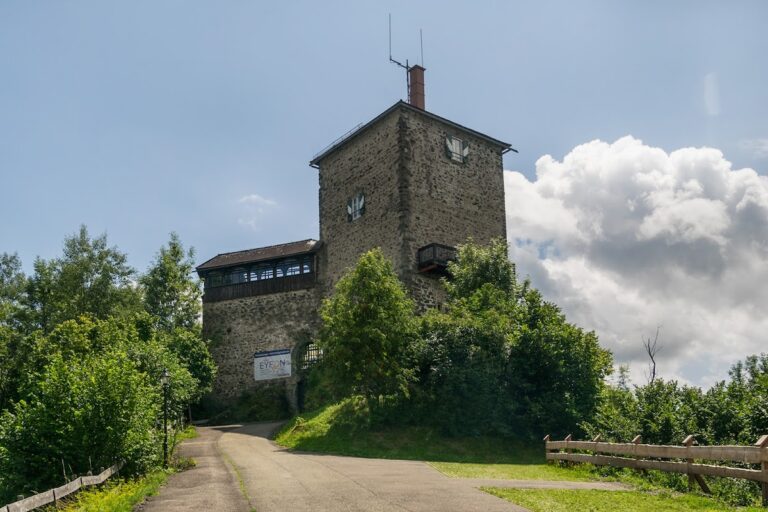
Burg Alt-Teuffenbach occupies a hilltop on the slope of a ridge above Teufenbach, at approximately 825 metres. The ridge falls steeply towards the Mur Valley, while the castle’s position overlooks the route below and the approach to the Neumarkt Saddle. The original complex was compact, combining a three-storey tower-like residential building with a defensive wall and a lower gatehouse. The wall enclosed a narrow courtyard on the south.
Original defensive complex
Tower-like residential building
The principal building of the original castle was a three-storey, tower-like house. It formed the core of the compact complex and was connected to the defensive wall leading towards the lower gatehouse. Its surviving arrangement belongs to the early medieval castle layout associated with the Teuffenbach family’s foundation.
Defensive wall and gatehouse
A defensive wall linked the tower-like house to a lower gatehouse and enclosed the narrow southern courtyard. A fifteenth-century round tower survives at the southwest corner of the surrounding wall, preserving part of the castle’s later defensive development.
Later residential buildings
The present complex includes a residential building constructed by Auguste Groner towards the end of the nineteenth century. Its principal facade faces southwest. The castle was rebuilt during the same period and is described as being in good condition, combining the restored ruin with the later residential fabric.
Nearby sites