Klingenhorn Castle: A Medieval Hill Castle in Switzerland


Site at a Glance
- Rating
- 5
- Popularity
- Very Low
- Country
- Switzerland
- Primary era
- Medieval
- Eras represented
- Medieval
- Civilizations
- Holy Roman Empire
- Site type
- Military
- Remains
- Castle
On this page9 sections
History
Klingenhorn Castle is a medieval hill castle in Switzerland, above Malans in the canton of Graubünden. It was probably built in the early thirteenth century, but its founder and original purpose remain uncertain. The castle may have been connected with the Lords of Vaz or Aspermont and was probably held by a ministerialis family, a group of unfree knights who served higher-ranking noble or ecclesiastical lords in military and administrative roles.
Changing lordship in the fourteenth century
During the fourteenth century, Klingenhorn may have passed by inheritance to the von Matsch family. Ulrich II von Matsch was married to Margarethe von Vaz, a connection that may help explain the castle’s transfer. On 12 March 1372, Ulrich von Matsch pledged Klingenhorn, described as standing above Malans, together with the jurisdiction of Malans, to his creditor Ulrich von Underwegen for 200 marks. The agreement allowed the Matsch family to continue entering and using the castle.
A document dated 28 June 1420 names Ulrich Seger as bailiff and judicial lord of Malans. A bailiff was an official who exercised administrative, judicial, or protective authority for a superior lord or institution. Seger granted property on Klingenhorn Mountain while reserving the right to reclaim it for his own use. The document indicates that the jurisdiction of Malans legally belonged to Klingenhorn Castle, although the castle then appears to have been uninhabited. Another document, dated 2 October 1441, refers to property belonging to Klingenhorn Castle.
Decline and abandonment
Around 1470, Klingenhorn came into the possession of the von Schlandersberg family. By 1497, it was apparently already a ruin, possibly because of a fire. On 26 July that year, Diepold von Schlandersberg and his wife, Ursula von Sigberg, granted their rights on Klingenhorn Mountain as an heritable fief to Hans Sutter of Malans. The agreement required the property to be returned if they rebuilt Klingenhorn Castle, but rebuilding never took place. The ruins now lie within the municipality of Malans.
Remains
Hilltop setting and defenses
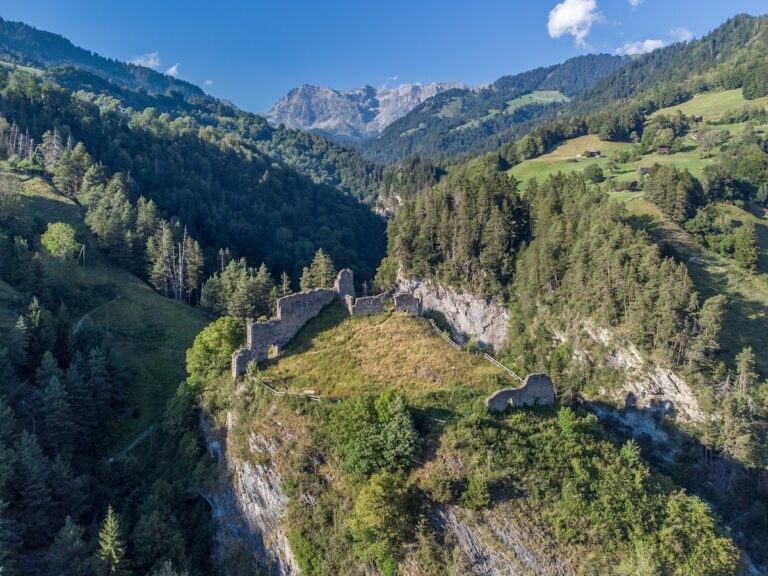
Klingenhorn occupies a long rocky promontory at 934 metres above sea level, more than 600 metres above Malans. The site lies south of the Ülltobel, while one side of the promontory falls steeply toward the ravine of the Üllbach. A neck ditch, perhaps enlarged by human action, separates the castle hill from the mountain slope. A further ditch once encircled much of the hilltop and helped protect the tower.
Buildings and enclosure
Keep
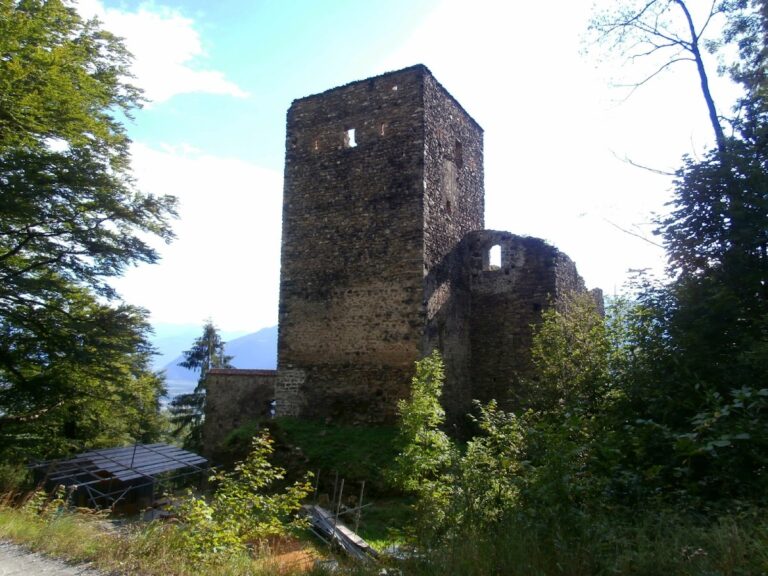
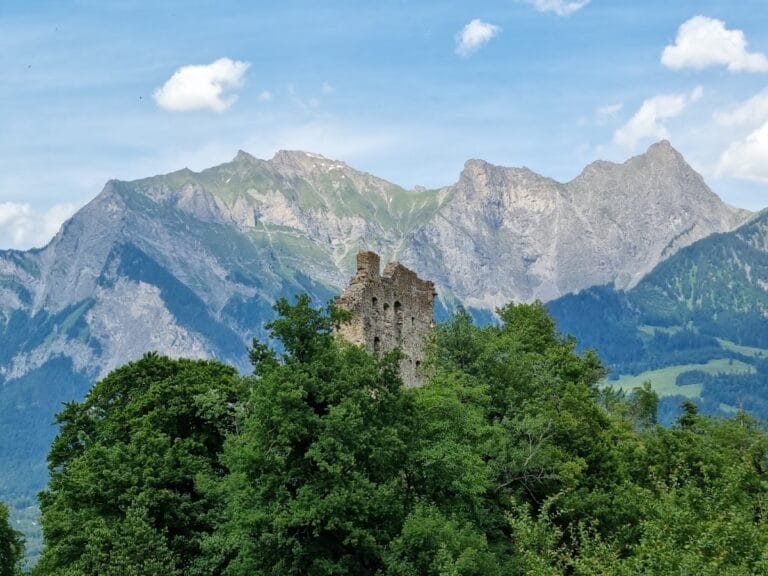
The keep survives to a height of three stories. Its upper section is in poor condition and is overgrown with brush, while rubble and vegetation fill the interior. Sections of pietra rasa survive on the tower. This masonry treatment covers rough stonework with mortar and scores the surface to imitate more regular blocks. Interior plaster traces and beam sockets remain, with the sockets showing the former levels of the stories.
A loophole window on the first story was enlarged to form a narrow entrance into the tower. The original high entrance on the second story was later blocked with masonry. Two smoke outlets and a narrow loophole stand beside it. An opening on the third story survives, although its purpose can no longer be identified.
Ancillary building and enclosure wall
West of the tower are the remains of an ancillary building. Beam sockets on its north side indicate that further buildings once stood there. The enclosure wall is now barely discernible, but portions of a dry-stone defensive wall remain standing.
Outer bailey
A large outer bailey occupied a lower terrace west of the main castle. Its position extended the fortified complex beyond the rocky summit and formed part of the site’s surviving spatial arrangement.
Nearby sites