Hlavačov: A Bohemian Royal Hunting Castle


Site at a Glance
- Rating
- 4.1
- Popularity
- Very Low
- Country
- Czechia
- Primary era
- Medieval
- Eras represented
- Medieval
- Civilizations
- Holy Roman Empire, Kingdom of Bohemia
- Site type
- Military
- Remains
- Castle
On this page7 sections
History
Origins and Early Identity
Hlavačov is a ruined royal hunting castle in Czechia, built for the rulers of medieval Bohemia probably in the twelfth century or, according to Tomáš Durdík, in the early thirteenth century. Its original name and foundation history are unknown, and it may have replaced an earlier fortification. The castle stood in the Rokytná region, whose administrative center is associated with the name castellum vetus, meaning “old castle.”
Hlavačov may have been Rokytno, the center of Rokytná mentioned from the twelfth century. Rokytno has also been identified with Na Hradišti near Senomaty, where excavations revealed an Early Slavic settlement covering about 150 hectares. That settlement may have been fortified and had been abandoned by the first half of the thirteenth century. By that time at the latest, the center of the region was known as castellum vetus.
Another possibility is that Hlavačov was the original Křivoklát mentioned by Cosmas of Prague in the early twelfth century, although the location of that earlier castle remains unknown. When the new royal castle of Křivoklát was completed in the early thirteenth century, Starý hrádek, or castellum vetus, was probably placed under its authority.
The Royal Castle in the Thirteenth Century
The first written reference to the royal castle castellum vetus dates from 1245. King Wenceslas I issued a confirmation charter there for the Benedictine monastery of Litomyšl. He returned repeatedly, issuing a charter at the castle in 1250 that transferred Chýnov to the Diocese of Prague, and another in 1251 that transferred patronage rights in Planá to Waldsassen Abbey.
In 1252, Wenceslas I confirmed the Vyšehrad Chapter’s rights to the Chapel of St Lawrence on Petřín in a charter issued at nearby Lišany. Since Lišany, about two kilometres away, had no royal residence, the king probably stayed at castellum vetus with his retinue. In March 1253, he received the archbishop of Salzburg and the bishops of Bamberg, Regensburg, Passau, Meissen, and Olomouc at the castle for several days. His final recorded stay there was in August 1253, one month before his death at Počaply.
Wenceslas was succeeded by Ottokar II Přemysl, the thirteenth-century king of Bohemia. In 1255, Ottokar confirmed an endowment to the Chapel of St Margaret at Machov at Starý hrádek. He granted Waldsassen Abbey immunity there in 1260, the last year in which the castle is mentioned in writing.
Destruction and Later History
Hlavačov was probably destroyed by fire in the 1260s. Another proposed explanation places its destruction during the political struggles that followed Ottokar II’s death, when Otto of Brandenburg administered Bohemia. The castle was not rebuilt. Its administrative role as the center of Rokytná passed to Křivoklát, while Rakovník had gained its own jurisdiction and the nearby Křivoklát offered a powerful and defensible royal stronghold. The sandy slope at Hlavačov was also unsuitable for a contemporary castle.
The overgrown spur and its ruins were first recorded as Hlawaczow in 1354. From the fifteenth century, people in Rakovník called the ruin Hlawaczy, and the name was adopted by an old Rakovník patrician family in the designation “of Hlawaczow” included in its armorial charter. From 1515, Rakovník quarried the abandoned castle for stone used in the town’s fortifications. The walls had been almost completely dismantled by the nineteenth century.
From the eighteenth century, some maps called the ruin Červený zámek, or Red Castle, because it stood above the Red Mill. In the nineteenth century, castle researcher Franz Alexander Heber argued that Hlawaczow survived until the transition from the eighteenth to the nineteenth century. That interpretation conflicts with the earlier evidence for the near-total dismantling of its walls by the nineteenth century. The remains are protected as a cultural monument.
Remains
Hilltop Setting and Defenses
Hlavačov occupied the southwestern end of Hlavačov Hill, on a spur of Tertiary sand above the valley of the Lišanský potok, formerly called the Červený potok. The ground falls steeply toward the west and provided extensive views. The castle stood at an elevation of about 390 metres, below the summit of Hlavačov Hill at 405 metres.
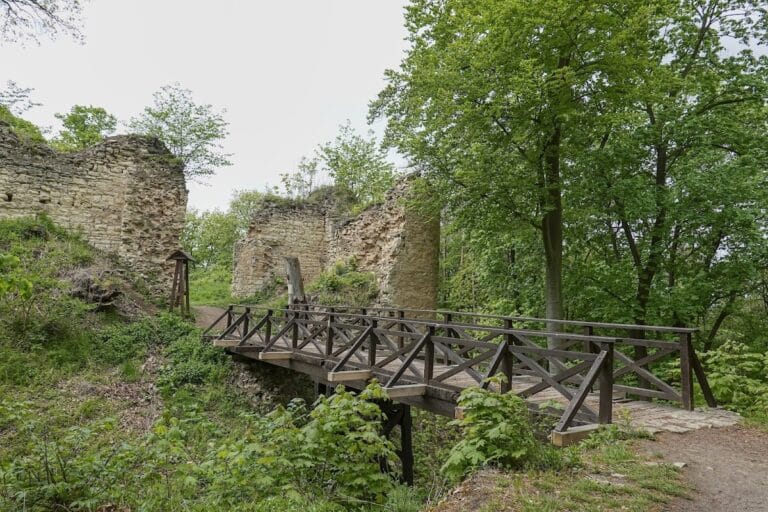
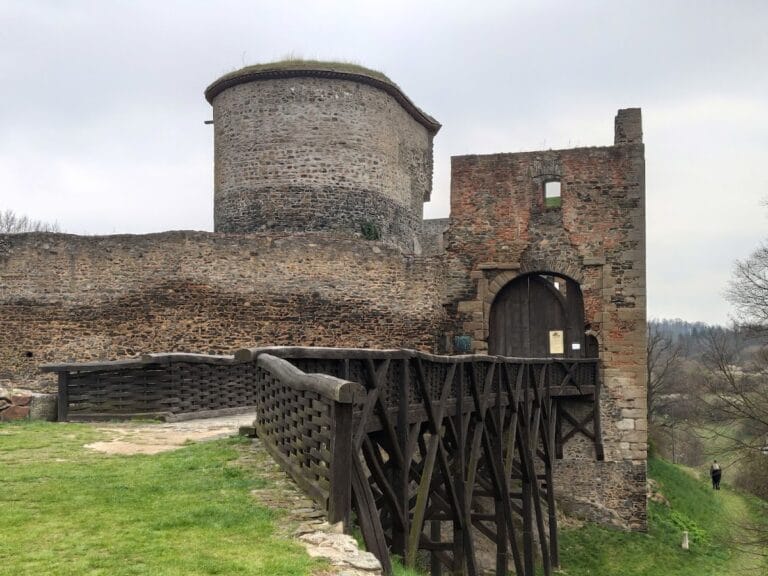
The fortified area measured approximately 80 metres across and 120 metres in length. At the narrow connection between the spur and the Hlavačov Plateau, a wooden bridge crossed two defensive ditches, each about 20 metres wide. Two outer baileys, enclosed subsidiary parts of a medieval castle used for work, storage, or defense, lay beyond the ditches. The inner castle was protected by a strong rampart and a deep ditch and was divided into two sections. The larger measured about 50 by 25 metres, while the smaller measured approximately 25 by 21 metres.
Construction and Archaeological Evidence
The fortifications were unusually massive. They consisted of local sand laid in layers and poured over with mortar, with an outer facing of Pläner masonry, a local limestone or calcareous stone used in Bohemian construction. The residential and service buildings were low and mainly wooden. Some used half-timbering with clay infill, while others incorporated Pläner stone and brick masonry. These buildings did not rise above the substantial defenses.
Excavations in 1974 showed that the castle had been destroyed by fire. Durdík interpreted the complex as having a ring wall made with timber and clay, together with half-timbered buildings and only limited use of stone. Excavations found no evidence for a Romanesque chapel or a low tower, although both had previously been proposed. Amateur excavations in the early twentieth century uncovered decorated ceramic fragments, knife blades, and horseshoes.
Stone quarrying, the removal of building material, and later damage from amateur digging have made the original arrangement difficult to reconstruct. Durdík classified Hlavačov as a transitional castle type comparable to Angerbach and considered it one of the largest examples of that type. Within the forest, the surviving ramparts and ditches are the features that remain visibly identifiable.
Nearby sites