Drishane Castle: A MacCarthy Tower House in County Cork
Site at a Glance
- Rating
- 4.3
- Popularity
- Very Low
- Country
- Ireland
- Primary era
- Medieval
- Eras represented
- Medieval, Early Modern
- Civilizations
- British, Irish
- Site type
- Military
- Remains
- Castle
On this page6 sections
History
Drishane Castle is a fifteenth-century MacCarthy tower house in Ireland, located 2.2 kilometres northeast of Millstreet in County Cork on the south bank of the Munster Blackwater. The MacCarthy clan, a Gaelic Irish aristocratic dynasty with major power in Munster, built it around 1436–1450. It is also known as Caisleán an Driseáin and is protected as a National Monument of Ireland, a site safeguarded by the Irish state for its archaeological or historic importance.
MacCarthy ownership
Construction was probably begun by Dermot Mór, the second son of Tadhg, King of Desmond from 1390 to 1428. Desmond was a medieval Gaelic kingdom in southwestern Ireland. The castle remained associated with the MacCarthy family through the sixteenth and seventeenth centuries. In 1592, Tadhg, son of Owen, surrendered Drishane to Queen Elizabeth I and received it back through a royal regrant. His son Owen, also known as Eoin, retained the castle until his death in 1637.
The MacCarthy lands were forfeited during the Irish Confederate Wars, the conflicts in Ireland from 1641 to 1653 that ended with the Cromwellian conquest and widespread land confiscation. They were restored in 1660 to Donough MacCarty, 1st Earl of Clancarty, after Charles II returned to the English throne. The family lost the lands again after the Williamite War of 1689–1691, a conflict over the English and Irish crowns that led to many Catholic landholders losing their estates.
Wallis ownership and later uses
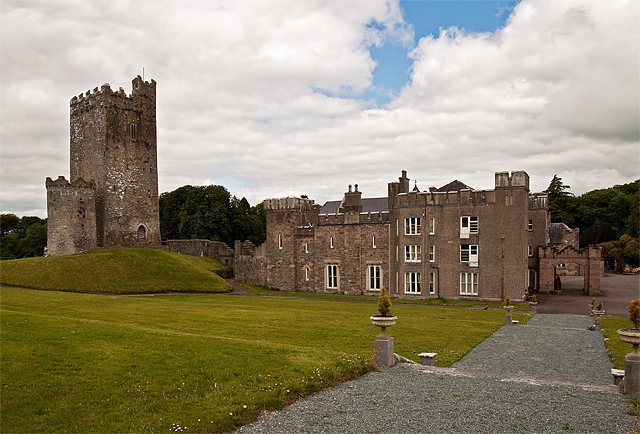
The Hollow Sword Blade Company acquired the lands and sold them to Henry Wallis in 1709. The Wallis family took full ownership in 1728 and built an adjacent house around 1730. This later building also came to be called a castle, creating a shared name for the medieval tower and the eighteenth-century house.
Drishane was garrisoned during the Fenian Rising of 1867, an attempted Irish insurrection organized by the Irish Republican Brotherhood, also known as the Fenians. The property remained in Wallis hands until 1882, after which it was owned by Patrick Stack. In 1909, it became a convent run by the Sisters of the Infant Jesus, a Catholic congregation involved in religious and educational work. The sisters operated a boarding secondary school for girls there until 1992.
In 1974, Drishane was used as a filming location representing the fictional Brede Abbey in the film adaptation of In This House of Brede. The Duggan family later acquired the property, which became a centre for asylum seekers. Modern descriptions identify the Duggan family as its owner.
Remains
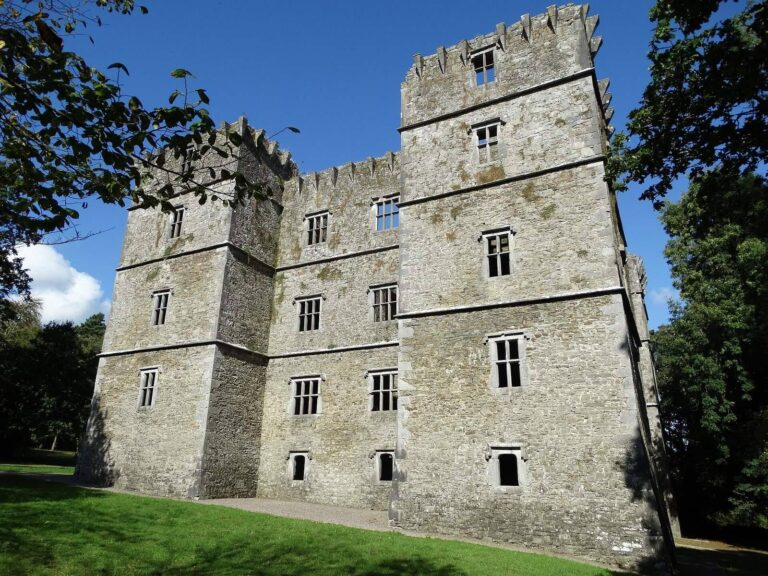
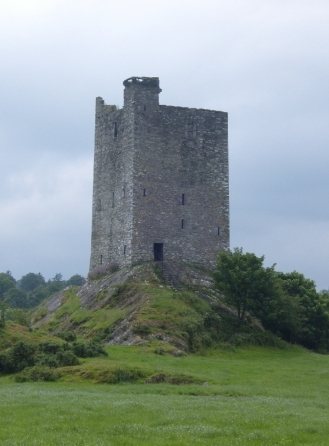
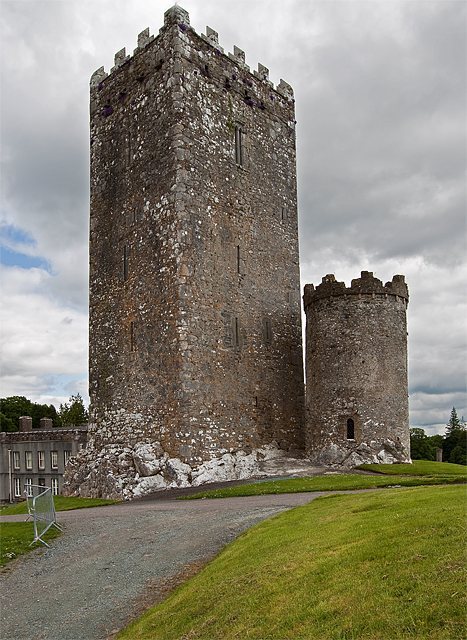
Drishane consists principally of a tall rubble-stone tower house, accompanied by a small circular tower and the adjacent eighteenth-century house. The medieval tower rises 22 metres through four storeys and retains defensive features associated with a fortified residence. Its roof has Irish crenellations, the raised sections of a battlemented roofline, while narrow arrowslits, or openings through which weapons could be used, pierce the stone structure. The castle is described as well preserved.
Medieval tower and circular tower
The four-storey tower house is the principal medieval structure. Its rubble-stone construction, substantial height, arrowslits, and crenellated roof reflect the combined residential and defensive purpose of a tower house. A small circular tower stands beside it, forming a separate element of the surviving castle group.
Wallis house
The adjacent house was built by the Wallis family around 1730, after their acquisition and consolidation of the estate. Although it is later than the MacCarthy tower house, it is also referred to as a castle and contributes to the property’s present architectural identity.