Church of the Nativity of the Virgin Mary: A Gothic and Baroque Parish Church in Nové Strašecí
Site at a Glance
- Rating
- 4.6
- Popularity
- Very Low
- Country
- Czechia
- Primary era
- Medieval
- External website
- Open
- Eras represented
- Medieval, Early Modern, Modern
- Civilizations
- Holy Roman Empire, Kingdom of Bohemia
- Site type
- Religious
- Remains
- Church
On this page15 sections
History
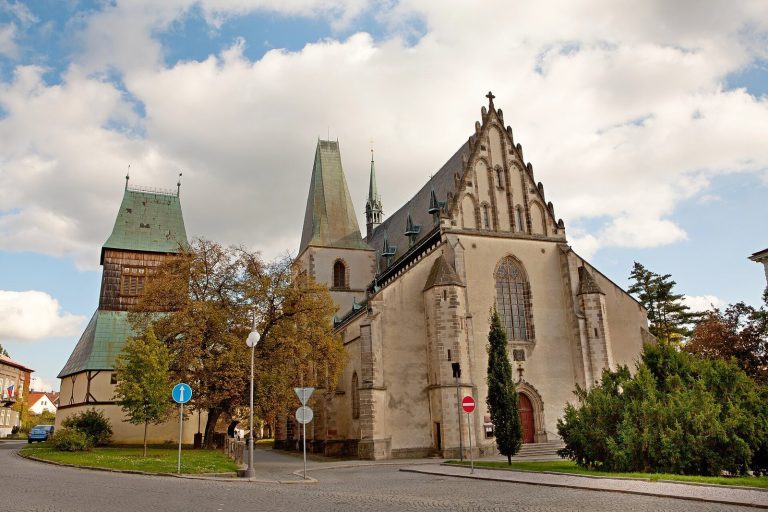
The Church of the Nativity of the Virgin Mary in Nové Strašecí, Czechia, is a Roman Catholic parish church whose origins lie in the Gothic period. It was already a parish church between 1344 and 1350 and remains the town’s largest religious building. The church belongs to the Prague ecclesiastical province and archdiocese, the Rakovník vicariate, and the Nové Strašecí parish.
Gothic Origins and Sixteenth-Century Expansion
The surviving presbytery belongs to the church’s original Gothic phase. The kings of Bohemia held the right to present clergy to the church, indicating its connection with royal authority. In 1553, with the support of King Vladislaus, a nave was added. The church was then attached to the parish of Zbečno.
A later tradition connected the church with a much earlier foundation. When the building was rebuilt after a fire, the parish priest Anselmus Proškovský reportedly discovered a lead container in the ruins. It was said to hold saints’ relics and two documents claiming that Gervasius, a collegiate provost of Vyšehrad, had built the church in 1158. According to the documents, Daniel, described as the thirteenth bishop of Prague, consecrated it on 30 May 1158 in the presence of King Vladislaus and his wife, Judith of Thuringia. The documents have not survived and are not regarded as historically reliable.
War, Rebuilding, and Parish Life
The church burned in 1639 during the period of the religious conflicts and the Thirty Years’ War, the wider European conflict that combined political struggles with religious divisions. It was rebuilt in 1640. Permanent pastoral administration was established again in 1658, after which the church continued as a Roman Catholic parish church.
Its present character developed through the combination of late Gothic fabric and Baroque alterations. A Baroque high altar was consecrated in 1733, while the altar of Saint Anne was consecrated at the same time. The altar of the Brotherhood of the Holy Family was consecrated in 1749 but was later removed during the religious reforms of Emperor Joseph II, an eighteenth-century Habsburg ruler whose policies restricted or dissolved some religious institutions and confraternities.
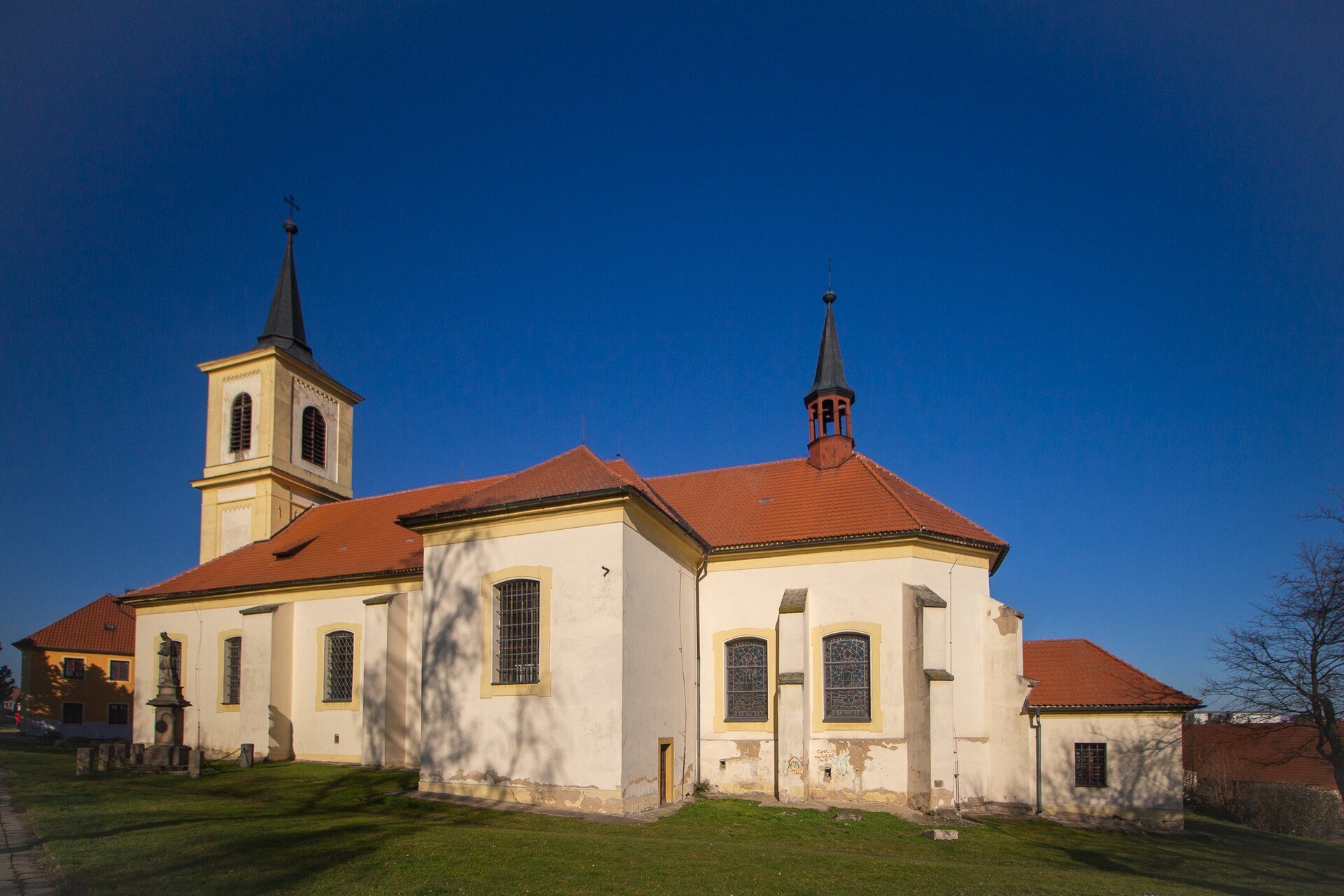
Major additions in 1840 altered the church’s plan and appearance. The nave was extended westward, and a 22-metre tower was built into the west facade. Rectangular side sections were added beside the presbytery, with two oratories, smaller spaces for private or restricted prayer, above them at choir-loft level. These changes gave the ground plan a cruciform shape. A sacristy was also inserted between the two eastern buttresses. The earlier hexagonal bell tower west of the church was demolished after the new tower was completed.
Paintings, Bells, and Continuing Use
The painting of the Virgin Mary on the high altar was made in 1873 by the Prague painter Antonín Lhota. The church also received a bust of Jesus Christ and a counterpart showing the Virgin Mary with a pierced heart, both made by Wolf Seidl in 1867. A painting of Saint Nicholas, originally intended for the church at Třtice, hangs in the nave, while a painting of Saint Francis Xavier in the presbytery is associated with the patronage churches of the Fürstenberg family.
The church’s bells were requisitioned during the First World War and again during the German occupation. After the second requisition, the building remained without bells for sixty years. A new bell was cast in Passau in 2002 and named Maria–John Paul after the Virgin Mary and Pope John Paul II. The church has continued to serve as a regularly used Roman Catholic parish church.
Remains
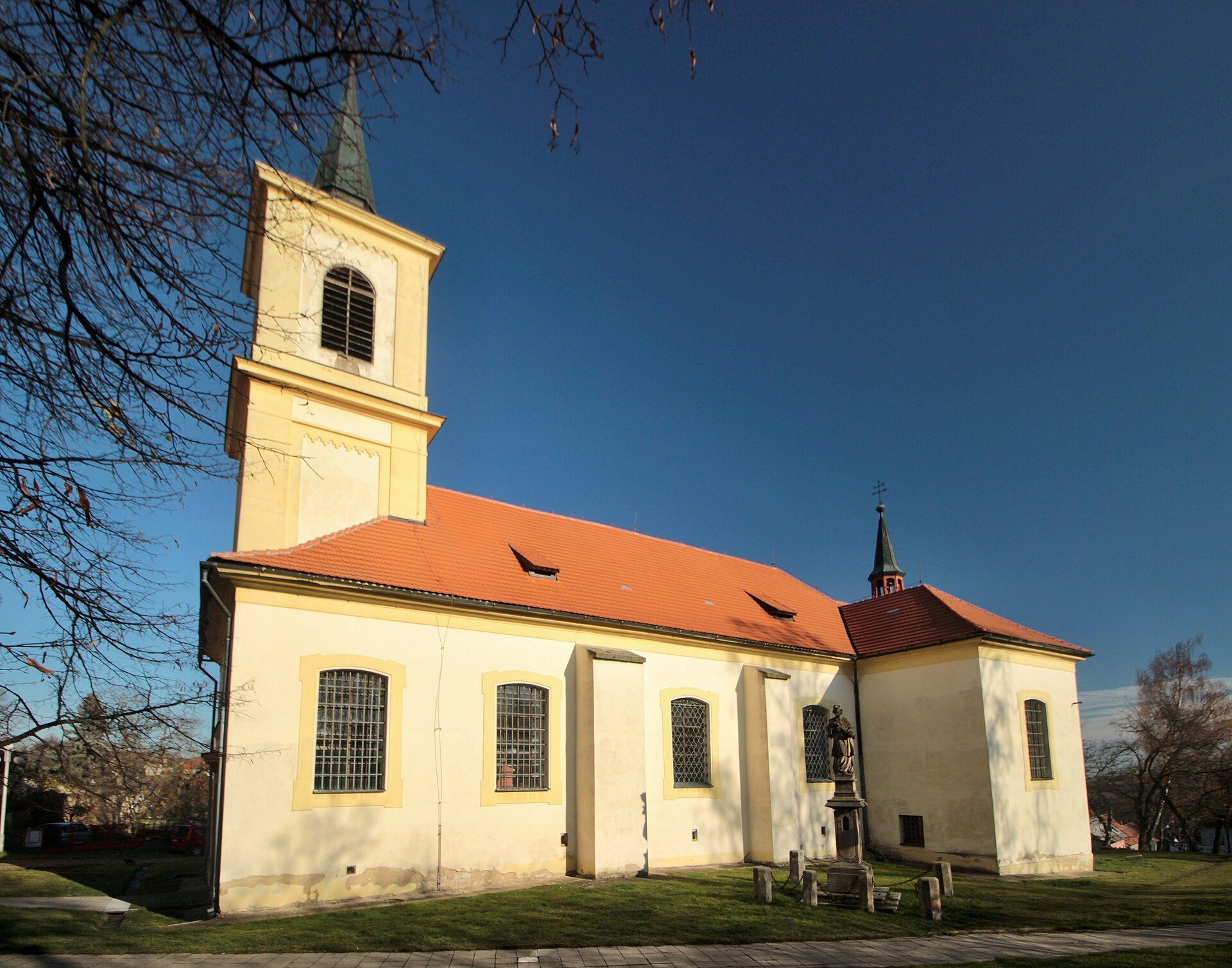
The Church of the Nativity of the Virgin Mary stands on U školy Street beside the Municipal Museum. It is a single-nave building whose surviving fabric brings together successive late Gothic and Baroque phases, followed by the substantial alterations of 1840. Entry is from the west, through an approach reached by several steps descending into the entrance area. A 22-metre tower rises from the west facade, preserving the configuration established during the nineteenth-century rebuilding.
Presbytery and Exterior Additions
Gothic Presbytery
The presbytery, the part of the church reserved primarily for the altar and clergy, forms five sides of an octagon. It is the surviving element of the early Gothic church. Six buttresses supported its walls, and four windows illuminated the space. Fragments of the former pointed windows remain in the building. A small sanctus bell turret, a small tower associated with a church bell, rises above the presbytery.
Nineteenth-Century Additions
In 1840, a sacristy was built on the church axis between the two eastern buttresses, with its entrance facing the parish house. Projecting rectangular sections were added beside the presbytery, and the two oratories were formed above them at choir-loft level. Together with the westward extension of the nave and the new tower, these changes produced the church’s cruciform ground plan. The former hexagonal bell tower, which had stood west of the building, was demolished in the same year.
Interior Furnishings
High Altar and Saint Anne Altar
The Baroque high altar, consecrated in 1733, carries a painting of the Virgin Mary made by Antonín Lhota in 1873. Statues of Saint Wenceslas and Saint Ludmila, approximately three-quarters life-size, stand beside it. The altar of Saint Anne was consecrated together with the high altar. Its scene shows Saint Anne teaching Mary to pray, while angels hold the painting at either side and God the Father appears above the canopy.
Altars of Saint John of Nepomuk and Saint Aloysius
The altar of Saint John of Nepomuk stands on the right side of the church. Saint John of Nepomuk was a fourteenth-century Bohemian priest and martyr who became one of Bohemia’s principal patron saints. The altar’s sculptural group shows him carried by three angels, with two more angels bowing below. A canopy above the group is topped by another angel pointing toward heaven. The altar was consecrated on 11 March 1747.
Opposite the pulpit is the altar of Saint Aloysius. Its painting, completed in 1864 by the priest Braun, is set in a Baroque frame. Gilded statues of Saint Barbara and Saint Catherine flank the image.
Pulpit and Other Interior Images
The Baroque pulpit follows the decorative character of the altars. Its brown base supports gold and white surfaces with reliefs of the four Evangelists, Matthew, Mark, Luke, and John, traditionally associated with the four canonical Gospels. Angels holding ribbons sit on the canopy.
The church also contains the 1867 bust of Jesus Christ by Wolf Seidl and its counterpart showing the Virgin Mary with a pierced heart. The painting of Saint Nicholas in the main nave was originally intended for Třtice. In the presbytery, the painting of Saint Francis Xavier reflects the type of religious patronage associated with the Fürstenberg family.
Devotional Features and Statues
Lourdes Grotto
On the right after the western entrance is a small Lourdes grotto, a cave-like devotional installation modeled on the French pilgrimage site associated with reported appearances of the Virgin Mary. A statue of the Virgin stands inside, with a kneeling girl depicted before it.
Statues of Saint John of Nepomuk
A statue of Saint John of Nepomuk dated 1710 stands in front of the church toward the parish house. Another statue of the saint is positioned on the opposite side of the building. Created in 1688, before Saint John of Nepomuk was formally recognized as a saint by the Catholic Church, it remained on the town square until 1958, when it was replaced there by a Red Army soldier.