Hildenburg: A Medieval Administrative Castle in Germany


Site at a Glance
- Rating
- 4.4
- Popularity
- Very Low
- Country
- Germany
- Primary era
- Medieval
- External website
- Open
- Eras represented
- Medieval
- Civilizations
- Holy Roman Empire
- Site type
- Military
- Remains
- Castle
On this page8 sections
History
Origins and the Hildenburg family
Hildenburg is a medieval hilltop spur castle in Germany, probably established around 800 during the eighth century. It later became an administrative center of the Bishopric of Würzburg, an ecclesiastical principality whose bishop exercised both religious and territorial authority. Around 824, a noblewoman named Hiltiburg donated estates at Sondheim, Nordheim in the Baringau, and Nordheim in the Gau Tussifeld to Abbot Rhabanus Maurus of Fulda.
The Hildenburg family appears again in 1116, when Cunemund of Hildenburg witnessed a charter. Albrecht of Hildenburg travelled to the Holy Land as a crusader in 1188 and died around 1192. The family’s male line ended with Adalbert III of Hildenburg, who died on either 9 February 1217 or 9 February 1228.
Transfer to Würzburg
Adalbert III left an only daughter, Adelheid, who inherited the extensive Hildenburg estates. In 1228 she married Count Otto III of Bodenlaube, a member of a branch of the Counts of Henneberg. With Adelheid’s consent, Otto granted many of the estates as fiefs to the Bishopric of Würzburg in 1228. In 1230 he sold all of them, including Hildenburg, to the bishopric, after which the castle became the seat of a high-princely office, an administrative district ruled by a territorial prince.
The marriage lasted less than three years. Otto entered the Teutonic Order, a medieval religious and military order, while Adelheid entered the Dominican convent in Würzburg. Their son Adelbert, also called Albert, was committed to the Church during childhood. Otto separated from Adelheid in 1231 because of a previously undisclosed impediment to the marriage. He died several years later, and Albert died as a canon of Würzburg Cathedral, ending the family line.
Administrative use and decline
Hildenburg remained the seat of the high-princely office until the sixteenth century. In 1335, Heinrich of Fladungen received the cent, a local judicial district, together with the office of reeve over Hildenburg. When the Fladungen office, including Hildenburg, was pledged to Count Georg of Henneberg-Aschach in 1435, Georg appointed Adolf Marschalk of Ostheim as district official. Adolf lived at Hildenburg and bought an estate at Nordheim in 1461.
Valentin Vatt served as district official of Hildenburg until 1547. An administrative officer still lived at the castle in 1577, or official administrative days were held there. The Hildenburg office was mentioned again in 1596, but by 1600 its district official lived in Fladungen. After that change, farmers were the only residents at Hildenburg.
Destruction and later traditions
The castle was probably destroyed in the German Peasants’ War in 1525, a series of rural uprisings in the German lands during 1524 and 1525. The attackers were insurgent peasants from Bastheim. A later tradition claimed that they targeted Hildenburg because they believed Martin Luther, the German religious reformer associated with the Protestant Reformation, was there. No evidence supports that explanation.
Other traditions connected with Hildenburg tell of a ghostly procession, a White Lady, treasure hidden in the cellar, and underground passages beneath Hillenberg. The surviving remains are protected as both a listed architectural monument and an archaeological monument.
Remains
Hilltop setting and enclosure
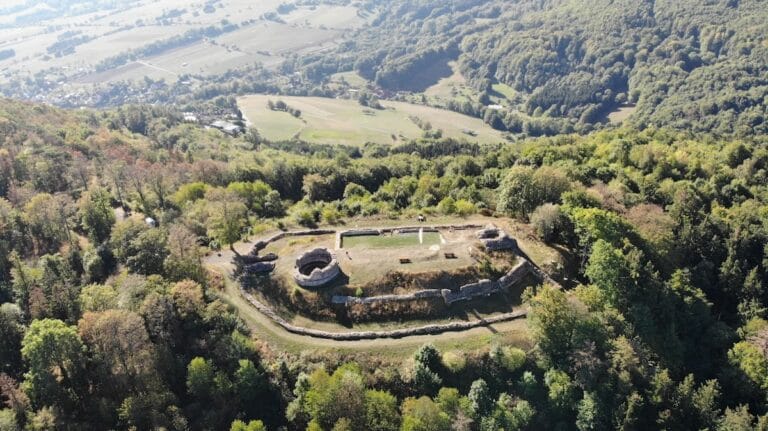
Hildenburg stood as a spur castle on a conical foothill northwest of Roth vor der Rhön, above the hamlet of Hillenberg in the municipality of Hausen, in the Lower Franconian district of Rhön-Grabfeld. Its position was at the entrance to the Baringau, at an elevation of 658 metres above sea level. The elevated site gave the castle command over the surrounding countryside.
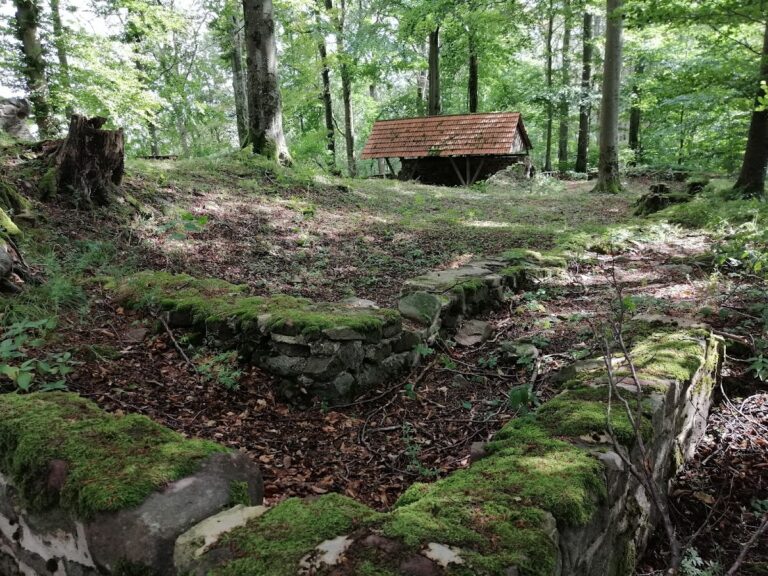
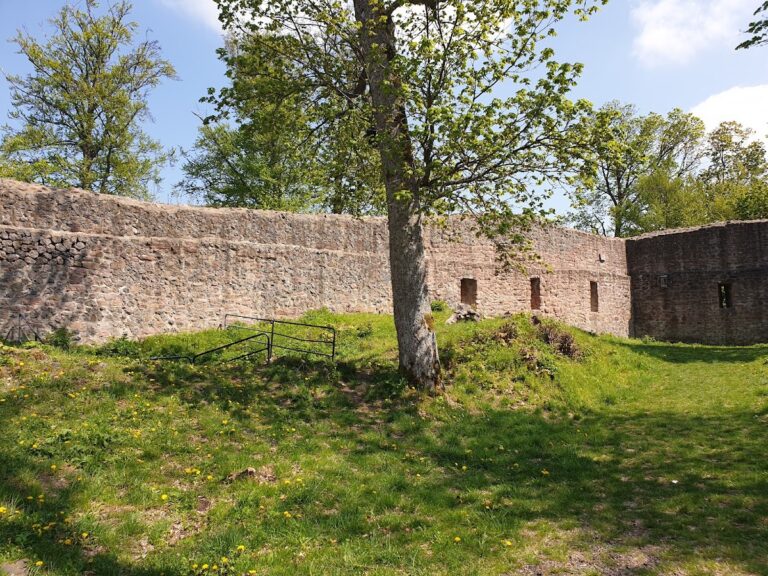
Only parts of the former castle survive. Foundations of a massive enceinte, an enclosing defensive wall or circuit, remain around farmsteads in Hillenberg. These foundations preserve the outline of the former fortified enclosure and its relationship to the present hamlet.
Keep and surviving tower remains
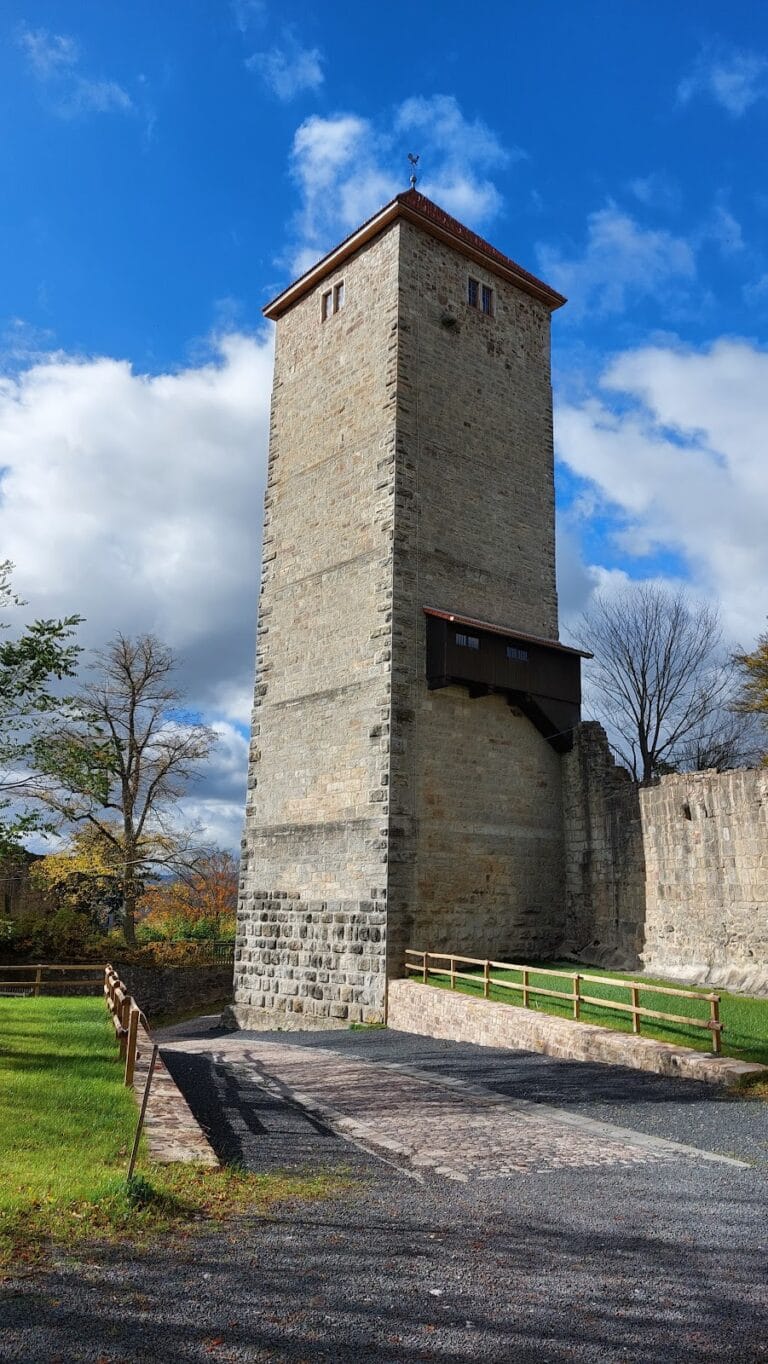
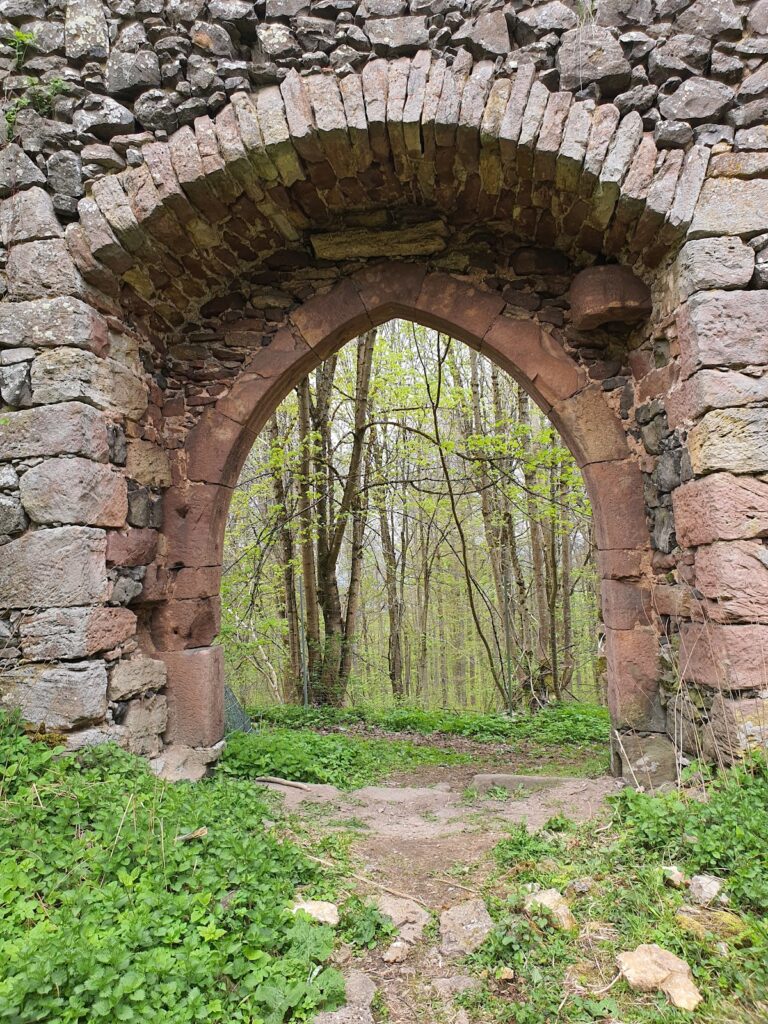
Sections of the keep, the castle’s principal fortified tower, also survive. The tower was reportedly demolished in the middle of the nineteenth century, leaving the remaining sections and associated foundations as physical traces of the medieval stronghold.
Nearby sites