Ruine Lichtenburg: A Medieval Castle Ruin in Germany


Site at a Glance
- Rating
- 4.5
- Popularity
- Low
- Country
- Germany
- Primary era
- Medieval
- External website
- Open
- Eras represented
- Medieval, Early Modern
- Civilizations
- Holy Roman Empire
- Site type
- Military
- Remains
- Castle
On this page8 sections
History
Ruine Lichtenburg is a medieval castle ruin and archaeological site in Germany, on the Schlossberg north of Ostheim vor der Rhön. Construction is dated to 1159, and the castle was first mentioned in 1161, when a branch of the Counts of Henneberg held it. Its probable founder was Heinrich I of Henneberg-Irmelshausen.
Henneberg origins and administration
The castle’s most prominent lord was Otto I of Henneberg-Botenlauben, a minnesinger, meaning a medieval German poet and composer of courtly songs. The Marschalk von Ostheim, dependent knights and officials serving the Henneberg dynasty, were based at Lichtenburg. A sales document from 1230 described the complex as a castle.
In 1315, Fulda’s Abbot Heinrich VI strengthened the fortifications and ordered the construction of the bergfried, the principal defensive tower of a medieval German castle. From this period, the Lichtenberg administrative district was governed and defended from Lichtenburg. Around the middle of the fourteenth century, the castle returned to the Henneberg family, specifically its Henneberg-Römhild branch, and later passed into Saxon possession.
Destruction, military reuse, and abandonment
The German Peasants’ War brought major destruction to Lichtenburg in the sixteenth century, although the castle was rebuilt soon afterward. During the Imperial war against France in 1671 and 1672, it was briefly prepared for military use again. An iron-clad gate and new earthwork fortifications were added.
The last official of the Lichtenberg district, Friedrich Sebastian von Stein, left the castle in 1680. Administration then moved to Ostheim, and Lichtenburg ceased to function as an administrative seat. The castle was finally abandoned in 1719 and slated for demolition.
Later preservation
Carl August of Weimar acquired the complex, and Ernst August of Saxe-Weimar-Eisenach arranged restoration work on the deteriorating buildings during the mid-eighteenth century. The work stopped again in 1744. From 1811, local inhabitants used the ruins as a quarry, causing renewed damage.
The government acquired the remains in two stages, in 1819 and 1843. A castle-preservation association later undertook conservation work at Lichtenburg and improved its surroundings. The ruin forms part of the municipality of Ostheim vor der Rhön in the Rhön-Grabfeld district of Lower Franconia, Bavaria, and is designated as an architectural heritage monument in Bavaria.
Remains
Hilltop layout and fortifications
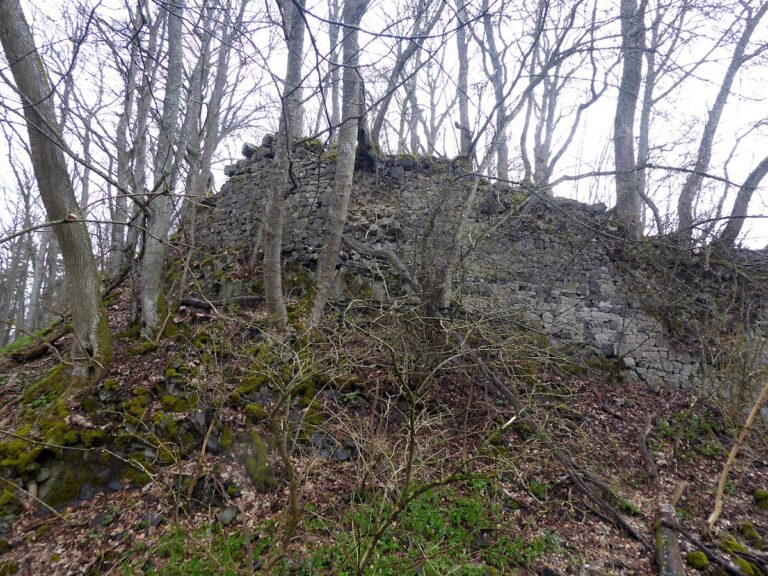
Lichtenburg occupies the 481.6-metre-high Schlossberg north of Ostheim vor der Rhön. The hilltop castle is enclosed by extensive ramparts, and substantial portions of the complex survive. Its layout includes an outer bailey, a separately fortified main castle, and a ring wall, creating distinct defensive areas within the ruin.
Entrance and principal buildings
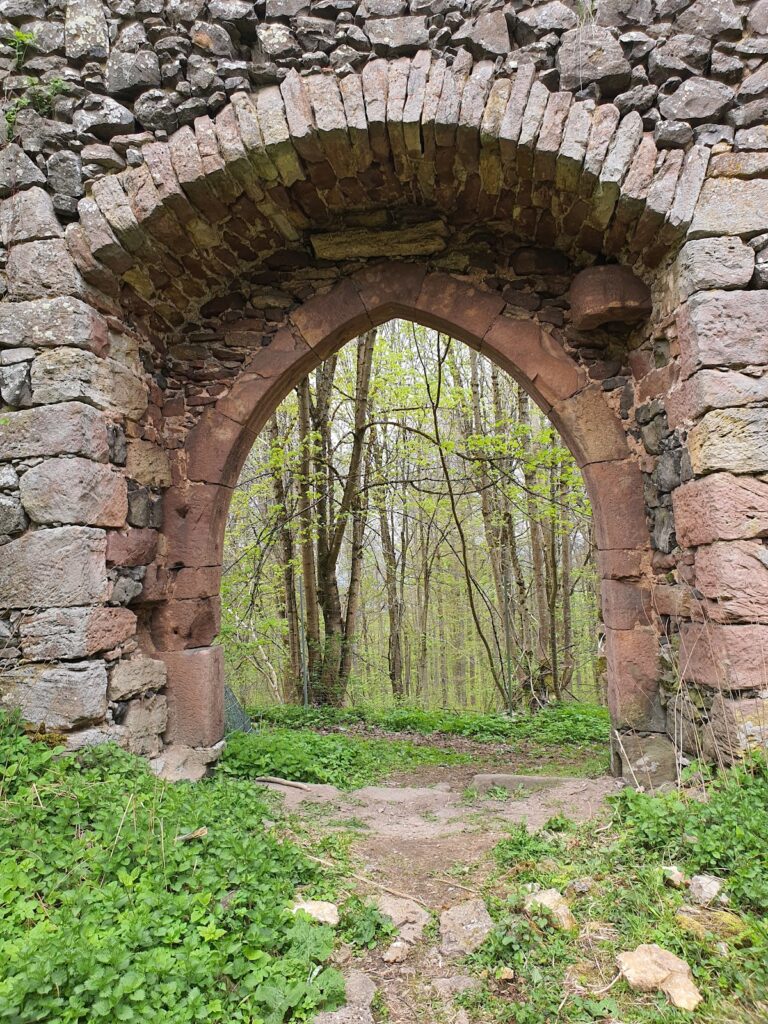
A paved approach road reaches the entrance gate and gatehouse. This part of the complex dates from the Renaissance, the cultural and architectural period that followed the Middle Ages and often favored classical forms and symmetry. A drawbridge probably stood at the entrance originally. Within the surviving castle are the palas, the principal residential and representational building, the kemenate, a heated residential chamber or building, a stable, and a chapel. The palas preserves remains of a chapel.
The bergfried
The bergfried retains its original masonry to a height of 28 metres. It has been converted into an observation tower with a roof and platform, bringing its total height to more than 31 metres. The tower is described as the highest bergfried in the Rhön.
An etching made by C. Wagner in 1835 depicts the castle ruins and provides a visual record of the complex during its later history.