Auersburg: A Medieval Hill Castle and Administrative Seat in Germany


Site at a Glance
- Rating
- 4.6
- Popularity
- Low
- Country
- Germany
- Primary era
- Medieval
- External website
- Open
- Eras represented
- Medieval
- Civilizations
- Holy Roman Empire
- Site type
- Military
- Remains
- Castle
On this page8 sections
History
Auersburg is a ruined hill castle in Hilders, Germany, built around 1120 on the wooded southwestern slope of the 757-metre Auersberg in the Rhön. Its position on a forward slope, rather than a dominant summit, suggests that it served chiefly as a seat of lordship or administration instead of as a fortress designed for sustained defence.
Early Lords and the Hennebergs
Around 914, the area around Hilders passed from Fulda Abbey to Regenher of Weid in an exchange of estates. Regenher probably established the first castle on the Auersberg. The earliest known reference to Auersburg dates from 1214, although the castle itself was older.
By around 1120, the counts of Henneberg had acquired the territory and probably rebuilt or replaced the earlier castle with a small knights’ castle. The building may have housed a younger Henneberg brother or an official responsible for local administration. The counts of Henneberg were a ruling dynasty whose lands bordered those of Fulda and Würzburg, placing Auersburg within a contested frontier zone.
Between Fulda and Würzburg
In 1214, a lord of Nithardshusen from the House of Henneberg sold Auersburg to Fulda Abbey. Fulda Abbey was a major ecclesiastical lordship whose abbots exercised both religious and territorial authority. The abbey granted the castle as a fief to its retainers, and by 1270 the lords of von der Tann held it.
A border feud between Fulda’s Prince-Abbot Bertho IV and Würzburg’s Bishop Berthold II of Sternberg was settled in 1282. By 1290, Würzburg possessed Auersburg. Around 1325, the Hennebergs acquired it again. Count Berthold VII of Henneberg-Schleusingen took advantage of financial difficulties in the Würzburg bishopric, disputes between its clergy and citizens, and a contested episcopal succession. During this period, however, the castle was allowed to deteriorate.
In 1342, Bishop Otto II of Wolfskeel bought back Auersburg and the Auersberg office. Hilders then became the seat of the Würzburg official who administered the Hilders district. In 1354, Prince-Bishop Albrecht II of Hohenlohe ordered a complete rebuilding of the deteriorated castle as an administrative stronghold for Würzburg’s frontier. The prince-bishop of Würzburg was both the head of the diocese and a territorial ruler, so this rebuilding served political and military purposes as well as ecclesiastical administration.
Pledges, Conflict, and Decline
In 1419, Würzburg Prince-Bishop and Duke of Franconia Johann II of Brunn pledged the newly rebuilt Auersberg castle to the brothers of Eberstein and the lords of von der Tann. The pledge was renewed in 1454. Disputes between the two groups became serious in 1477 and were settled by Prince-Bishop Rudolf II of Scherenberg.
During the Peasants’ War, a revolt that brought widespread attacks on ecclesiastical and aristocratic property in 1525, travelling peasants burned and destroyed the interior buildings between 17 and 25 April. The castle received only inadequate repairs and remained partly habitable. Prince-Bishop Julius Echter of Mespelbrunn repaired the habitable section in 1579. The lords of von der Tann lost their share in the administrative district and court, but retained hunting and fishing rights as lessees.
In 1585, the administrative seat moved to Hilders. During the Thirty Years’ War, the deteriorating castle was used several times by local inhabitants as a refuge. The remaining interior buildings were demolished in 1686, after which the site was used largely as a quarry. Around 1790, the outer forewall was also dismantled for building material, including stone used in new buildings such as the parish church in Hilders. Fields and meadows created in front of and behind the castle from 1722 were later abandoned and became forested.
Secularization and Conservation
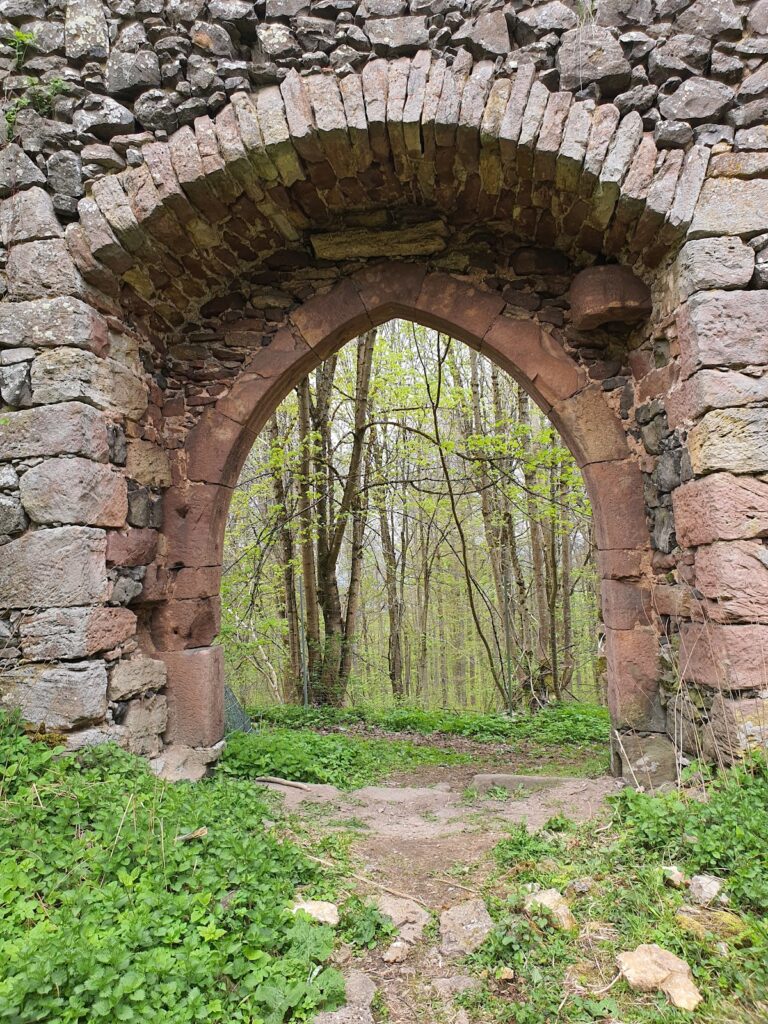
In 1803, during secularization, the transfer of ecclesiastical territories and property to secular rulers, Auersburg and the Hilders administrative district passed to Bavaria. In 1848, the Bavarian government prohibited further removal of stones. The entrance was cleared, rubble was removed from the front part of the interior, and access was opened to the remains of the old vaulted cellar and the inner castle. Further clearance began in 1865.
After the German Unification War, the Hilders area and Auersburg passed to Prussia in 1867. From 1876, members of the Hilders-Tann section of the Rhön Club carried out systematic clearance and maintenance, including the first masonry repairs. On 24 June 1879, the restored entrance, a wooden viewing tower, and access to the cellar and inner castle were inaugurated. Later major repairs took place in 1914, 1932, 1940, and from 1957 to 1969. The wooden tower was replaced by a solid staircase, missing masonry was supplemented, and the walls were repointed.
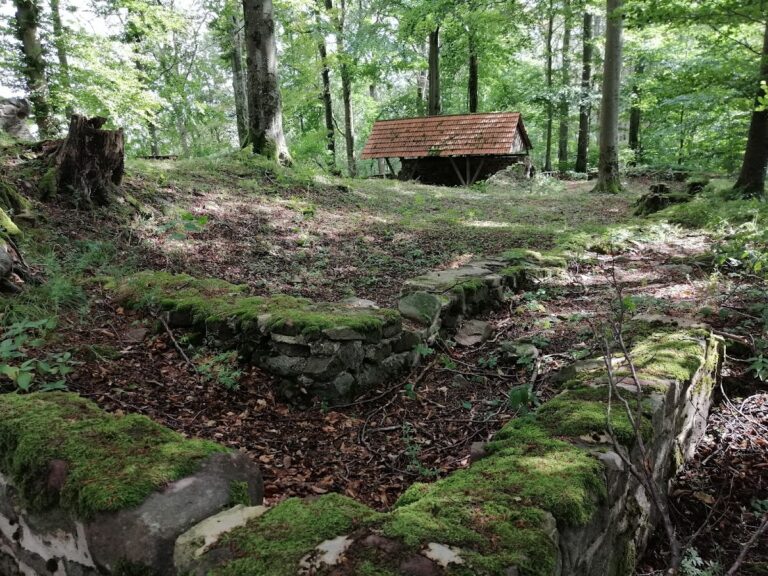
In 2007 and 2008, the State of Hesse conserved the walls and completely reconstructed the viewing tower built in 1969. The ruin now includes a shelter and viewing platform. Legends associated with the site include stories of the ghost of Auersburg and of the last Auersbergers.
Remains
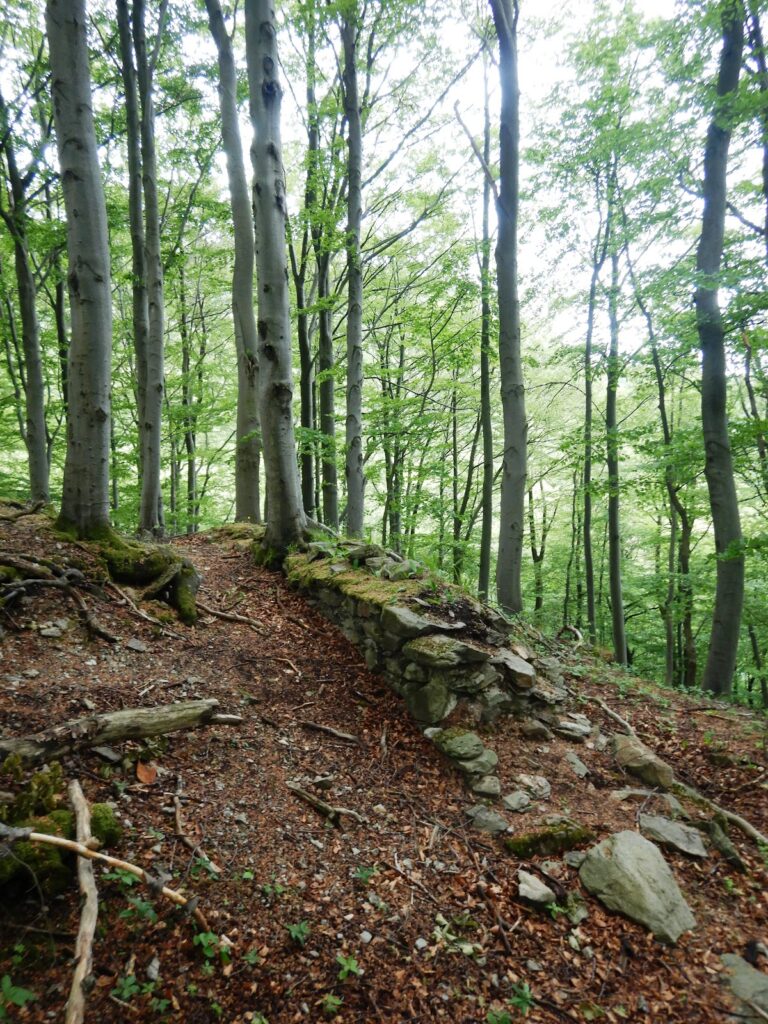
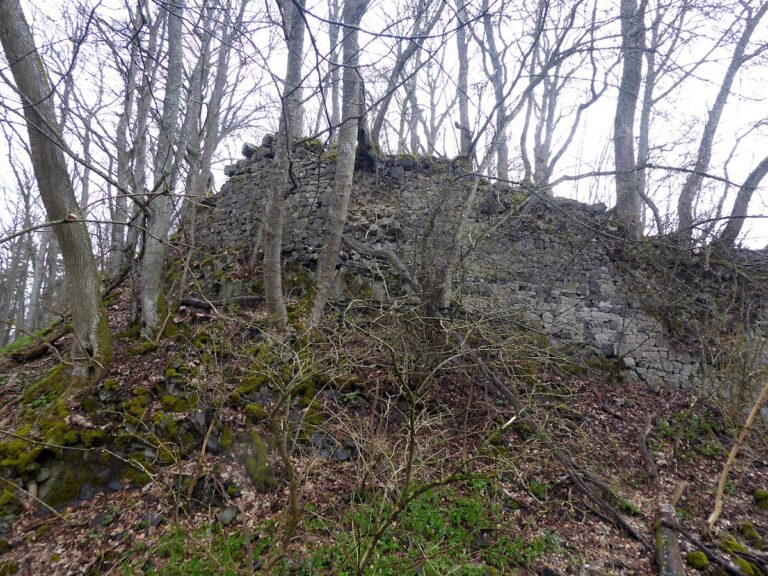
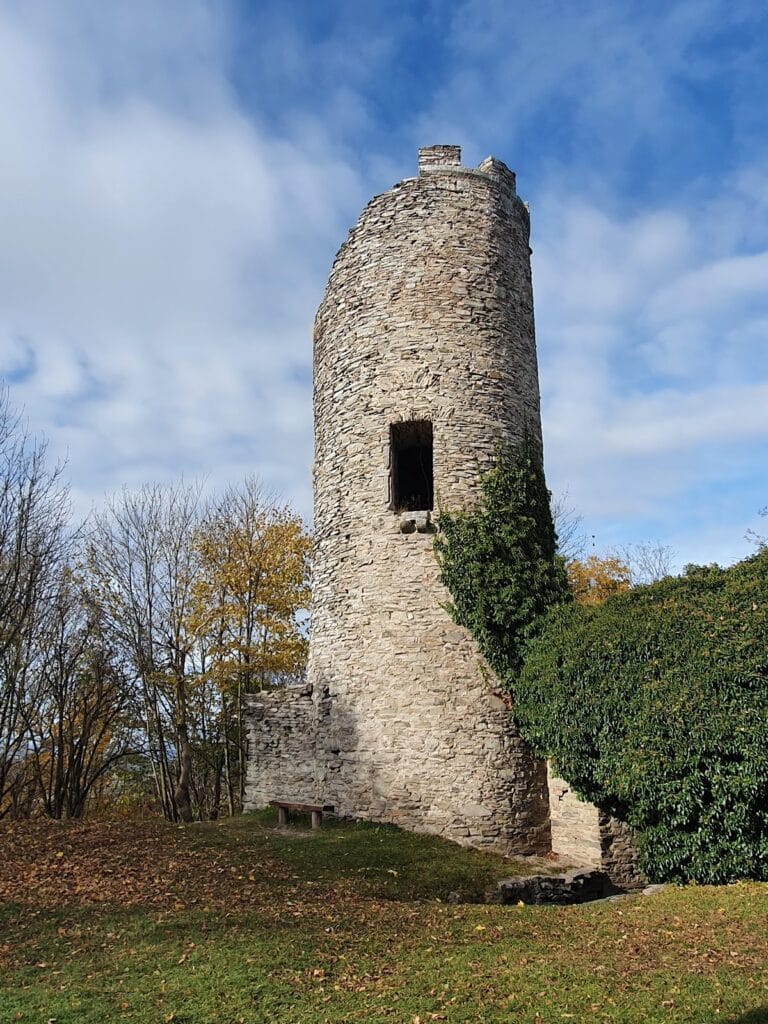
Auersburg survives as a polygonal hill-castle ruin on the forested southwestern slope of the Auersberg. The principal remains are the enclosing defensive wall, a remnant of a tower, an earth bank, and a ditch. The castle’s position on a forward slope shaped its compact defensive layout, while the destruction of the interior buildings in 1525, later demolition, and stone removal left the enclosure and limited cellar remains as the main evidence of the former complex.
Enclosure and Approach
The surviving enceinte, the enclosing defensive wall of a fortified complex, contains loopholes on the side facing the attack. On the eastern approach, a neck ditch cuts across the slope between the castle and the adjoining ground. Remnants of the associated bank and ditch remain visible. Only part of a tower survives on this approach side, and the castle probably never had a keep.
Interior and Conservation Features
A cellar is the principal surviving element of the interior buildings. The old vaulted cellar and the entrance were cleared and made accessible during nineteenth-century conservation work, together with access to the inner castle. A memorial to the Rhön poet Julius Türck stands within the castle grounds. The viewing tower erected in 1879 was replaced by a solid staircase, while the tower built in 1969 was reconstructed in 2007 and 2008.
Nearby sites