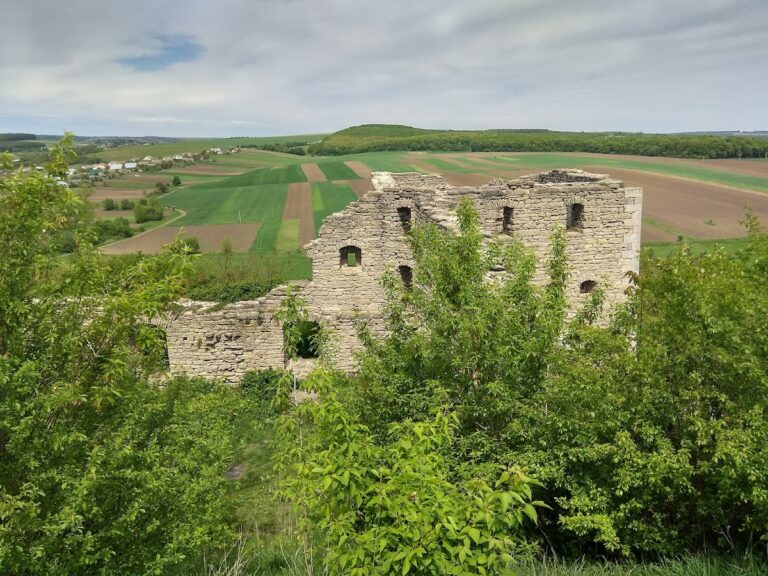
Potocki-Kossetsky Palace: An Eighteenth-Century Polish Manor in Ukraine
Site at a Glance
- Rating
- 3.4
- Popularity
- Very Low
- Country
- Ukraine
- Primary era
- Early Modern
- Eras represented
- Early Modern
- Civilizations
- Polish–Lithuanian Commonwealth
- Site type
- Domestic
- Remains
- Palace
On this page10 sections
History
Potocki-Kossetsky Palace is an eighteenth-century residence in Savintsi, Ukraine, built by the Polish nobleman Teodor Potocki in 1759 in the style of a traditional Polish manor. It replaced an older palace destroyed in 1703 and became the centre of a substantial estate with a large household, a Cossack guard, and choral ensembles at Savintsi and Smotrych.
Teodor Potocki and the Residence
Teodor Potocki was a Sejm ambassador, meaning a representative in the legislative assembly of the Polish-Lithuanian Commonwealth. He also belonged to the Bar Confederation, an eighteenth-century movement formed in 1768 against Russian influence and the policies of King Stanisław August Poniatowski. Potocki served as Voivode of Belz, a high-ranking territorial governor, and as a major-general of the Crown forces.
The palace underwent almost no rebuilding for roughly 150 years, until the First World War. Its rooms and grounds continued to support the life of the Potocki household, whose estate maintained a large court and several forms of cultural activity.
Royal Visit and Changes of Ownership
The palace included rooms prepared for King Stanisław August Poniatowski, the last king of the Polish-Lithuanian Commonwealth. He spent the night at Savintsi on 16 November 1781 while returning from Kamianets, and a marble plaque was placed in one of the palace walls to commemorate the visit.
After Teodor Potocki’s death, the estate passed to his son Adam Potocki and later to his grandson Juliusz Potocki, who lived from 1824 to 1903. The Franpil estate, which included Savintsi, was purchased at auction by Józef Kossecki around 1860. His son Franciszek sold Savintsi in 1895 to the Russian colonel Benckendorff. The Kosseckis had acquired old furniture with the estate, but removed it and transported it to their other properties rather than leaving it for the new owner.
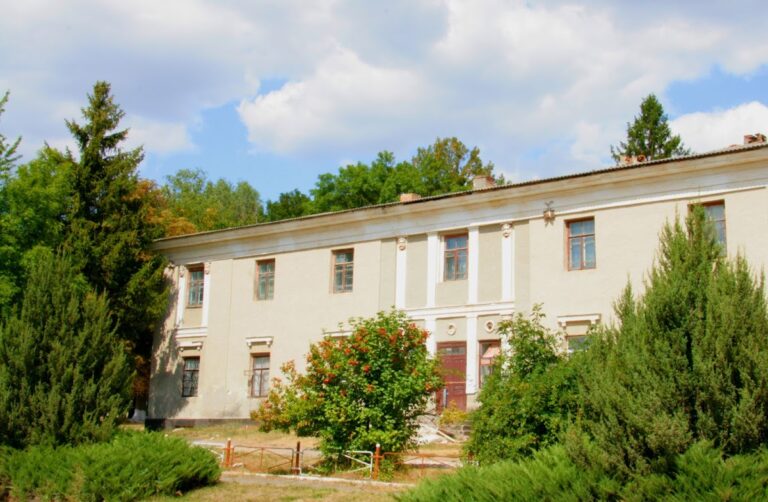
The palace is now used for other purposes as a school.
Remains
Palace Buildings
Main Residence
The residence followed the form of a traditional Polish manor and contained 25 rooms serving different purposes. The central section housed the owners and included reception halls. One salon had an antique oak parquet floor and a fireplace, while several rooms were known as the “royal” rooms because they had been furnished for the reception of Stanisław August Poniatowski.
Two salons were especially richly furnished, with brocade covering their walls. One contained paintings of Cupid and Samson, probably by Marcello Bacciarelli, an Italian-born painter associated with the Polish royal court. The palace also had a large theater hall. Rooms in the mansard, the upper storey partly enclosed within a steep roof, served as wardrobe and utility spaces.
Pavilions and Orangery
Guests were accommodated in two pavilions beside the main residence. Both pavilions survive, although they have been extensively rebuilt.
A two-storey orangery stood to the left of the palace. Its southern side was completely glazed. Such buildings were used to cultivate citrus and other plants that required protection from cold weather.
Park and Estate Boundary
Terraced Park and Underground Passage
Teodor Potocki ordered a 25-hectare park to be laid out around the palace. The grounds descended in terraces toward ponds. At the beginning of the park stood a stone figure of John of Nepomuk, a Bohemian Christian saint traditionally associated with bridges, waterways, and protection from floods.
An underground passage extended from the figure toward a neighboring forest. Its function remains unclear. The passage formed part of the designed landscape, whose terraces connected the palace grounds with the ponds below.
Wall and Entrance
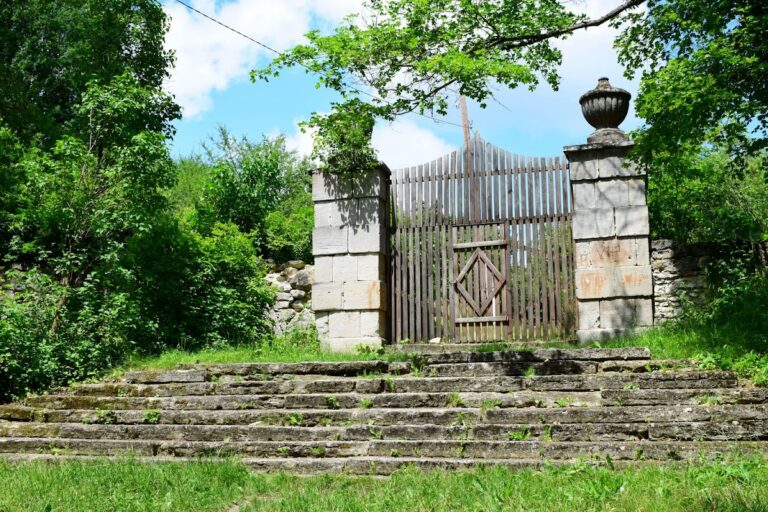
The estate was enclosed by a low wall. Its entrance gate was decorated with obelisks, but the gate has not survived.
Nearby sites