Zinkiv Castle: A Medieval Fortress in Ukraine


Site at a Glance
- Rating
- 4.5
- Popularity
- Low
- Country
- Ukraine
- Primary era
- Medieval
- Eras represented
- Medieval, Early Modern
- Civilizations
- Kingdom of Poland, Ottoman
- Site type
- Military
- Remains
- Castle
On this page9 sections
History
Zinkiv Castle in Ukraine stands at Zin’kiv in Khmelnytskyi Oblast. Associated with the Polish-Lithuanian Commonwealth and built as a medieval fortress in the mid-fifteenth century, it guarded a settlement on the former Black Route and protected its population from Tatar raids.
Grants and the Odrowąż family
The castle appears in written records among the oldest and largest fortresses of its kind. In 1404, it was granted to the nobleman Piotr Szafraniec. In 1430, King Władysław II Jagiełło granted it to Piotr Odrowąż in recognition of military service. The castle then became closely associated with the Odrowąż family.
In 1458, Andrzej Odrowąż, with the consent of King Kazimierz Jagiellończyk, granted Zinków Magdeburg rights. These medieval urban privileges, based on Magdeburg law, gave towns defined municipal institutions together with legal and economic freedoms. The grant also included tax concessions. By 1530, Zinków was a district town.
Sieges and wartime destruction
The fortress played a defensive role during the conflicts of the region. In December 1504, Moldavian forces led by Voivode Bogdan III besieged it for eight days. The siege ended after a relief force commanded by the cavalry officer Piotr Olecki and the brothers Szczęsny and Zygmunt Struś arrived. A clash beneath the castle routed the Moldavian army, which lost 300 men.
In 1524, a Tatar force of 12,000 burned the town and the surrounding area, but the castle resisted the attack without sustaining damage. Tatars were Turkic-speaking Muslim peoples whose armies repeatedly raided and campaigned across the borderlands of eastern Europe.
Ownership passed from the Odrowąż family to the Sieniawski family in 1594. The castle later suffered substantial destruction during the Cossack wars in 1651. Under the Treaty of Zboriv, Zinków became a border town between Podolia and Ukraine.
Ottoman rule and later ownership
By 1671, Zinków was described as completely ruined. Fragments of the town walls and the remains of two churches survived, while the castle stood abandoned. The town lay below the fortress beside the river, and a Tatar camp occupied the nearby area.
In 1672, the castle and the rest of Podolia came under Ottoman rule. The Ottoman Empire, an Islamic empire that ruled territories across southeastern Europe, Anatolia, and the eastern Mediterranean, strengthened the fortifications. Sieniawski recaptured the castle in 1673.
During the eighteenth century, Zinków belonged to the magnate families of Czartoryski and Sieniawski. In 1776, the property was described as a masonry fortress enclosed by a moat. In 1784, it belonged to Ludwig of Württemberg, and construction of a palace began as part of the estate. On 28 October that year, Maria Anna, the daughter of Adam Czartoryski, married Prince Ludwig of Württemberg and received Zinków and its surroundings as her dowry.
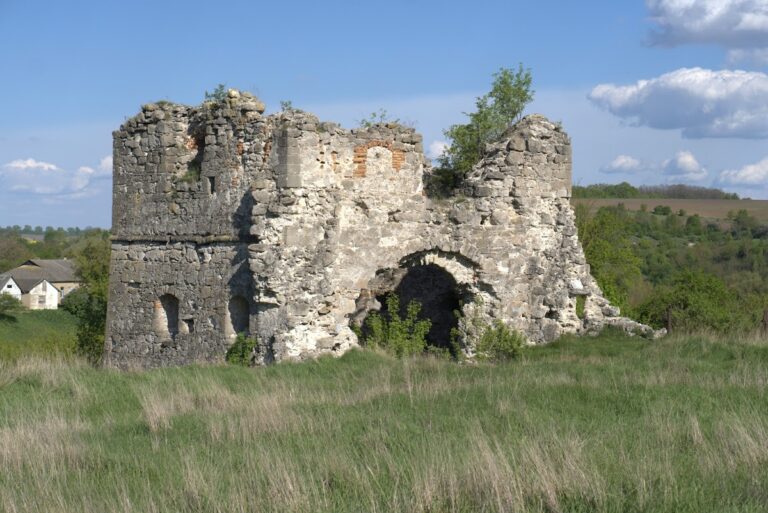
The castle was dismantled in 1898. Its surviving remains are limited to part of one tower.
Remains
The castle occupied elevated ground on a prominent hill on the left bank of the Uszka, a tributary of the Uszyca. A moat surrounded the fortress. In the seventeenth-century description, the stronghold had a four-sided plan with a tower at each corner and was regarded as well built and strongly fortified.
Fortress structures
Walls and corner towers
The main fortress formed a quadrilateral enclosure protected by four corner towers. Its masonry walls were decorated with the coats of arms of its owners, linking the physical appearance of the stronghold with the families who controlled it. The castle was later dismantled, and only the remains of one tower survive.
Gates and drawbridges
Two entrance gates provided access across the moat by means of drawbridges. One of the gates carried the coat of arms of the Sieniawski family. The gates, moat, and surrounding walls formed the principal defensive arrangement of the fortress.
Palace estate
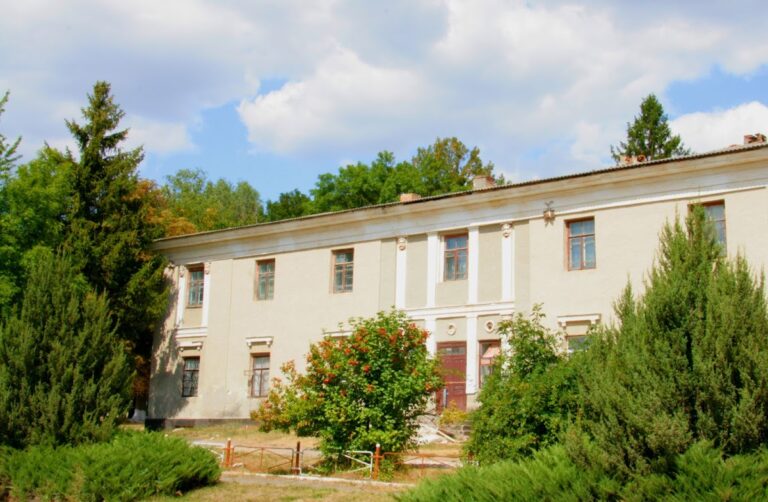
A palace was begun in 1784 in connection with the castle estate. It belonged to the later phase of the property, when the site was associated with Ludwig of Württemberg and the Czartoryski family through Maria Anna’s dowry.