Haughton Castle: A Medieval Tower House and Country Mansion

Site at a Glance
- Rating
- 4.8
- Popularity
- Very Low
- Country
- United Kingdom
- Primary era
- Medieval
- Eras represented
- Medieval, Modern
- Civilizations
- British, English
- Site type
- Domestic
- Remains
- Castle
On this page7 sections
History
Haughton Castle is a country mansion in the United Kingdom, on the west bank of the North Tyne north of Humshaugh and about 8.9 kilometres north of Hexham. It began in the 13th century as a tower house, a fortified residence centred on a substantial defensive tower, and was enlarged and strengthened during the 14th century.
Medieval origins and decline
During the 14th century, Haughton Castle belonged to Gerald Widdrington. The Widdrington family continued to own it into the early 14th century, while the Swinburn family lived there. Its position near the Anglo-Scottish border exposed the property to the activity of Border Reivers, raiding groups active in the region during the late medieval and early modern periods.
By the 16th century, the castle had deteriorated into a ruin and was attacked by Border Reivers. A survey made in 1541 reported that its roof and floors had decayed or disappeared. The Smith family acquired the property around 1640, but a further survey in 1715 still described the building as ruinous.
Transformation into a mansion
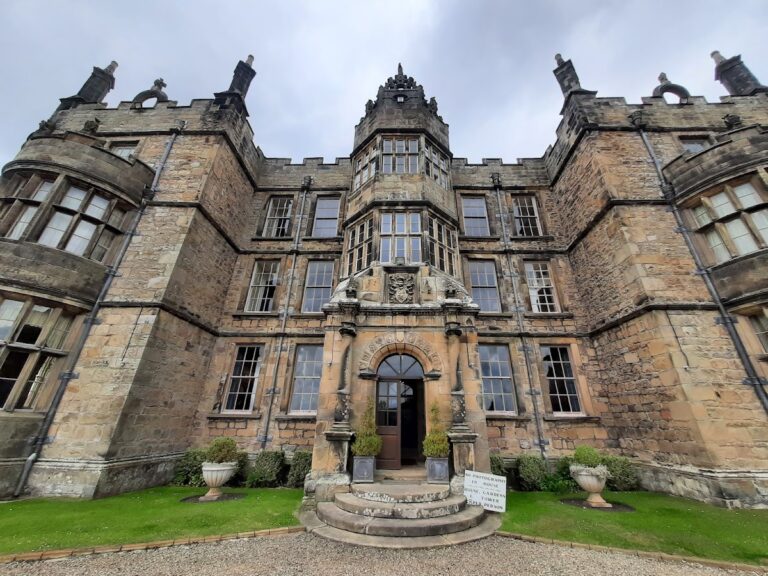
The Smith family commissioned major alterations between 1816 and 1845. Later work by the English architect John Dobson transformed the medieval ruin into a substantial country mansion. The Crawshaw family acquired Haughton Castle in 1862 and commissioned Anthony Salvin to add a west wing in 1876. The Cruddas family acquired the property in 1888.
Part of the castle served as a hospital during the Second World War. Haughton Castle is now owned by the Braithwaite family and has been a Grade I listed building since 20 October 1952. Grade I is the highest category of listed-building protection in England and applies to buildings of exceptional architectural or historic interest. Some commentators have suggested an association between the castle and the traditional song Waters of Tyne, but this identification remains unestablished.
Remains
Medieval core and later additions
Haughton Castle survives as an oblong tower house that was enlarged and fortified before its later conversion into a country mansion. Its earlier form belongs to the tradition of northern English fortified residences, while the completed building also reflects the substantial 19th-century remodelling carried out after the medieval structure had fallen into ruin.
Oblong tower house
The central building originated as a 13th-century tower house and was expanded and fortified in the 14th century. The roof and floors had decayed or vanished by the time of the 1541 survey, and the structure remained ruinous in 1715. The 19th-century alterations incorporated the surviving medieval building into the mansion. Haughton Castle is also described as one of the best-preserved traditional hall houses in northern England, a form of residence organised around a principal communal hall.
West wing
Anthony Salvin added the west wing in 1876 for the Crawshaw family. This extension forms part of the country mansion created through the 19th-century rebuilding of the earlier tower house and its associated structures.