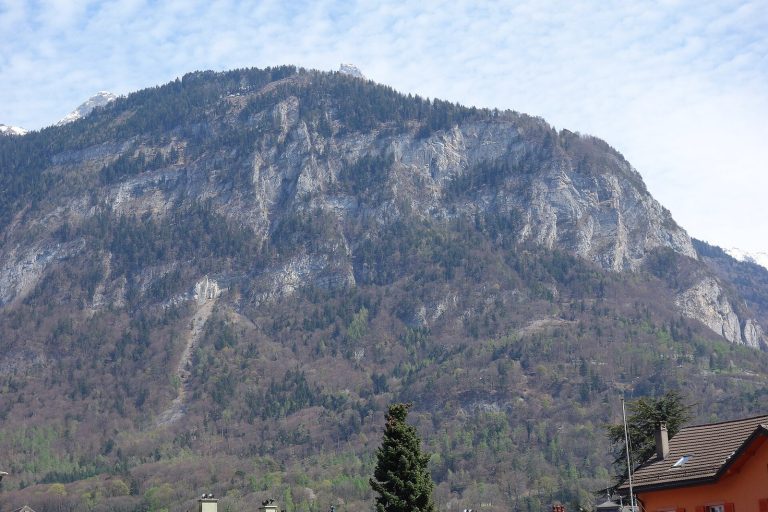
Artilleriewerk Commeire: A Swiss Mountain Artillery Fortification


Site at a Glance
- Rating
- 4.6
- Popularity
- Very Low
- Country
- Switzerland
- Primary era
- Modern
- Eras represented
- Modern
- Civilizations
- Swiss
- Site type
- Military
- Remains
- Fort
On this page8 sections
History
Artilleriewerk Commeire is a former Swiss artillery fortification beneath the village of Commeire in the municipality of Orsières, Valais, Switzerland. Built in the Saint-Maurice fortress area during the Second World War, it occupied a mountainside at about 1,300 metres and was intended to block the eastern Val de Bagnes while protecting the Great St Bernard Pass, the Alpine route linking the Swiss and Italian regions.
Planning and construction
The Swiss Army designated the work A 27. Plans for Commeire and the nearby Artilleriewerk Champex were prepared in 1930, along with a third proposed fortification at Roc Cornet northwest of Liddes. Roc Cornet was never constructed. Mountain Brigade 10 designed Commeire with four positions for 7.5 cm guns.
Construction began in August 1940 and continued until September 1943, when the completed work was handed over to the troops. The guns were installed in May 1944, while the camouflage was finished in 1947. The original armament consisted of four 7.5 cm Krupp Model 1903 field guns, with ranges between 6.5 and 11.5 kilometres.
Military role and organization
The four guns were arranged in two batteries, each with its own fire-control post. Two positions directed their fire toward the Great St Bernard Pass and could reach as far as the entrance to the present tunnel. The other two covered the direction of Champex, the lower Val Ferret, and the Orsières basin.
Fortress Company II/22 garrisoned Commeire. Together with Fortress Company I/22 at Champex, it formed part of Fortress Detachment 22 and Fortress Regiment 19, Swiss formations organized for mountain and fortress defense. Champex held the detachment’s fire-control and command posts, allowing artillery fire from the regional works at Champex, Commeire, Follatères, and Dailly to be coordinated.
Cold War changes and decommissioning
Commeire continued to be modernized during the Cold War. Filters were installed in 1950, and the safety systems serving the ammunition magazines were improved. In 1957, the fortification was adapted for use in a nuclear war, reflecting the changing conditions of Swiss military planning.
Commeire was disarmed in the early 1970s and subsequently used as mountain accommodation. Its former artillery role was taken over by the newly built A 400 “Napoleon” monoblock, a compact reinforced-concrete military structure containing the main elements of a fortification within one hardened block. The new installation was equipped with the 12 cm Fortress Mortar 1959, a heavy fixed mortar designed for a permanent military emplacement.
In 1999, the work was released from military secrecy, decommissioned, and transferred to the association Pro Forteresse. Since 2010, the association has sought to acquire the “Napoleon” mortar as military cultural heritage. The Swiss Federal Department of Defence, Civil Protection and Sport halted the decommissioning of the 12 cm fortress mortars in 2014, and the weapons remain subject to military secrecy. Commeire itself remains largely in its original physical condition apart from its guns.
Remains
Artilleriewerk Commeire is an extensive underground fortification built around a network of protected tunnels. The system contains four gun positions, three observation posts, a machine room with engines, generators, and filters, an ammunition cavern, material rooms, four accommodation sections, and a water reservoir. A central tunnel connects the various caverns, while two entrances and six emergency exits provided access to the installation.
Living and service spaces
The four accommodation sections were arranged for a wartime garrison of approximately 140 personnel. They included dormitories, kitchens, canteens, and operating rooms. The machine room housed the equipment needed to operate the underground complex, including engines, generators, and filtration systems. Together with the ammunition cavern, material rooms, and reservoir, these spaces formed the logistical infrastructure supporting the artillery positions.
Gun and observation positions
The four gun positions were distributed according to the sectors they covered. Two faced toward the Great St Bernard Pass, while two others were directed toward Champex, the lower Val Ferret, and the Orsières basin. The installation also contained three observation posts, which formed part of the system used to control and direct artillery fire. The surviving spaces retain the arrangement of the former artillery work, although its original guns are no longer in place. A gun could be reinstalled in Gun Position 2.
Camouflaged entrances and embrasures
Gun and observation embrasures, together with the emergency exits, were concealed as rural buildings or natural features. Some were shaped to resemble alpine huts made of concrete and wood, while others were disguised as rock formations. The two gun positions facing the Great St Bernard Pass used the alpine-hut camouflage, and the two positions covering the other sectors were made to appear as rocks. Apart from the removed guns, the fortification survives in largely original condition.