Mehovo Castle: A Medieval Frontier Stronghold in Slovenia


Site at a Glance
- Rating
- 4.6
- Popularity
- Very Low
- Country
- Slovenia
- Primary era
- Medieval
- Eras represented
- Medieval
- Civilizations
- Holy Roman Empire
- Site type
- Military
- Remains
- Castle
On this page8 sections
History
Mehovo Castle is a medieval hill castle in Slovenia, situated above the village of Podgrad. First mentioned in 1161 and already built before 1162, it was regarded as one of the largest, most powerful, and oldest castles in Carniola, the historical territory in the eastern Alps that formed part of the medieval and early-modern Habsburg lands. Its foundation may have been connected with Hemma of Gurk, an eleventh-century noblewoman and founder of religious institutions, although this attribution remains uncertain.
The Counts of Weichselberg
The castle’s first documented owner was Hartwig, recorded as Hartwic de Micho in a charter of 1162. His exact status is unclear. He may have been a ministerial, a service noble who held office or property for a higher lord, or an early ancestor of the Counts of Weichselberg. That noble family held Mehovo until 1209 and used it as a base for campaigns toward Hungary and Croatia. The castle later became the administrative centre of territories conquered during these operations, and Črnomelj remained subordinate to it in 1277.
Mehovo occupied a frontier position during the rule of the Counts of Weichselberg. Forces drawn from Mehovo and nearby castles, including Kronovo, Čretež, Mirna, Hmeljnik, Prežek, Mokro Polje, and Litija, advanced south toward the Kolpa River. Their campaigns extended Carniola across the Gorjanci into the region now known as Bela krajina, but attempts to move beyond the Kolpa into Croatia failed and the forces were driven back. From about 1200, the Kolpa marked the boundary between Croatia and Carniola from the Gottschee forests to the foothills of the Gorjanci.
A late-twelfth-century charter, partly regarded as falsified, describes Stephan Ursin, son of Nikolo and a relative of the Counts of Gorizia, defeating Albert of Maichau, understood as Albert of Weichselberg. The episode took place during the reign of Béla III of Hungary and Croatia, from 1173 to 1196, and was associated with an attack on the Hungarian borderlands.
Changing dynastic control
After Albert of Weichselberg’s death, much of his property passed through the marriage of his daughter Sophie to Heinrich of Andechs, Margrave of Istria. The Andechs family held Mehovo until 1228. Frederick II of Babenberg, Duke of Austria, controlled it until 1246, followed by the Spanheims until 1269. In 1277, Rudolph of Habsburg pledged the castle to Albert, Count of Gorizia-Tyrol. Mehovo later passed to the Counts of Cilli and, after the death of the last Cilli count in 1456, to the Habsburgs under an inheritance agreement.
The castle continued to be administered and pledged to successive holders. Ludwig von Kosiack became administrator in 1472, followed by Caspar von Khreig in 1490. Balthasar von Mündorff held it as pledge-holder in the early sixteenth century, and Hermann Püchler controlled it from 1540 to 1548. Ivan Lenković, commander-in-chief of the Military Frontier, became an owner in 1549. The Military Frontier was a Habsburg defensive zone along the Ottoman frontier, where military command and administration were closely connected. Lenković’s grandson Georg, also provincial governor of Carniola, owned Mehovo in 1587.
Later owners included Karl von Jurić in 1603 and Baron Ernst von Paradeiser in 1619. Paradeiser was captain of Senj and Žumberak. His sons subsequently held the castle: Johann Ernst was captain of Žumberak until his death in 1688, while Georg Siegmund was captain of Otočec in 1675.
Frontier warfare and the 1515 revolt
From the early fifteenth century, Turkish incursions repeatedly affected the area around Mehovo. The castle served as both a military stronghold and a station in a warning network. Fires were lit at designated points, and mounted messengers carried reports from Mehovo to Hmeljnik, Sv. Peter near Žužemberk, Primskovo, Višnja Gora, Magdalenska Gora near Šmarje, and finally Ljubljana Castle.
During the Windisch Peasant Revolt of 1515, peasants gathered in Novo mesto on 14 May and marched on Mehovo under the leadership of a servant of the Mündorff family. The castle had been left negligently unguarded, allowing the rebels to capture it. The two Mündorff brothers and Caspar Wernegkh were beheaded, while Balthasar Mündorff’s two sons were strangled. His wife Martha was dressed in peasant clothing and forced to work in the fields, and an old woman took away the young daughter.
Later accounts may have confused Mehovo with Brežice. Marko of Clissa, commissioned by the estates of Carniola to seek Croatian assistance against the rebels, is said to have taken refuge at Brežice rather than Mehovo. The same account states that, before leaving, he had about 500 Carniolan peasant women and children rounded up and sold in Croatia. The events later entered Slovenian literature. Anton Aškerc treated them in the 1888 ballad Tlaka – Frondienst, while Janez Trdina presented his version of the events of 17 May 1515 in Sprehod v Belo krajino, published in 1912.
Abandonment
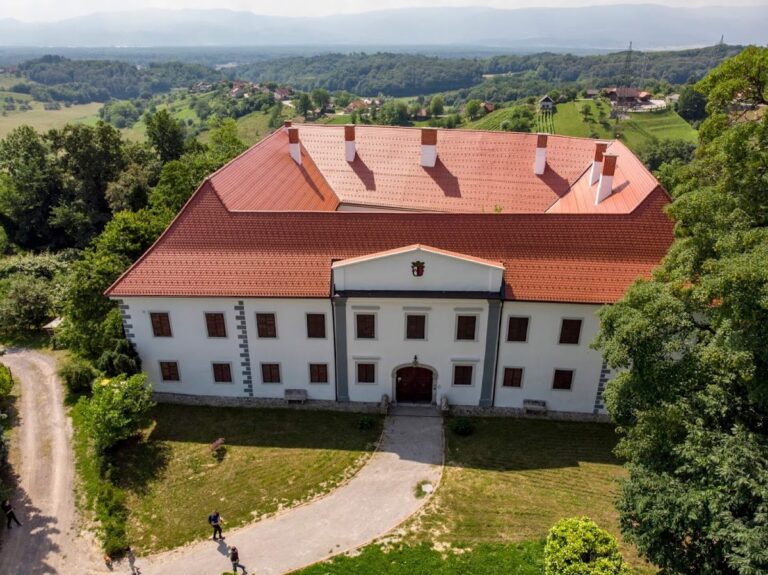
Mehovo lost its strategic importance by the later seventeenth century. Its owners abandoned the hilltop castle and constructed the more convenient Ruperčvrh, also called Ruprechtshof, on level ground about five kilometres to the northwest. Masonry from Mehovo was reused in the new building, linking the later castle physically with the dismantled frontier stronghold.
Remains
Hilltop setting and castle site
Mehovo stood on a conical hill above Podgrad, approximately eleven kilometres south of Novo mesto and nearly two kilometres west of the junction where the road crosses the Gorjanci toward Metlika. Its elevated position overlooks much of Lower Carniola to the north, while the view extends westward toward the Kamnik Alps. The Gorjanci block views toward Metlika, Bela krajina, and Croatia. The former hill castle now survives as a castle site with sparse ruins, and no dimensions or detailed plan are available.
Historical representation and reused masonry
A copper engraving by Johann Weikhard von Valvasor, dated 1679, preserves a historical representation of Mehovo Castle’s appearance. The castle’s physical remains were also dispersed through later building activity, since masonry from the abandoned site was incorporated into Ruperčvrh Castle roughly five kilometres to the northwest.
Nearby sites