Fort de Dailly: A Swiss Underground Artillery Fortress


Site at a Glance
- Rating
- 4.9
- Popularity
- Very Low
- Country
- Switzerland
- Primary era
- Modern
- External website
- Open
- Eras represented
- Modern
- Civilizations
- Swiss
- Site type
- Military
- Remains
- Fort
On this page23 sections
History
Fort de Dailly is a Swiss underground artillery fortress begun in 1892 above the Rhone valley as part of Fortress Saint-Maurice. It became operational in 1894 and guarded an important route between France and Italy, as well as the western entrance to the Swiss National Redoubt, a twentieth-century defense strategy that concentrated fortifications in the Alps and at key approaches.
Foundation and early development
The Dailly, Savatan, and Dailly-Aiguille positions formed the principal artillery complex on the heights above Saint-Maurice. Dailly and Aiguille protected the lower Fort de Savatan, supported it with artillery, and controlled fortified positions on the same side of the Rhone valley. Fort Cindey and Fort du Scex, on the opposite side, supplied flanking support.
Between 1892 and 1910, the complex developed into a fortress with 34 guns and more than 15 underground barracks. Its defenses combined open artillery positions, rock-cut galleries, concrete and steel construction, command and observation posts, infantry shelters, trenches, telephone lines, roads, water-supply installations, food magazines, bakeries, baths, and drying rooms. This sequence preserved the changing methods of Swiss fortress construction, from exposed guns to armored weapons protected within the mountain.
Expansion before and after the First World War
Between 1895 and 1903, Dailly received positions for 12 cm Model 1891 armored howitzers, including Battery O6. These weapons could traverse through 360 degrees and had a range of approximately 5.9 to 7 kilometers. More underground barracks, command posts, observation posts, shelters, magazines, bakeries, baths, and drying rooms were added during the same phase.
From 1904 to 1910, exposed positions were progressively replaced by covered positions, concrete works, and armored casemates, fortified chambers from which guns fired through protected openings. The Golèze and Aiguille batteries belonged to this phase. Independent electric power stations using alcohol fuel allowed the forts to operate without the civilian power network during an emergency, while searchlights were introduced for battlefield illumination.
Construction and reinforcement continued from 1911 to 1920. Four 10.5 cm field-howitzer batteries were established at Observatoire, Righi, Plan, and Rossignol. The wider system also included a 7.5 cm gun on Dent de Morcles, a position for mobile 5.3 cm armored turrets at Evionnaz, and additional work at Fort du Scex, including a medical station and a cableway.
After the First World War, the older 10.5 cm guns at Dailly and the 15 cm mortars at Aiguille were removed. By 1928, four 12 cm armored howitzers at Savatan and one 12 cm howitzer in Dailly’s O6 battery remained operational. A second Model 1891 armored howitzer, Battery O5, was added in the mid-1930s.
Second World War and the 1946 disaster
During the Second World War, two 10.5 cm Model 1939 L/52 guns were installed in armored turrets at Battery Planaux in 1940. Their range was approximately 20 to 24 kilometers, and each could traverse through 360 degrees. Up to ten 10.5 cm field guns were also placed in rock casemates at Dailly Nord.
On 28 May 1946, three ammunition magazines exploded one after another. About 449 tonnes of ammunition, including approximately 5,500 105 mm shells, were involved. Ten workers died, largely from gas poisoning, while the 286 soldiers present at the fort survived because they were outside the installation. The explosions caused extensive destruction and led to an almost complete reconstruction beginning in 1948.
Reconstruction and Cold War modernization
The rebuilding program also brought comprehensive modernization. Obsolete weapons were removed, new 81 mm and 120 mm fortress mortars were installed, and the surviving 105 mm batteries were repaired and upgraded. Two modern 150 mm gun turrets were added. Their design began in 1949, and the first test firings took place in 1960.
During the Cold War, Dailly received two 15 cm L/42 1958 automatic gun turrets, designated T1 and T2. They were the only two turrets of this type ever built and served from 1962 until 1994. Their heavy artillery role was later replaced by a Bison battery, a Swiss protected artillery system, and the 12 cm fortress-mortar installation Rosseline A 404. Fortress mortars were short-barreled weapons designed to fire shells on a high trajectory from protected positions.
The fort was operated by Fortress Brigade 10, formerly Mountain Brigade 10. Dailly and Savatan formed Fortress Group 2 within Fortress Regiment 19. In 1995, the Dailly garrison comprised 29 officers, 101 non-commissioned officers, and 485 soldiers, organized into a fort command, an infantry company for external defense, an artillery company, and a service company responsible for operations and logistics.
Decommissioning and later military use
The artillery role ended in 1995, although the installation continued to support training. Fort de Dailly was fully decommissioned at the end of 2003. From 2007, its infrastructure and headquarters training operated under Infra/HQ S 35 and the Centre of Competence Infrastructure Defence Dailly. That training was later combined with mechanized artillery training at Biere, and the last shot fired by the remaining fortress artillery unit took place in 2011.
The Dailly training ground closed at the end of 2017, followed by the army’s withdrawal. Military training resumed in early 2020, initially under Military Police Recruit School 19. In mid-2022, the barracks were assigned to infantry security soldiers, while the military police moved to Sion.
Fort de Dailly and the other Saint-Maurice works were designated military-historical heritage of national importance. Public tours began in April 2014, but civilian visits ended in October 2021 after the site returned to military training. Since May 2022, visits to the Planaux section have been offered by CIPAD.
Remains
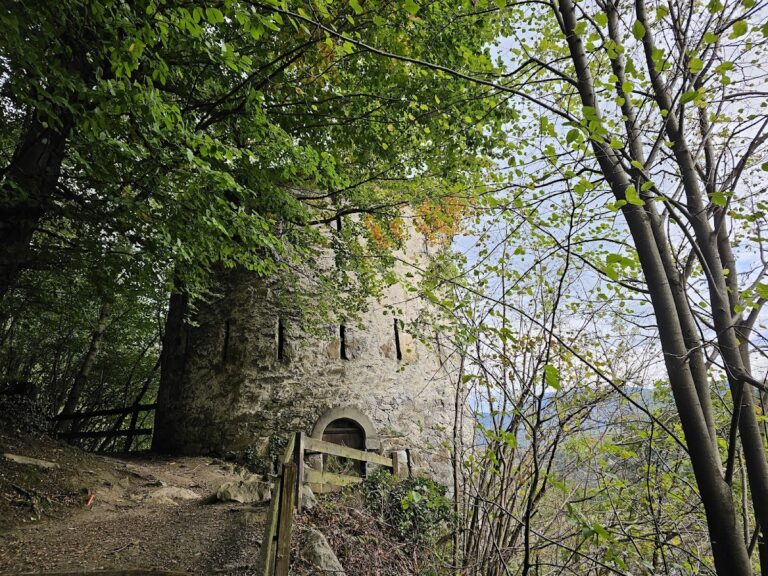
Fort de Dailly is an almost entirely subterranean artillery system cut into rock in the Dailly massif above the Rhone valley, on the territory of Lavey-Morcles in the canton of Vaud. It occupies the higher terrace on the southwestern side of L’Aiguille, approximately 1,250 to 1,400 metres above sea level. The entrance lies at about 1,400 metres, while the main fort connects with higher positions reaching approximately 1,500 metres. Across the wider Savatan-Dailly-Aiguille complex, galleries extend for nearly 25 kilometres between barracks, command posts, ammunition magazines, and guns in turrets and casemates.
Early artillery positions
Righi batteries
By the end of 1894, the Righi sector contained six 120 mm Krupp guns on Saint-Chamond disappearing mounts. A disappearing mount lowered the gun behind protective cover after firing. The weapons were installed on rails in a trench and organized as Batteries E1, E2, and E3. They had a range of approximately 9 to 10.5 kilometres and were accompanied by gun shelters and ammunition magazines.
Batterie de Morcles
The Batterie de Morcles provided southern flank defense with two 8.4 cm casemate guns. External defenses included infantry lines, firing galleries, entrenchments, steep-sided ditches, two 5.3 cm rapid-fire guns on rails or transport carriages, observation posts, underground telephone connections, roads, paths, and water-supply facilities.
Dailly-Aiguille positions
Dailly-Aiguille contained Switzerland’s only 15 cm Model 1877 position gun, placed in Battery M15. It had a stated range of 3 kilometers and a 360-degree traverse. Battery Rossignol held two 10.5 cm position-artillery guns, while a small turret contained two 15 cm Model 1881 breech-loading mortars.
Covered batteries and wartime artillery
O5 and O6 batteries
The positions for 12 cm Model 1891 armored howitzers included Battery O6, built during the expansion from 1895 to 1903, and Battery O5, added in the mid-1930s. The howitzers were protected within the fortress and could traverse through 360 degrees. O6 remained in use with one 12 cm howitzer after the older weapons were removed following the First World War.
Planaux battery
Battery Planaux contains two 10.5 cm Model 1939 L/52 guns in armored turrets. Installed in 1940, they had a range of approximately 20 to 24 kilometres and a 360-degree traverse. The later Planaux area also includes the T2 15 cm turret, an ammunition magazine, a battery fire-control station, accommodation, and the two 10.5 cm turrets known as Saint-Maurice and Sainte-Barbe.
Dailly Nord and Rosseline
After the 1946 explosion, the four guns of the southern Plex battery were thrown from their emplacements and six other guns were damaged. The 120 mm guns of Battery C10 also suffered damage. The four northern 105 mm guns and two Rosseline guns were repaired and upgraded. The southern battery was not replaced because its rock cover was considered inadequate, and Battery Dailly Nord took over its role. Dailly Nord remained operational until the end of 2003.
Cold War installations
T1 and T2 gun turrets
The two 15 cm L/42 1958 automatic gun turrets were installed on barbettes, supporting platforms or shafts on which turrets are mounted, approximately 50 metres deep. Their range approached 24 kilometres. Their firing rate was stated as 22 rounds per minute in bursts or 15 rounds per minute for sustained fire. T1 occupied the former E3 mobile 120 mm position at about 1,300 metres, while T2 stood on the Rosseline heights near Battery Planaux.
Mortar and protected barracks
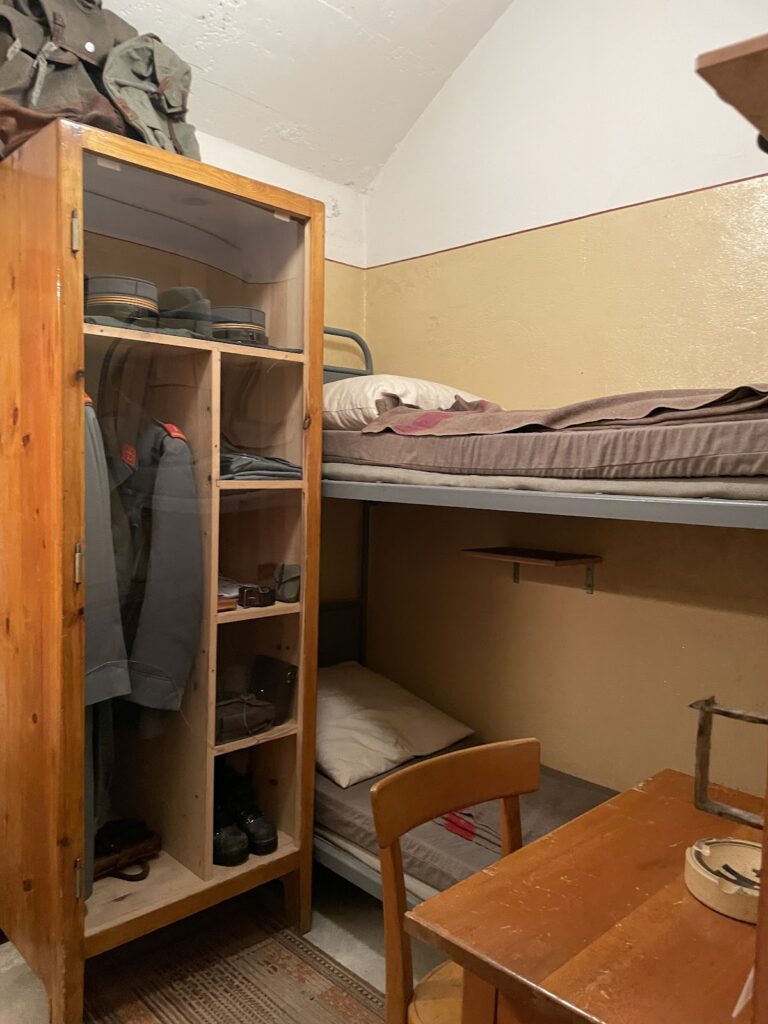
Additional postwar works included two completely buried 81 mm fortress-mortar positions at the summit and a twin 120 mm mortar battery installed during the 1960s. The complex also contained an underground barracks for approximately 650 men, with protection against nuclear, biological, and chemical hazards. In 1995, the armament included the T1 and T2 turrets, the Planaux guns, four 10.5 cm guns in the Rossignol gallery and the two Dailly Nord batteries, one 12 cm fortress mortar, four 8.1 cm fortress mortars, one 9 cm antitank gun, 17 fortress machine guns, four 8.1 cm mortars of the 1933 type, and four 1951 machine guns. Planaux also contained the 12 cm twin fortress-mortar bunker, type F A 404.
Underground transport and connected areas
Savatan-Dailly funicular
A 560-metre underground funicular, opened in 1946, connects Savatan supérieur at 868 metres with Fort Dailly at 1,256 metres. It rises 388 metres at a gradient of 102 percent, includes a passing point, and is driven from the upper station. The former military railway also carried electricity and telephone connections from Savatan to Dailly, while Dailly supplied Savatan with water. Since 2008, the funicular has been restricted to installation and tunnel inspections.
Upper inclined railway
A second inclined railway, 66 metres long, opened in 1962 between the Dailly artillery works at 1,256 metres and the T1 turret at approximately 1,306 metres. It carried personnel to the turret. After declassification in 1995, it provided access to the fort’s ventilation system until its closure in 2012.
Entrance and Rossignol areas
The former tour route linked two lift-connected areas. The entrance area contained the T1 turret, an ammunition magazine, a battery fire-control station, and the upper station of the Savatan-Dailly funicular. The Rossignol gallery contained the two Dailly Nord batteries, a 10.5 cm gun, an ammunition magazine, a battery fire-control station, a historical museum, and a photographic exhibition concerning the 1946 explosion.
Planaux section
The Planaux section includes the T2 turret, an ammunition magazine, a battery fire-control station, accommodation, the Saint-Maurice and Sainte-Barbe 10.5 cm turrets, and the A 404 twin 12 cm fortress-mortar bunker. Together, these features preserve the transition from early exposed and rail-mounted artillery to deeply buried, armored weapons and protected Cold War infrastructure.