Laxton Castle: A Norman Motte-and-Bailey Stronghold in England
Site at a Glance
- Rating
- 3.9
- Popularity
- Very Low
- Country
- United Kingdom
- Primary era
- Medieval
- Eras represented
- Medieval, Early Modern
- Civilizations
- English, Norman
- Site type
- Military
- Remains
- Castle
On this page8 sections
History
Laxton Castle is a late 11th- or early 12th-century Norman medieval castle in England, north of Laxton village in Nottinghamshire. Its first motte-and-bailey castle appears to have been built soon after the Norman Conquest, the invasion and conquest of England by William, Duke of Normandy, in 1066. The castle formed part of the wider Norman programme of territorial control and assertion of authority.
Norman foundation and development
Geoffrey Alselin received the property in 1066, and he may have ordered the initial construction. A more likely patron was his son-in-law, Robert de Caux, who used Laxton as his seat after Alselin’s death. A second phase of construction may have followed Robert’s appointment as Hereditary Keeper of the Royal Forests of Nottingham and Derbyshire, an office concerned with administering and protecting royal forest lands and enforcing forest law.
King John seized the castle in 1204 and held it for several years. The extent of the changes made during or after this period is unknown. In 1230, the property and its title passed to the Everingham family. They lost the title in 1286 and moved to estates in Yorkshire because Laxton could no longer support them adequately. The castle then declined into disrepair.
Later ownership and changing use
The Roos family acquired Laxton in 1408. By the 16th century, the medieval castle was already ruinous, and the family built Laxton Hall, a three-gabled brick manor house, on the same property. Ownership changed frequently during the 17th and 18th centuries. In 1788, the estate passed to Charles Pierrepont, 1st Earl Manvers, an English aristocrat, whose family retained it until selling it to the Ministry of Agriculture in 1952. The Crown Estate Commissioners purchased the property in 1981.
An early 20th-century assessment by the British Archaeological Association described Laxton Castle as an exceptionally striking local example of a motte-and-bailey stronghold and valued its courts as being in nearly perfect condition for archaeological study. Archaeologists from the universities of Birmingham and Nottingham have examined the surviving earthworks and masonry ruins since 2003.
Remains
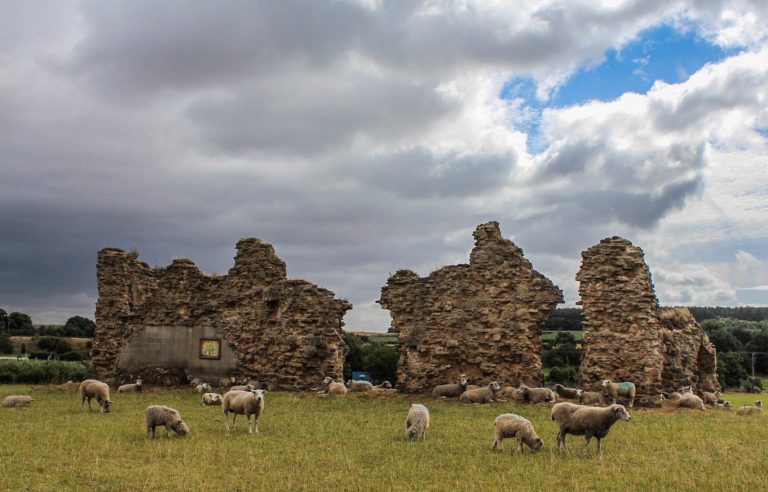
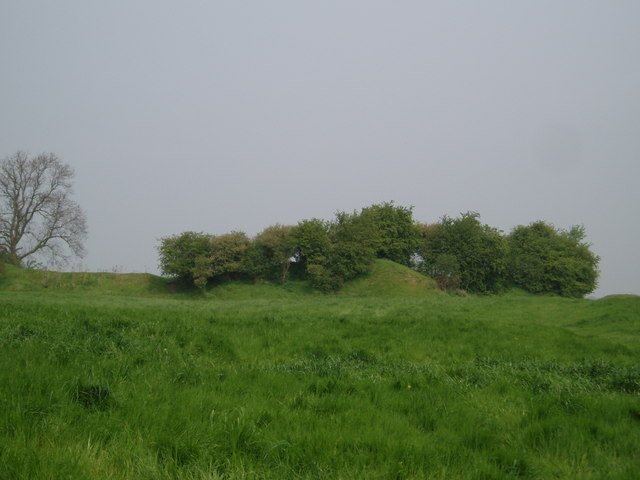
Laxton Castle survives as a substantial motte-and-bailey earthwork stronghold with a raised motte, an inner or base court, and a large outer court. Its layout combines earthworks with surviving masonry ruins. The inner bailey has the form associated with smaller Norman earthwork castles, while the scale of the outer court and the strength of the defences give the site an extensive physical plan.
Earthwork layout and defences
Keep-mount
The keep-mount, or motte, stood at the northern edge of the site beside a steep natural escarpment. This raised earthwork formed the principal elevated defensive position within the castle. Its placement beside the escarpment was one of the features emphasized in the early 20th-century assessment of the site.
Courts and approach routes
The inner, or base, court was enclosed by substantial and formidable earthworks. Beyond it lay a large outer court, whose scale is a defining feature of the surviving remains. Guarded trackways approached the castle, providing controlled routes through its defences. Together, the courts, earthworks, escarpment, and approach routes show how the stronghold was organized across the site.
Masonry remains and later buildings
Masonry ruins survive alongside the earthworks. Laxton Hall, the later three-gabled brick manor house built after the medieval castle had become ruinous, also occupied the property. The surviving medieval remains and the later hall therefore represent successive uses of the same estate, with the castle preserved chiefly through its earthworks and fragmentary masonry.