Burg Kapfenstein: A Medieval Hilltop Castle in Switzerland


Site at a Glance
- Rating
- 4.8
- Popularity
- Very Low
- Country
- Switzerland
- Primary era
- Medieval
- Eras represented
- Medieval
- Civilizations
- Holy Roman Empire
- Site type
- Military
- Remains
- Castle
On this page7 sections
History
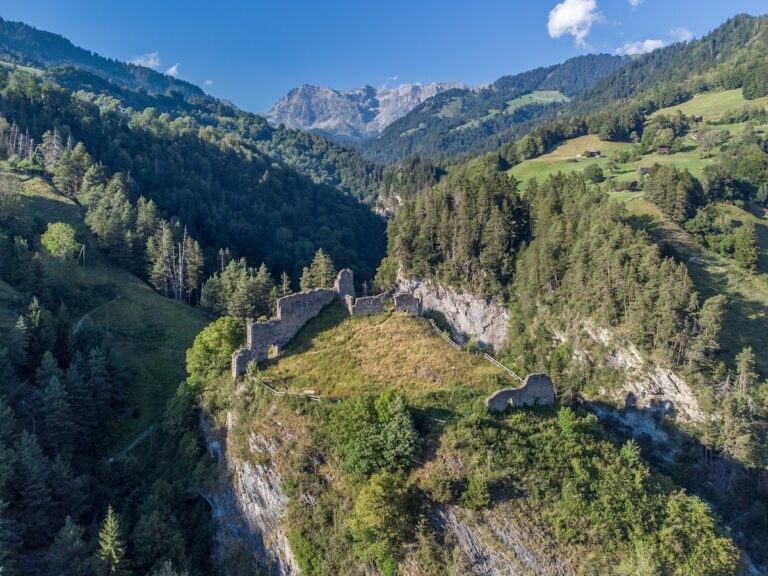
Burg Kapfenstein, also known as Ober-Sansch, is a medieval hilltop castle in Switzerland, above Küblis in the canton of Graubünden. It was probably established by the thirteenth century and was first recorded in 1275. The castle was associated with several noble families and with the territorial interests of the Bishopric of Chur, an ecclesiastical principality whose bishop also held political rights and controlled castles and estates.
The Lords of Kapfenstein
The Lords of Kapfenstein appear in records from the thirteenth century. In 1249, Ulricus de Kaphinstain acted as an arbitrator in a dispute with the Bishop of Chur concerning Gräpplang Castle near Flums. Heinrich of Kapfenstein was recorded as deceased in 1275. That year, Walter von Vaz excluded Kapfenstein and the County of Schams from a conditional transfer of his possessions to the Bishopric of Chur. He had obtained the castle through an exchange with the deceased Heinrich. A reference from 1365 to a field at Kapfenstein suggests that the Kapfenstein family had ceased to exist by that time.
Fiefs and Toggenburg ownership
After the period of Kapfenstein family ownership, the castle was granted as a fief to the Straiff family. A fief was property or a right held from a superior lord in return for allegiance and related obligations. In 1351, the children of the deceased Simon Straiff surrendered their rights to Kapfenstein and its two associated structures to Count Friedrich of Toggenburg and his wife, Ursula von Vaz, receiving 40 marks in compensation. Anton von Castelmur also recorded a transaction in which Andreas von Marmels and Ulrich Manus von Castelmur allegedly sold the castle on 1 April 1351 to Countess Kunigunde of Toggenburg on behalf of Simon Straiff’s heirs. The precise relationship between these transactions is uncertain.
In 1352, Simon Straiff’s son Johannes confirmed that the Toggenburgs had compensated him for expenses and losses connected with the castle and with his late father’s involvement there. Kapfenstein passed to Count Friedrich VII of Toggenburg during the division of the Toggenburg inheritance in 1394. The castle was probably abandoned during the fifteenth century.
Excavation and stabilization
The Canton of Graubünden stabilized the ruins between 1982 and 1984. In 1998, the Swiss Castle Association carried out maintenance work and prepared measured plans. These interventions helped preserve the surviving remains of the medieval fortification.
Remains
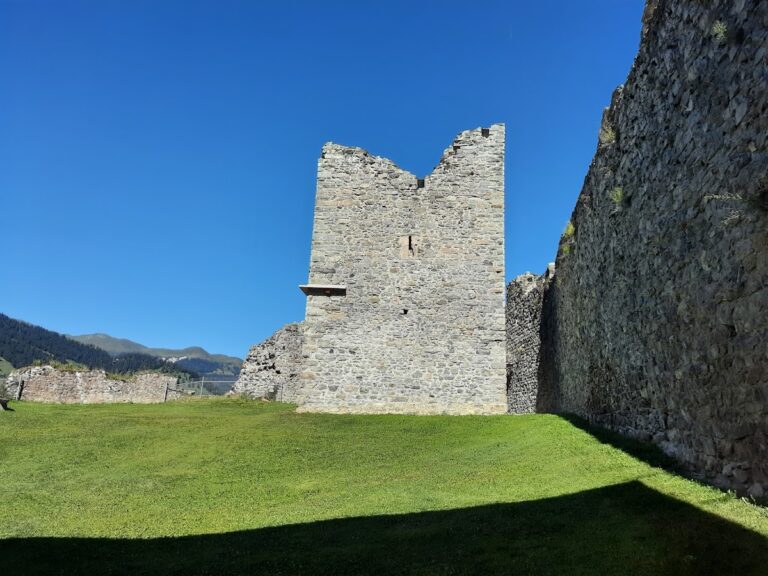
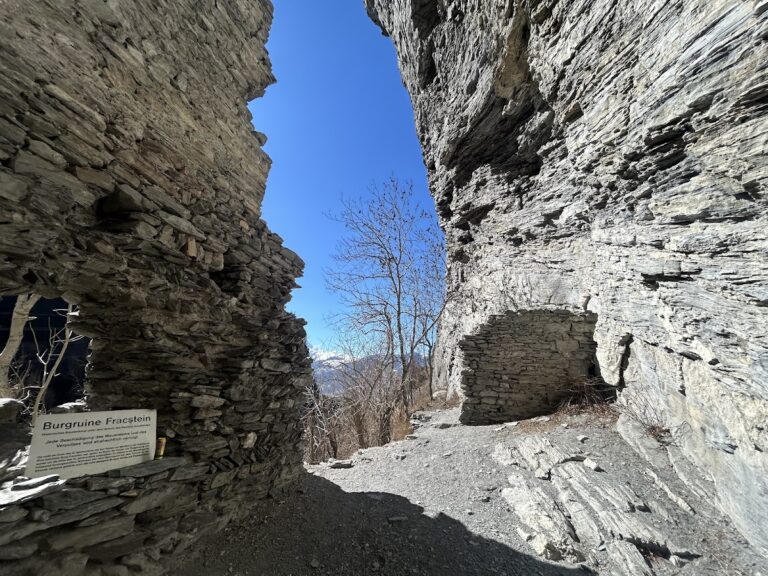
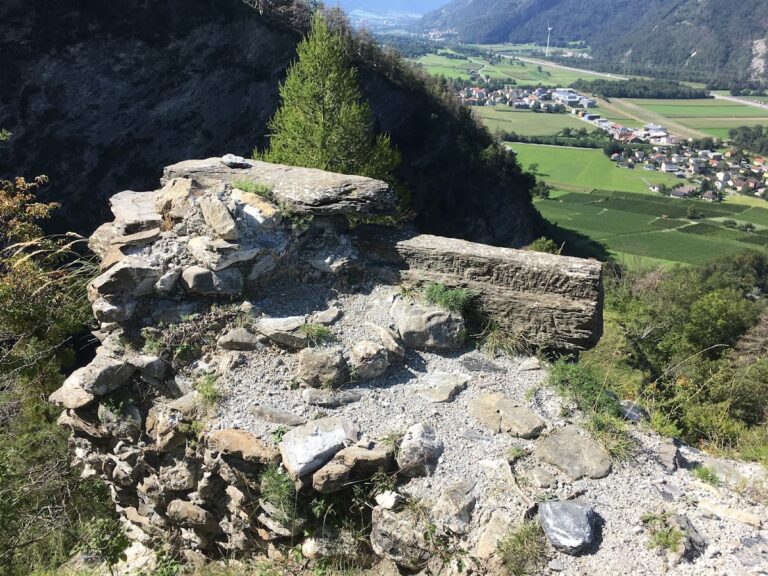
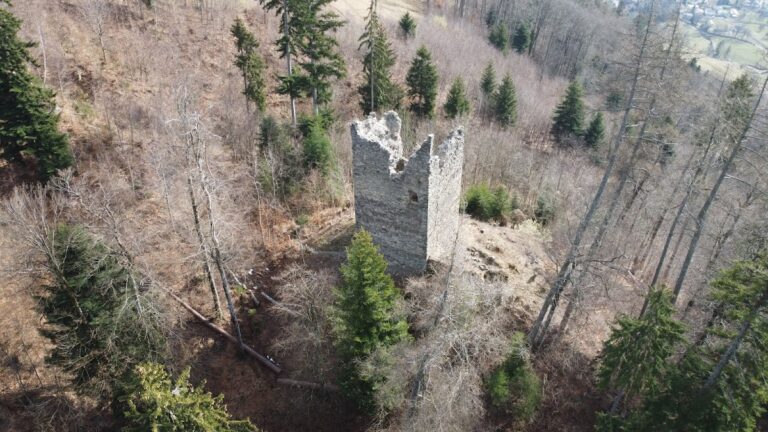
The ruins stand at approximately 1,060 metres above sea level on a plateau above the hamlet of Tälfsch in the municipality of Küblis. The hilltop fortification was enclosed by a perimeter wall that followed the natural shape of the plateau. Collapsed masonry now covers much of the interior, while only fragments of former wall alignments survive within the enclosure.
Perimeter wall and enclosure
The southern part of the perimeter wall remains several metres high, whereas much of the northern section has slipped away. The original wall was about 1.4 metres thick. It was later reinforced with an additional 1.5 metres of masonry, and the arrow slits in the earlier wall were reshaped into funnel-like openings within the added construction. The surviving wall fragments and rubble preserve parts of the enclosure, although the relationships between the buildings that once formed the larger complex can no longer be established.
Unter-Sansch tower
A separate lower site known as Unter-Sansch lies about 100 metres west of the church at Küblis. Excavations in 1952 exposed substantial walls belonging to a round tower. Nicolin Sererhard, an eighteenth-century local chronicler, described the tower in 1740 as still roofed and containing habitable rooms at its upper level. A chronicle also states that the Davos magistrate Ulrich Beeli died in the Küblis tower after being expelled for homicide and was buried at Küblis. The exact history of this tower and its relationship to Burg Kapfenstein remain uncertain.