Cambil Castle: A Nasrid Frontier Fortress in Spain


Site at a Glance
- Rating
- 4.1
- Popularity
- Very Low
- Country
- Spain
- Primary era
- Medieval
- Eras represented
- Medieval
- Civilizations
- Nasrid
- Site type
- Military
- Remains
- Castle
On this page8 sections
History
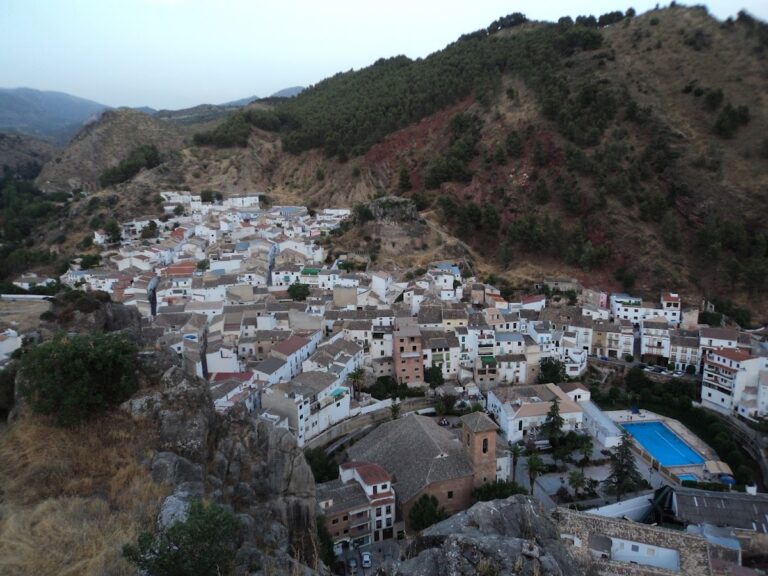
Cambil Castle is a medieval fortress in Spain, built in the twelfth century or earlier on a rocky promontory west of Cambil. Together with the castle of Alhabar across the Cambil River, it occupied an important position in the frontier struggles between the Nasrid Kingdom of Granada and Castile.
Early settlements and frontier control
Cambil and Alhabar were first mentioned in the twelfth century during a dispute or problem involving water. The reference indicates that two small villages stood on opposite sides of the Cambil River, each protected by a small castle. In their earliest form, these strongholds may have consisted mainly of the summits of their rocky outcrops, with only limited reinforcement.
The castles were conquered by Infante Don Pedro, a royal prince of Castile, as recorded in the Chronicle of Alfonso XI in the first half of the fourteenth century. They later returned to the centre of the frontier conflict between the Nasrids, the ruling dynasty of the Kingdom of Granada, and Castile.
Nasrid recovery and Castilian conquest
The Nasrids recovered Cambil and Alhabar during the war between Pedro I and Infante Enrique of Trastámara from 1350 to 1369. During this dynastic struggle, Nasrid forces operated against Jaén, which supported the Trastámara faction, while allied with the Castilian king.
In the fifteenth century, the Castilian constable Miguel Lucas de Iranzo led unsuccessful attacks against the castles in 1462 and 1471. The Catholic Monarchs, Isabella I of Castile and Ferdinand II of Aragon, finally conquered them in 1485 during the Castilian-Aragonese conquest of the Kingdom of Granada. Cambil and Alhabar formed important points in the Nasrid defensive line, and their capture led to the immediate abandonment of the fortress of Arenas.
Jaén administration and later status
On 21 September 1486, the Catholic Monarchs granted the castles of Cambil and Alhabar, along with their jurisdictions, to the city of Jaén. They remained under Jaén until Philip II, king of Spain from 1556 to 1598, emancipated Cambil on 19 April 1558. By that time, Cambil had incorporated Alhabar. The castle is legally classified as a monument, with its heritage declaration dated 22 June 1993.
Remains
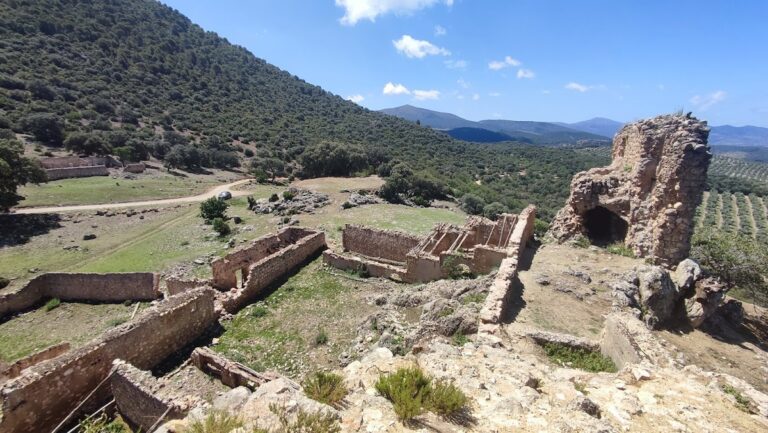
Cambil Castle occupies the approximately rectangular plateau of a rocky promontory west of Cambil, opposite Alhabar. The eastern side drops sharply toward the Cambil River along an almost vertical rock face, while the northern and southern sides are similarly steep. The western side has the only relatively gentle approach, with an elevation difference of about 4.85 metres, and this was therefore the likely access side. The fortress is arranged on two levels, with a central upper enclosure surrounded by a peripheral enclosure.
Outer fortifications and construction
Peripheral enclosure
The outer enclosure was fortified only along the western face of the rock, where the terrain offered the easiest approach. These defenses have been completely destroyed, possibly as a result of the extensive artillery used by Castilian forces during the reconquest in 1485.
The surviving interior fabric is roughly built from small rubble masonry bonded with a large quantity of gypsum mortar. This construction forms the material setting for the two-level arrangement of the fortress on the rocky summit.
Central upper enclosure
The central alcazarejo, a small fortified enclosure within a larger castle, occupies a raised plateau. Parapets, low protective walls for defenders, surrounded the upper level, which may have been made level with earth. On the eastern side, a supporting structure can be detected beneath the plateau, raising it still further above the rock.
Nearby sites