Castillo de Arenas: A Medieval Frontier Fortress in Spain

Site at a Glance
- Rating
- 4.6
- Popularity
- Very Low
- Country
- Spain
- Primary era
- Medieval
- Eras represented
- Medieval
- Civilizations
- Almohad, Crown of Castile, Nasrid
- Site type
- Military
- Remains
- Castle
On this page12 sections
History
Castillo de Arenas is a medieval fortress in Spain, located near Campillo de Arenas in Jaén Province. Occupying Cerro del Castillo de Puerta Arenas in the Sierra de Alta Coloma, it controlled routes between the realms of Jaén and Granada, including passages along the Guadalbullón and Quiebrajano rivers. The site also protected the rear of the castles of Cambil and Alhabar and served as the western key to Sierra Mágina.
Early enclosures and the frontier
The earliest structures at Castillo de Arenas date approximately from the ninth to eleventh centuries. The first enclosure probably provided refuge for the local population. Its difficult position and surviving recesses that resemble beam sockets suggest that some parts may have carried timber-supported structures. Later rammed-earth walls and towers containing stone inclusions belong to the Almohad period, while the main fortress took shape around the fourteenth century. Most of its surviving defensive system was constructed during the fourteenth and fifteenth centuries.
Castilian forces apparently conquered the site during the first half of the thirteenth century, when it became part of the district of Jaén. It passed to the Nasrids during the second half of the century. The Nasrids were the Muslim ruling dynasty of the Kingdom of Granada, the last Islamic kingdom in the Iberian Peninsula before its conquest in 1492. The 1246 capitulations concerning Jaén stipulated that Castillo de Arenas would remain under Granada’s control. The roughly 30-kilometer zone between the fortress and the advanced Castilian castles of Pegalajar and La Guardia remained a frontier no-man’s-land throughout the Late Middle Ages.
Repeated changes of control
Control of the fortress shifted repeatedly between Muslim and Christian powers, although Granada held it for most of this period. In 1280, Alfonso X of Castile and León, known as Alfonso the Wise, launched a punitive campaign against the Vega of Granada with assistance from his son Sancho. The campaign was repeated the following year with Marinid support and reached the point of besieging Granada. An agreement involving Muhammad II settled control of the castle, and in 1282 Sancho ceded it to Muhammad II in return for assistance against his father during the events known as the Vespers of Priego.
Pedro is said to have reconquered Castillo de Arenas in 1315, but Muslim forces regained it in 1319 after the Battle of Elvira. During the 1430s, Castile took control of the Guadalbullón and Jandulilla passes. Campaigns led by the Nasrid rulers Muhammad IX and Muhammad X in 1446 restored Castillo de Arenas and the Guadalbullón route to Granada.
Castilian conquest and later jurisdiction
Miguel Lucas de Iranzo, Constable of Castile, a senior military and political officeholder, made repeated attempts to capture the fortress. After Enrique IV’s truces with Granada expired, his troops reached the castle in April 1462 and burned two of its five gates, but the assault was repulsed. Further attacks under Juan de Navarrete followed in September and November 1463. A larger assault in 1471 also failed after the fortress received reinforcements from the king of Granada. In another isolated action, Ferdinand the Catholic sent the Master of the Order of Calatrava, a military religious order founded in the twelfth-century Iberian Peninsula, to recover stolen goods and seize property as compensation for goods that had not been returned.
Ferdinand the Catholic began the conquest of the northern part of the Kingdom of Granada in 1485. The capture of Cambil and Alhabar on 22 September caused the collapse of the frontier sector of Sierra Mágina. Several days later, the Muslim defenders surrendered and abandoned Castillo de Arenas without resistance, along with the castles of Piñar, Iznalloz, and Montejícar. After Granada was conquered, the frontier lands were reorganized. Jaén took possession of Cambil and Alhabar and, well into the sixteenth century, founded Campillo de Arenas south of the castle and Valdepeñas de Jaén. Castillo de Arenas then became part of the jurisdiction of the Jaén council.
The castle is protected as a Spanish Bien de Interés Cultural monument, a formal designation for protected cultural heritage, under reference RI-51-0007892. The declaration dates from 22 June 1993. It is classified as a medieval castle associated with both the High and Late Middle Ages.
Remains
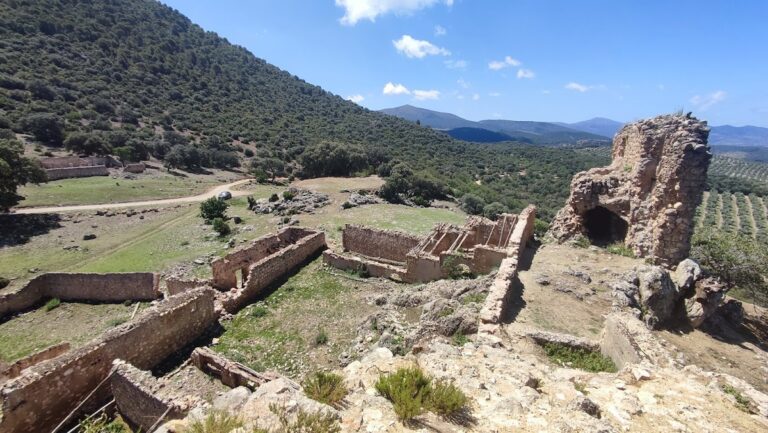
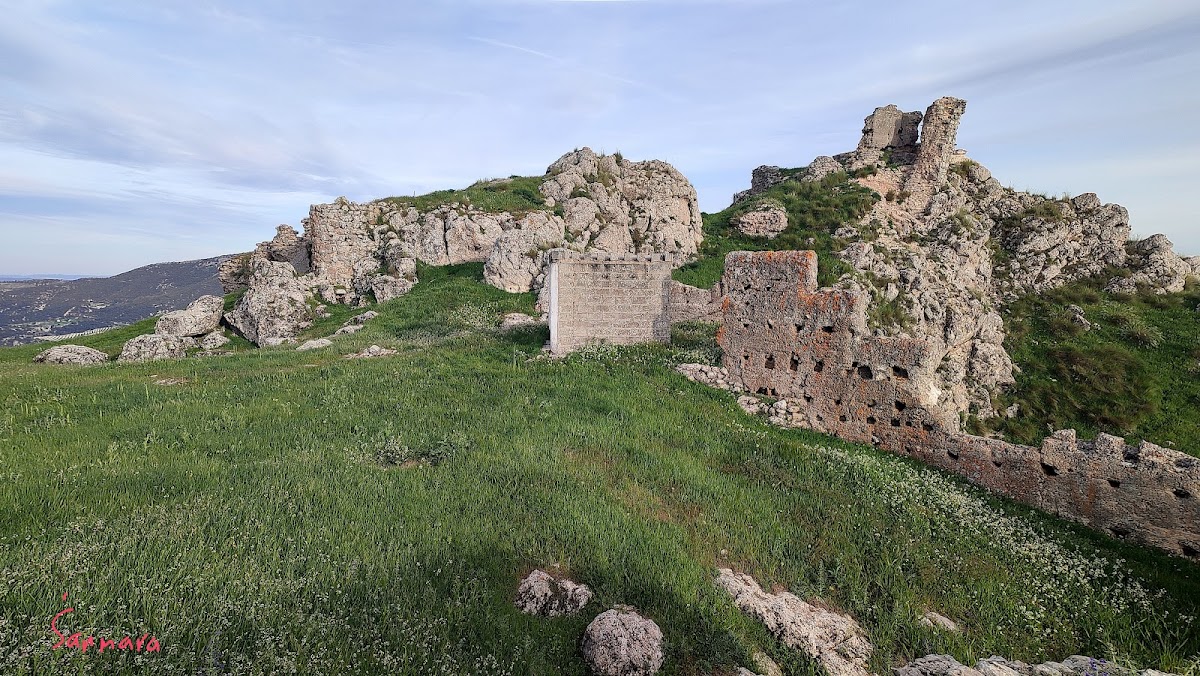
The fortress occupies an L-shaped platform. Its longer arm extends from south to north and its shorter arm from west to east. Steep natural cliffs defend the promontories at both ends. The site was later arranged as three enclosures, preserving a layered defensive layout that incorporates early rammed-earth construction, later towers, passages, a ditch, cisterns, and an upper stronghold.
Early and outer defenses
Early western enclosure
The oldest remains stand at the western end of the shorter arm. They form an irregular enclosure built of rammed earth, a technique in which an earthen mixture is compacted within formwork to create walls. Here the mixture contains a large amount of lime. The walls are approximately 60 centimeters thick and survive in only some areas. A row of recesses resembling beam sockets runs along parts of the enclosure and may indicate supports for wooden structures. The enclosure occupies ground that is very difficult to reach.
Outer enclosure
The outer enclosure surrounds the hill on its east and south sides and continues along a small part of the west side. Its surviving circuit includes a line of walls and three polygonal towers, perhaps built by the Castilians. The masonry uses ashlar blocks, with the dressed stones bonded at the corners. The earlier rammed-earth walls lie within this later defensive circuit. Access to the outer enclosure survives as a walled passage arranged in a zigzag. The fortress historically had five gates, two of which were burned during the Castilian attack of April 1462.
Inner enclosures
Second enclosure and ditch
The second enclosure stands independently from the outer wall. Its arrangement created a ditch between the two defensive circuits. Collapses have made the ditch difficult to access, but its position remains part of the fortress’s layered defensive organization.
Upper enclosure
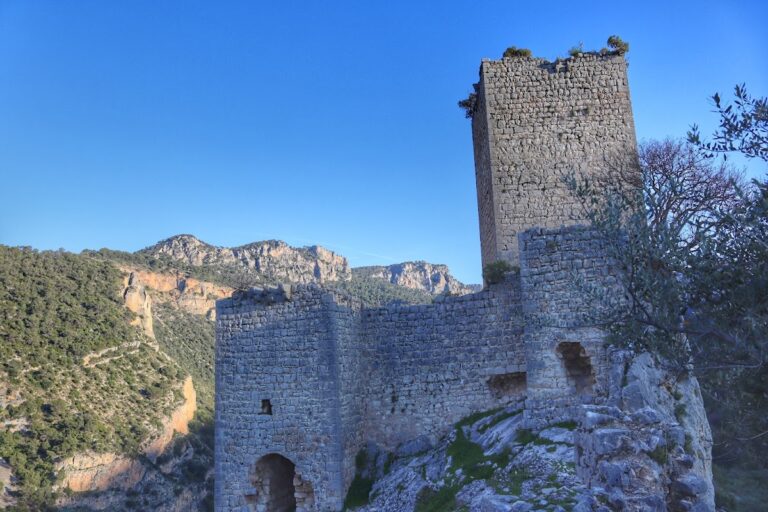
The upper enclosure occupies the higher ground at the southern end of the fortress. It contains two large cisterns, tanks used to collect or store water, whose coverings have been lost. The walls of another building also survive there, together with a large tower on the western side.
Western tower and chapel
The large western tower was restored, probably during the Nasrid period, in masonry. The entrance gate stood beside it. A chapel has later been built inside the upper enclosure from concrete blocks. An iron grille closes the chapel, contrasting with the surrounding fortified complex.
Nearby sites