Burg Rödelheim: A Medieval Water Castle in Frankfurt, Germany


Site at a Glance
- Rating
- 4.6
- Popularity
- Very Low
- Country
- Germany
- Primary era
- Medieval
- Eras represented
- Medieval
- Civilizations
- Holy Roman Empire
- Site type
- Military
- Remains
- Castle
On this page7 sections
History
Burg Rödelheim was a medieval water castle in Frankfurt, Germany, built as a fortified residence on an island between the Nidda River and a mill ditch. It is first recorded as a castrum in 1276, while a construction date around 1150 has been proposed. The castle became an imperial stronghold, placing it within the direct authority of the medieval German king and giving it strategic importance in relation to the Imperial City of Frankfurt.
Early holders and the imperial castle
The origins of the castle are associated with the early history of Rödelheim. The settlement was recorded as Radilenheim in 788, and the ministerial family Keppler of Rödelheim appears in records from 1248. The last Count of Nürings is also named in a Mainz document as Gerhardus de Redelenheim. These clues have led to the proposed date around 1150, although the castle itself is first mentioned later.
The Keppler family apparently died out soon afterward. In 1305, King Albert granted several Rödelheim fiefs to Ulrich of Hanau because they had become vacant after members of the von Godeloch and Capeler families of Rödelheim had died. The knights of Praunheim then became the principal later holders. They were already identified as co-owners in the 1276 transfer of two parts of the castle to King Rudolf of Habsburg. Other co-holders included the probably related knights of Preungesheim and Sachsenhausen, as well as the Schelms of Bergen. Over time, these families transferred their shares to the king and received them back as fiefs, or were compensated with castle fiefs connected with the burgraviate of Friedberg at the Imperial Castle of Friedberg.
Through these transfers, Burg Rödelheim became an imperial castle, meaning a stronghold held directly by the medieval German king or emperor rather than by a territorial lord. Its position concerned Frankfurt because the castle could serve as a place where raids against Frankfurt territory were assembled. The Kronberg Feud of 1389 illustrated this danger. Frankfurt secured an opening right in 1404, a legal agreement that allowed the city to enter and use a privately held castle for strategic purposes, and acquired further co-owner shares in 1441. Another share passed by inheritance to the lords of Cronberg, and a castle peace agreement followed in the next year.
The Cronberg rebuilding
In 1446, Frank the Rich of Cronberg replaced his section of the castle with a heavily fortified new building. The older structure was said to be dilapidated, but the construction created a dispute with Frankfurt because it violated a privilege of Emperor Louis the Bavarian that prohibited new castles within five miles of the city. Emperor Frederick III issued a demolition order, which was initially ignored. The Cronbergs eventually faced the possibility of losing all their imperial fiefs, and a settlement followed. Frankfurt received the opening right and one-tenth of the new building in return for 1,000 florins.
That same year, Frankfurt commissioned Sebald Fyoll, a fifteenth-century artist associated with the city, to draw the castle. His drawing is one of the few surviving sources for the appearance of the medieval complex.
Solms ownership and later destruction
After Frank the Rich of Cronberg died, the Cronberg share passed to the Counts of Solms. Relations between the counts and Frankfurt remained difficult. In 1503, when the counts attempted to acquire a share in the older castle, Frankfurt’s council demanded a share in the purchase. By then, the older parts of the complex were increasingly decayed. In 1569, the Counts of Solms exchanged Frankfurt’s share for three-quarters of the village of Niederrad and thereby gained sole ownership.
The Solms-Rödelheim line was established at the beginning of the seventeenth century and took its name from Rödelheim. Members of the family sometimes lived in the castle, while the family is now based at Assenheim Castle. The County of Solms-Rödelheim was mediatized in 1806, when it lost its direct status under the emperor and was incorporated into a larger state while the ruling family generally retained limited privileges.
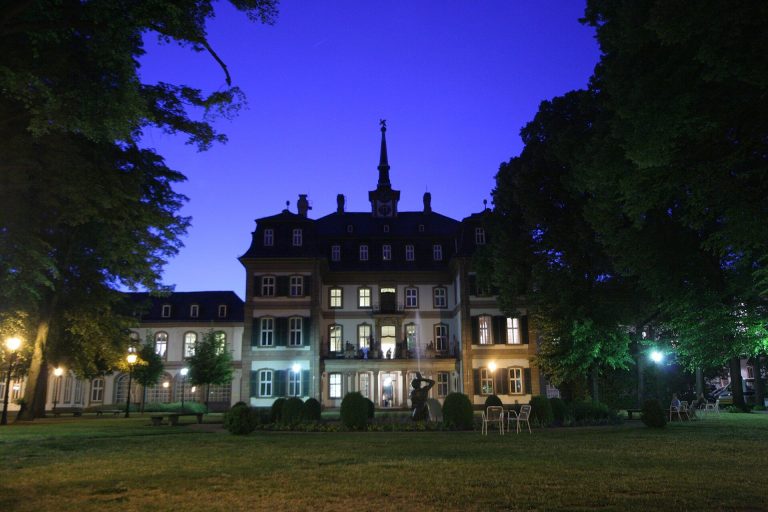
In 1802, most of the late-medieval structures were demolished and replaced by a Neoclassical palace that incorporated some older elements, including two corner towers. Air raids in 1944 severely damaged the palace, and its last remains were removed in 1955. In 2008, the local historical society made the foundations visible again and commissioned a bronze model of the former complex.
Remains
The surviving physical evidence presents Burg Rödelheim as a former water castle set on an island between the Nidda River and a mill ditch, south of the historic center of Rödelheim. The medieval complex was later partly replaced by the fortified building erected by Frank the Rich of Cronberg in 1446. Its appearance is preserved in the drawing made by Sebald Fyoll in that year, which provides rare visual evidence for the castle’s medieval form.
Medieval castle foundations
The castle’s original island setting formed part of its defensive arrangement, using surrounding water and the river channel to protect the fortified residence. The medieval structures underwent substantial alteration during the fifteenth century when the Cronberg section was replaced by a heavily fortified new building. The foundations were made visible again in 2008, allowing the former layout to be represented within the present park. A bronze model records the complex as it formerly stood.
Neoclassical palace
Most of the late-medieval structures were replaced in 1802 by a Neoclassical palace. Older fabric remained within the new building, including two corner towers. The palace was heavily damaged during the air raids of 1944, and the last standing remains were demolished in 1955. The former palace complex has since almost completely disappeared, and its original remains are not recognizable in the present park.