Burg Pusignan: A Medieval Fortress in France


Site at a Glance
- Rating
- 3.9
- Popularity
- Very Low
- Country
- France
- Primary era
- Medieval
- External website
- Open
- Eras represented
- Medieval
- Civilizations
- Holy Roman Empire
- Site type
- Military
- Remains
- Castle
On this page8 sections
History
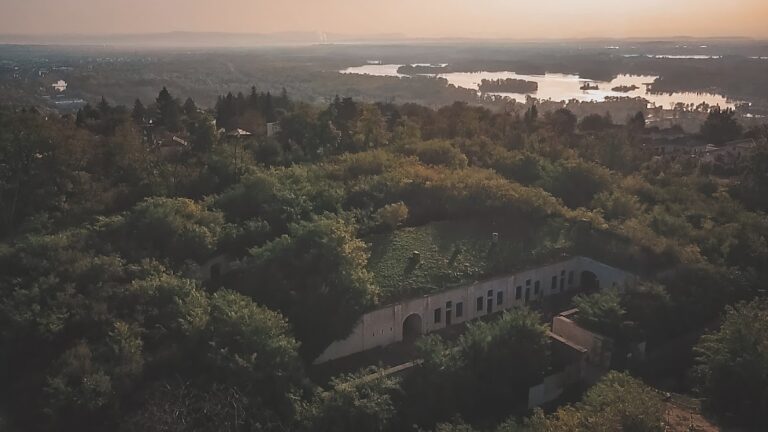
Burg Pusignan is a medieval fortified castle in France, developed over an earlier Roman military camp and expanded as a stone fortress in the twelfth century. Also known as Chastel-Vieil, it stands on a morainic hill near modern Lyon, where the Roman camp controlled the road between Lugdunum and Cremiacum. Its later fortifications overlooked the southern plain and the Planaise Forest.
Roman and early medieval origins
The earliest known defensive installation was a Roman fortified camp commanded by Pusinius, a lieutenant of Julius Caesar. After the fall of the Roman Empire, the site became part of the settlement area of the Burgundians. During the early Middle Ages, a motte castle was established over the former camp. Its first structures were wooden, followed later by buildings made from pebbles, forming the complex called Chastel-Vieil.
The medieval fortress
In the twelfth century, the local lords of Moifond began building a larger fortified castle. Its enclosing wall covered enough ground to shelter peasants during periods of conflict, while the hill gave the stronghold command over the surrounding plain and forest. In 1234, the Bocsozel family held Pusignan as a fief, first under the Count of Savoy and later under Dauphin Humbert II of Viennois.
King Charles VI authorized the demolition of the older Chastel-Vieil in 1389. The remaining castle nevertheless became involved in the struggle over the Dauphiné, a historic principality in southeastern Alpine France. In 1430, Alix de Varax, then its owner, supported Louis de Chalon, Prince of Orange, a nobleman aligned with Burgundy, and admitted an Orangist garrison.
Raoul de Gaucourt, governor of the Dauphiné, attempted to recover the castle with help from Rodrigue de Villandrando, a military captain. After Dauphiné forces captured several castles in the region, they established a camp below Pusignan on 7 June 1430. The garrison surrendered at the first attack on 9 June. Two days later, at the Battle of Anthon, the Dauphiné army defeated Louis de Chalon’s larger force. More than 200 men drowned while trying to cross the Rhône.
After the victory, King Charles VII confiscated the castle from Alix de Varax and granted it to Rodrigue de Villandrando, whose military contribution had been decisive. In 1450, Aymar de Poisieu, known as Cap Dorat, acquired Pusignan. A former lieutenant of Joan of Arc who had distinguished himself at the siege of Orléans, he later served as a royal cupbearer and household steward. He became a confidant of the future Louis XI and negotiated Louis’s marriage to Charlotte of Savoy.
From lordship to destruction
In 1573, Aymar de Poisieu’s descendants sold the lordship of Pusignan to François de Costaing. His grandson, Aymar de Costaing, served as lieutenant general of the Grand Falconry of France, the royal household office responsible for the king’s falconry establishments, and often accompanied Louis XIII.
Because Aymar de Costaing had no descendants, he left the lordship to his nephew Claude de Camus d’Arginy on the condition that Claude adopt the Costaing name and arms. After Aymar’s death in 1679, Claude became Claude Costaing de Pusignan. He took part in most of Louis XIV’s campaigns and commanded the Plessis-Praslin and Languedoc regiments. In the same year, the king raised Pusignan to the rank of marquisate.
Claude Costaing de Pusignan was mortally wounded during an attack before Londonderry on 5 May 1689 and died five days later, on 10 May. The castle subsequently changed owners several times and eventually passed to Hugues Gautier de Mézia, who was born in 1745. On 29 July 1789, Dauphiné brigands joined by peasants from the surrounding area looted and burned the castle.
Remains
Fortifications on the morainic hill
The surviving remains lie southwest of Pusignan’s town center on a morainic hill overlooking the plain. The site preserves traces of two principal defensive phases: the early medieval motte established over the Roman camp and the larger stone fortress created in the twelfth century.
The medieval motte
The adapted mound of the motte occupied the former Roman camp. A wooden tower first stood on it, followed by structures built from pebbles. The inner facing of the motte’s medieval wall remains visible, providing part of the surviving fabric of the older Chastel-Vieil complex.
The twelfth-century castle
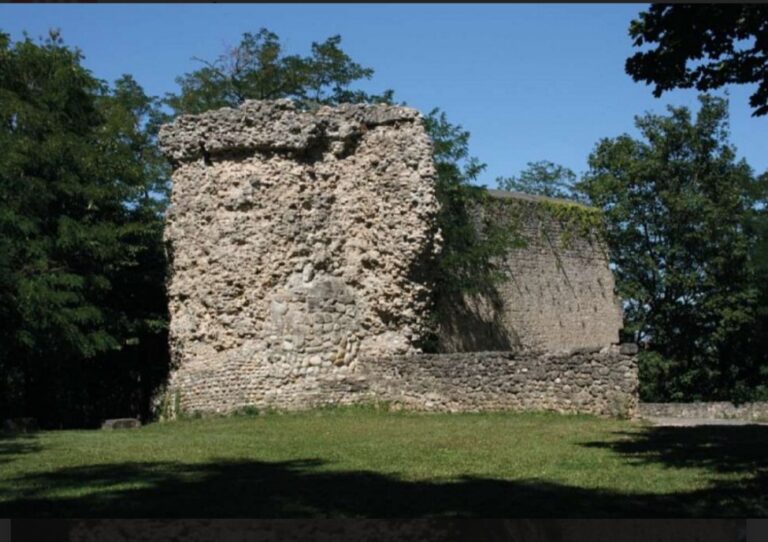
The later stronghold was a stone-built fortress enclosed by a broad ring wall. Only fragments survive, principally sections of wall and a tower. Their position on the hill reflects the castle’s defensive setting above the southern plain and the Planaise Forest.