Bolongaropalast: A Baroque Palace and Civic Landmark in Frankfurt-Höchst


Site at a Glance
- Rating
- 4.4
- Popularity
- Very Low
- Country
- Germany
- Primary era
- Early Modern
- External website
- Open
- Eras represented
- Early Modern, Modern
- Civilizations
- Holy Roman Empire
- Site type
- Domestic
- Remains
- Elite Residence
On this page10 sections
History
Bolongaropalast is a large Baroque palace in Frankfurt-Höchst, Germany, built between 1772 and 1780. The merchants and tobacco manufacturers Josef Maria Markus Bolongaro and Jakob Philipp Bolongaro commissioned it between 1772 and 1774. Its monumental composition and richly decorated interiors reflect Baroque architecture, an early modern style known for elaborate ornament and theatrical spatial effects. The palace became closely connected with Höchst’s civic development, later serving as a military headquarters, town hall, and municipal administrative center.
The Bolongaro family and the palace
The Bolongaro brothers came from Stresa on Lake Maggiore and settled in Frankfurt am Main in 1735. There they established Europe’s largest tobacco business and snuff-manufacturing enterprise. Their wealth did not give them access to Frankfurt citizenship, because they were Catholics and Frankfurt was a Lutheran Imperial Free City, a self-governing city within the Holy Roman Empire that was directly subject to the emperor rather than to a territorial prince.
The brothers accepted an invitation from Emmerich Josef, Elector of Mainz, to move to Höchst Neustadt. An elector of Mainz was both a senior church prince and one of the holders of the political office that participated in choosing the Holy Roman Emperor. The new settlement had been founded in 1768, and Josef Maria Markus Bolongaro became a citizen of Höchst in 1771. The Neustadt project was abandoned after the elector died in 1774, leaving the Bolongaros to use their palace for only a short period.
Josef Maria Markus Bolongaro died in 1779. Four years later, his heirs reached an agreement with the Frankfurt council and secured Frankfurt citizenship. The palace nevertheless remained associated with the family’s brief attempt to establish themselves within the developing Neustadt of Höchst.
Military headquarters during the Coalition Wars
During the Coalition Wars, the series of European conflicts fought against Revolutionary and Napoleonic France between 1792 and 1815, the palace accommodated several military commanders. Napoleon Bonaparte spent the night of 1 to 2 November 1813 there after his defeat at the Battle of Leipzig. It was his last night on what was then German territory. The Prussian field marshal Gebhard Leberecht von Blücher, who was pursuing the retreating French army, used the palace as his headquarters from 17 November to 27 December 1813.
Industrial use and civic administration
The Bolongaro family sold the palace in 1862 to Friedrich August Sonntag, a manufacturer from Mainz. Sonntag installed a factory producing gas and water pipes in the complex. In 1880, the Rödelheim pastor Eduard Lohoff purchased the property, divided the estate into smaller units, and sold some of them. Industrial production continued, including a brass foundry and the manufacture of bed feathers. These uses damaged the palace’s richly decorated interiors.
In 1907 and 1908, the city of Höchst bought back the subdivided estate from its various owners and carried out an extensive restoration costing approximately 400,000 marks. From 1908 until Höchst was incorporated into Frankfurt in 1928, the palace served as Höchst’s town hall. After the incorporation, it contained an office of Frankfurt’s lord mayor and became the seat of the city-district administration. The German County Association maintained an office in the palace from 1947 to 1950.
The western park pavilion was formerly occupied by Otto Vollbehr and by Frankfurt lord mayor Walter Kolb. It now contains a registry office, a municipal office responsible for civil-status records and ceremonies such as marriages. The eastern pavilion was occupied by the actress Rosemarie Fendel until her death on 13 March 2013.
Renovation and cultural use
The palace was cleared in 2016 for renovation, and construction began in February 2017. The work was intended to reconcile monument-preservation requirements with the needs of a modern civic center in the 240-room complex. Plans included a museum section, a music hall, and an events hall. The chapel hall hosts concerts and literary events, while the garden is used for summer theatre. The Barock am Main theatre festival has been held there in late summer since 2004.
Remains
Palace plan and garden setting
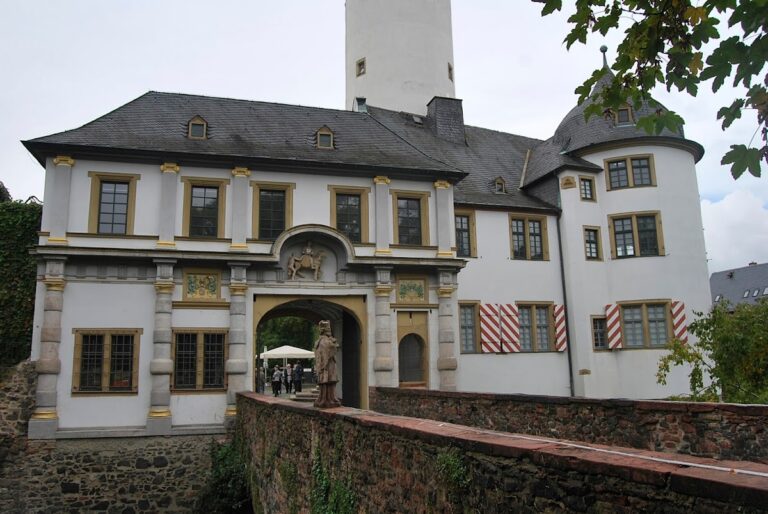
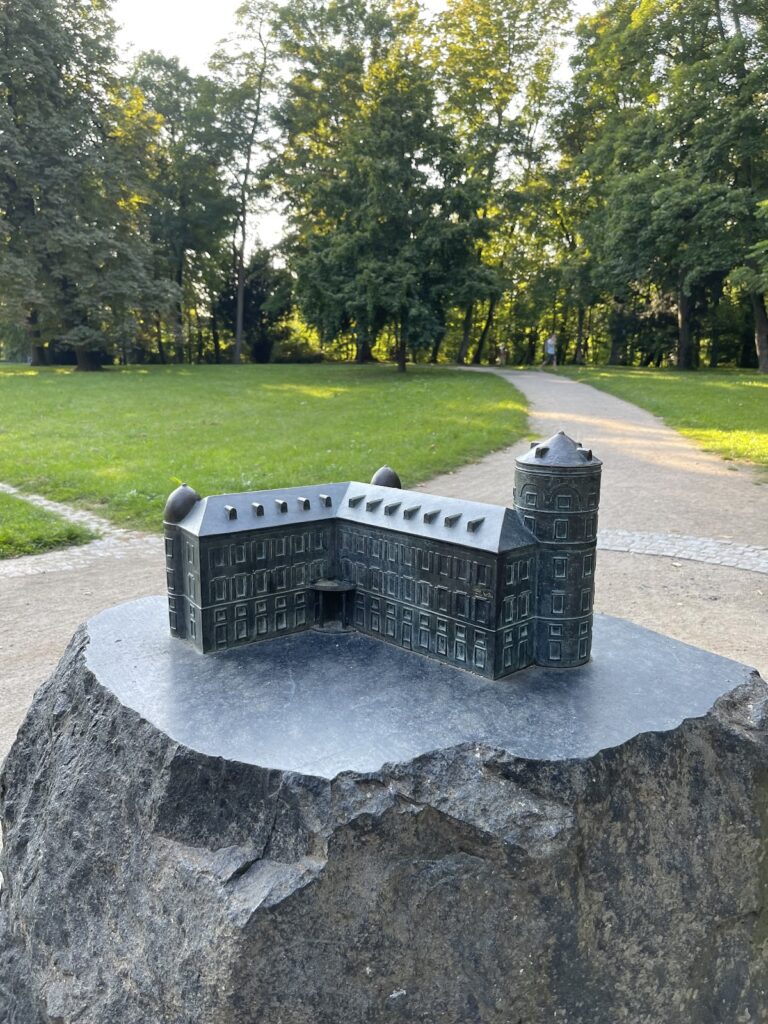
Bolongaropalast stands on the south side of Bolongarostraße, with its garden extending southward along the high bank above the mouth of the Nidda into the Main. The street-facing north facade measures 117 metres. A three-winged plan forms a horseshoe around an open courtyard. South of the building, the park descends in two terraces, and two garden pavilions flank its lower section. This arrangement connects the long palace frontage with the sloping grounds and the river-side landscape below.
Garden fountain
A neo-Baroque fountain created in 1909 by the Frankfurt sculptor Josef Keller stands in the park. Neo-Baroque is a later revival of Baroque forms. The fountain has a round basin and is dominated by a reclining dolphin carrying a water-spouting Triton. Triton is a sea deity of Greek mythology, traditionally shown with a human upper body, a fish-like lower body, and a shell trumpet.
Decorated interiors
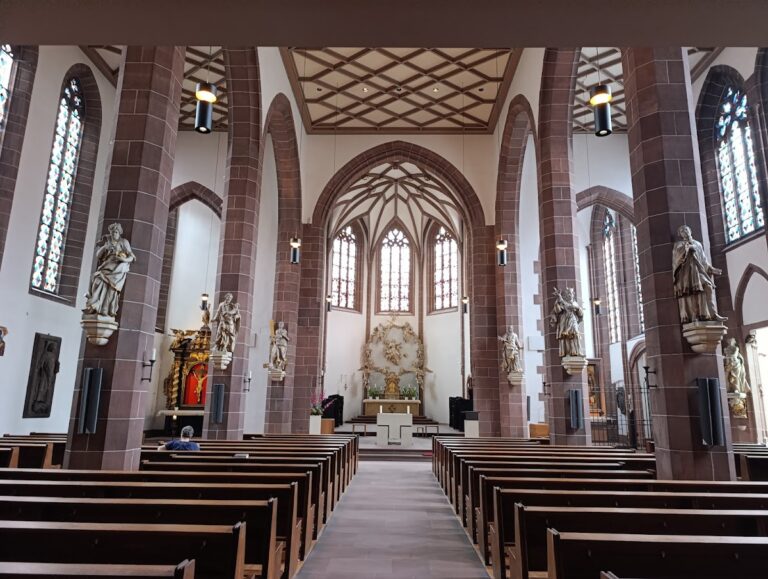
The palace contains richly ornamented rooms with mirrored walls, ceiling paintings, and silk wall hangings. Principal interiors include a house chapel, an elaborately decorated festival hall, and the chapel hall. Other rooms retain stucco and wall coverings. The chapel hall also functions as a cultural space for concerts and literary events, giving a continuing public use to one of the palace’s principal interiors.
Historic porcelain reproductions
The first floor contains a comprehensive exhibition of reproductions of historic Höchst porcelain forms. The pieces were produced in 1927 for the city of Höchst by a manufactory in Passau. They represent historic Höchst porcelain, but are twentieth-century reproductions rather than original eighteenth-century manufacture. A Frankfurt cabinet is also displayed on the first floor.
Nearby sites