Nellenburg: An Early Medieval Hilltop Castle Ruin in Germany


Site at a Glance
- Rating
- 3.6
- Popularity
- Very Low
- Country
- Germany
- Primary era
- Medieval
- External website
- Open
- Eras represented
- Medieval
- Civilizations
- Holy Roman Empire
- Site type
- Military
- Remains
- Castle
On this page11 sections
History
Nellenburg is an early medieval hilltop castle ruin in Germany, west of Stockach in Baden-Württemberg. It served from the mid-tenth century as the seat of the Counts of Nellenburg and became the political center of the Landgraviate of Nellenburg, a territorial lordship whose ruler held authority comparable to that of a count over a strategically important region.
Origins and the Nellenburg counts
The castle’s foundation date and early building history remain uncertain. Its existence is established by the tenth century, when Gottfridus de Nellenburg was recorded in 958. The castle was explicitly mentioned in 1056 as “Eberhard’s castle, the count of Nellenburg.” A tradition that emerged in the sixteenth century placed its construction in the 750s, but that earlier date has not been established. A nineteenth-century claim that Roman-period vases were discovered during demolition also prompted speculation about an earlier Roman settlement or rural villa at the site.
Eberhard, Count of Nellenburg, was born at the castle around 1010 and died at Schaffhausen in 1078. He was related to the Holy Roman Emperors Conrad II and Henry III, and in 1049 he founded the Benedictine monastery of Allerheiligen at Schaffhausen. A Benedictine monastery was a Christian religious community following the Rule of Saint Benedict, with an emphasis on communal worship, discipline, and monastic work. Around 1050, the Nellenberg family shifted its center of power from the Zürichgau to the Upper Rhine to protect both Nellenburg and the newly founded monastery.
Dynastic changes in the medieval period
During the Investiture Controversy, the medieval conflict between the papacy and secular rulers over the appointment of bishops and other church officials, Count Burkhard, the last representative of the older Nellenburg line, lost the county and castle. In 1105, they passed to his nephew, Count Dietrich. Some of the family’s territorial possessions went to Count Adalbert of Mörsberg, while the Lords of Bürglen formed the middle Nellenburg line.
In 1170, the county passed through marriage to the Counts of Veringen. Later succession arrangements established the younger Nellenburg line, which held the county from 1216 until 1422. The castle therefore remained connected to changing dynastic branches while continuing to anchor the territorial lordship.
Siege, Habsburg control, and decline
In 1291, Duke Albrecht of Austria besieged Nellenburg after Count Mangold II of Nellenburg-Veringen joined an uprising of Swabian nobles against the Habsburgs. The attackers undermined the round main tower, causing it to collapse. This siege permanently altered one of the castle’s principal defensive structures.
Nellenburg passed by marriage to the Lords of Tengen in 1422. They subsequently adopted the title Counts of Tengen. In 1465, they sold the Landgraviate of Nellenburg, including the castle, to Archduke Sigismund of Austria for approximately 38,000 gulden. The administrative center was transferred to Stockach, and the castle then entered a period of decline. Stockach and the county remained part of Further Austria from 1465 until 1805. Further Austria was the group of Habsburg possessions in southwestern Germany and neighboring regions outside the Austrian duchy proper.
During the Swabian War of 1499, the conflict between the Swiss Confederacy and the Habsburgs and their regional allies, Nellenburg’s garrison fired artillery at the Swiss camp during the siege of Stockach. The castle was probably seriously damaged during the wider war. Sixteenth-century building accounts describe it as being in poor condition and unsuitable for a princely residence. In 1571, a substantial section of wall collapsed, leaving many rooms unusable.
Destruction and later history
Troops commanded by Konrad Widerholt, the Württemberg commander of Hohentwiel, severely damaged Nellenburg in either 1639 or 1642 during the Thirty Years’ War, the major European conflict fought from 1618 to 1648 amid religious, dynastic, and political struggles. The castle well was filled to make the fortress unusable for defense, and the buildings deteriorated considerably.
Several buildings had been reconstructed by 1668-69. The castle later declined again, and in 1782-83 the responsible authorities ordered the largely ruinous castle and its chapel to be demolished. Stone from the buildings was reused in regional road and bridge construction. A fire in the 1830s and the demolition campaign greatly reduced the surviving remains. During the 1840s, poor inhabitants lived in houses built among the ruins. The property passed to the Counts of Langenstein in the mid-nineteenth century.
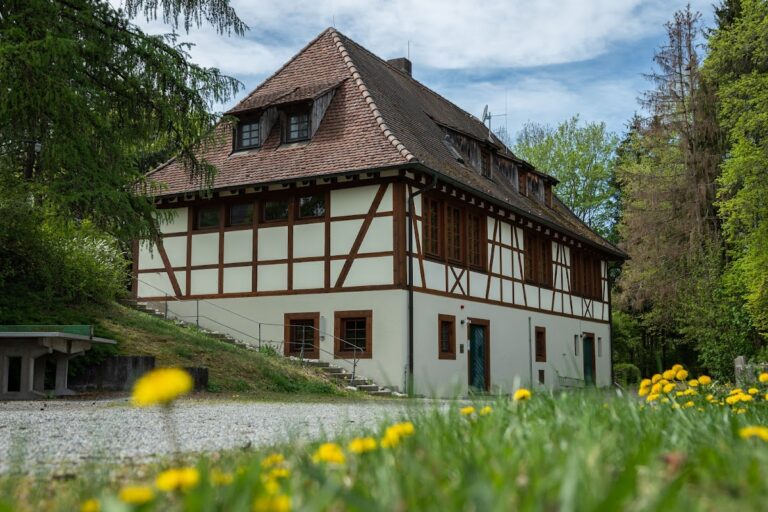
The Stockach Beautification Society erected a wooden observation tower within the main castle ruins in 1886. Structural deterioration led to its dismantling in 1922. From 1926 until 2010, a restaurant operated in the former estate residence at the lower Nellenburg. The lower estate remains privately owned by the Douglas family, and its surviving buildings require substantial renovation.
Legend and heraldic traditions
A local legend connects the castle’s name with a woman called Nella. According to the story, Count Mangold became lost while hunting and encountered a pagan sacrificial site. He destroyed its sacrificial stone, was captured, and was condemned to death, but Nella secured his pardon and later converted to Christianity. When she requested baptism, a spring appeared. Mangold then built a castle called Nellaburg in her honor.
The arms of the older Nellenburg family are not certain, although they were probably associated with a ram. The later Nellenburg line, descended through the marriage with the Veringen family, used three blue antlers arranged vertically on a gold shield. The ram emblem probably passed to the monastery of Allerheiligen, the city of Schaffhausen, and the canton of Schaffhausen.
Remains
Nellenburg occupies a molasse spur at an elevation of approximately 613 meters, about two kilometers west of Stockach and near the 624-meter Nellenburger Berg. Molasse is sedimentary rock formed from material eroded from the Alps and deposited across the Alpine foreland. The exposed spur overlooks the Hegau and Lake Überlingen, with views toward the Alpine foothills and, in exceptionally clear conditions, the Austrian, Swiss, and French Alps. The ruins border a nature reserve.
Upper castle ruins
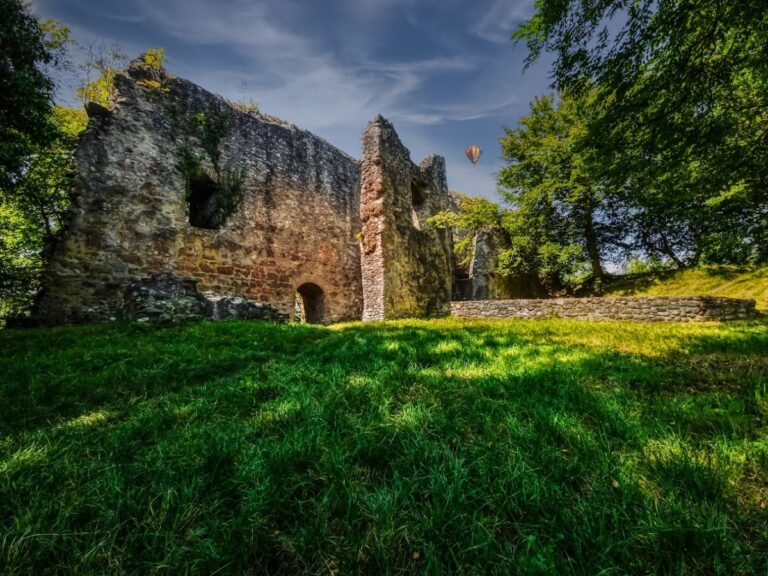
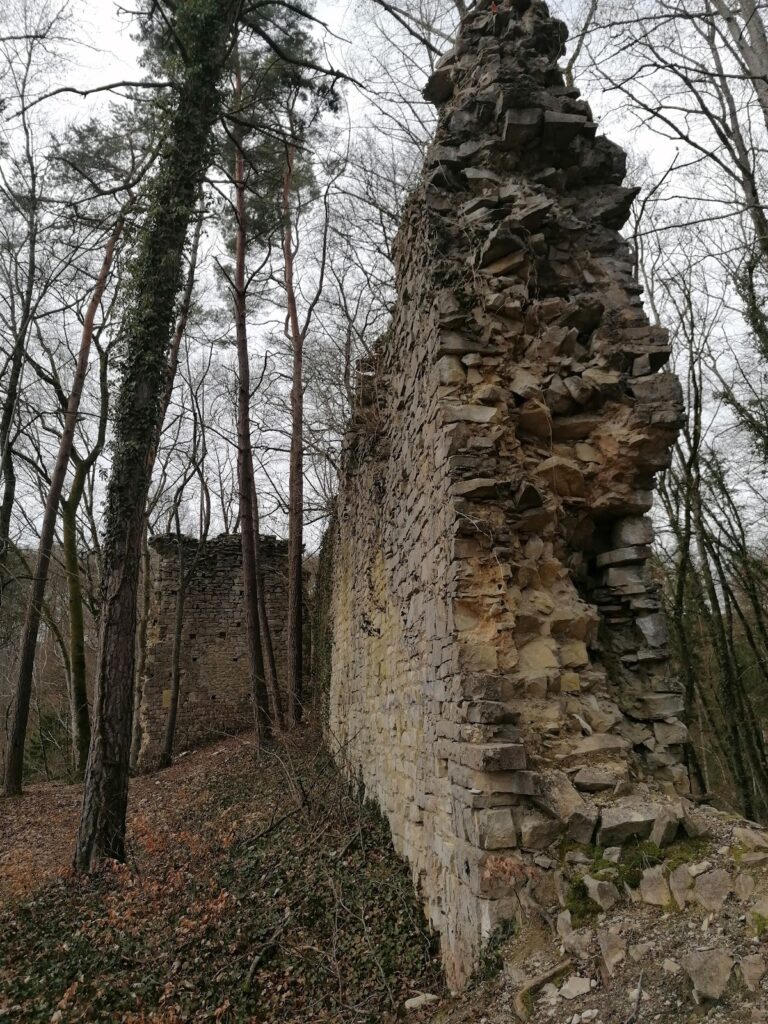
Nellenburg was a spur castle, a fortification built on a projecting ridge that used steep natural slopes for protection. The surviving upper castle consists of limited remains of the main tower, the wall along the side facing the valley, and parts of the wall leading toward the forecourt. The round main tower collapsed during the 1291 siege after attackers undermined it, while later demolition and decay further reduced the upper castle.
Reconstructed buildings and chapel
The buildings reconstructed by 1668-69 contained seven living rooms, nine chambers, two kitchens equipped with baking ovens, three cellars, and a vaulted room. The complex also included the chapel of St. Gangolf and service buildings in the outer castle. By that time, the well that had been filled during the Thirty Years’ War had been cleared again. Demolition in the late eighteenth century and later deterioration reduced these buildings to the surviving fragments of the upper ruins.
Lower Nellenburg estate
The so-called young Nellenburg, or lower Nellenburg, lies approximately 300 meters east of the main ruins at a lower elevation. It developed outside the older castle from the late seventeenth century as accommodation for estate administrators and senior gamekeepers.
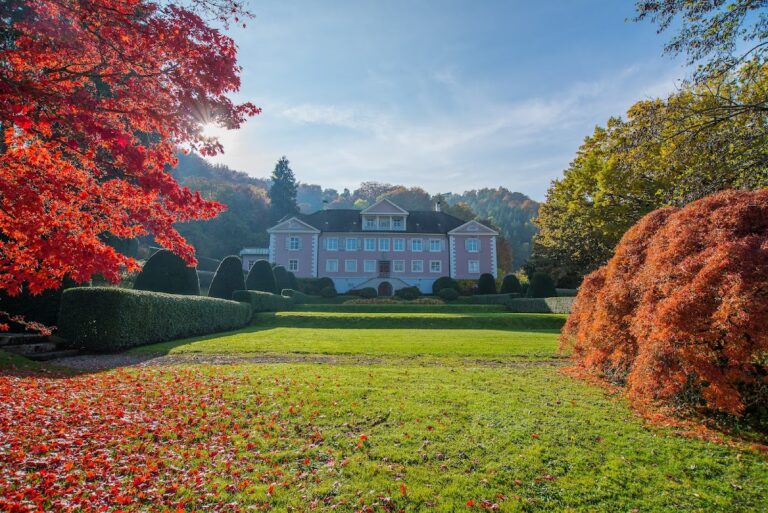
The lower estate is centered on a nineteenth-century residential building. Its former inn room retains dark wooden ceiling beams, built-in wooden corner benches, and a centrally placed tiled stove. The kitchen and inn room originally occupied the opposite positions from their later arrangement, while the apartments are located above the inn room. The surviving estate buildings form a later phase of Nellenburg’s development beyond the medieval castle.
Architectural reconstruction
A reconstruction of Nellenburg’s external appearance is exhibited at the Freiburg Zinnfigurenklause, a Freiburg museum specializing in historical tin-figure displays, including reconstructions of buildings and historical scenes.
Nearby sites