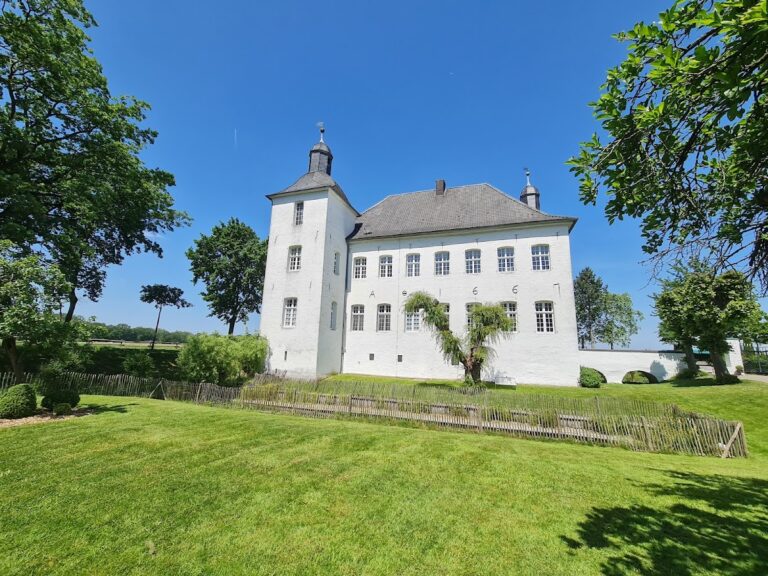
Krickenbeck Castle: A Moated Noble Residence in Germany


Site at a Glance
- Rating
- 4.1
- Popularity
- Very Low
- Country
- Germany
- Primary era
- Modern
- External website
- Open
- Eras represented
- Medieval, Early Modern, Modern
- Civilizations
- Duchy of Cleves, German, Holy Roman Empire
- Site type
- Domestic
- Remains
- Castle
On this page13 sections
History
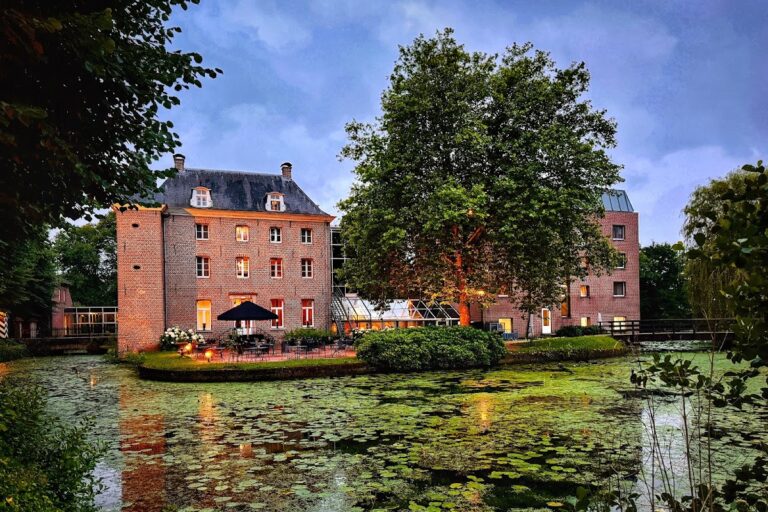
Krickenbeck Castle is a moated castle in Nettetal, Germany, whose new foundation in the mid-thirteenth century created a Lower Rhine residence near the present Krickenbeck Lakes. The complex later passed through several noble families, was repeatedly rebuilt, and became a residence, religious home, conference venue, and seminar house.
The earlier castle and the thirteenth-century foundation
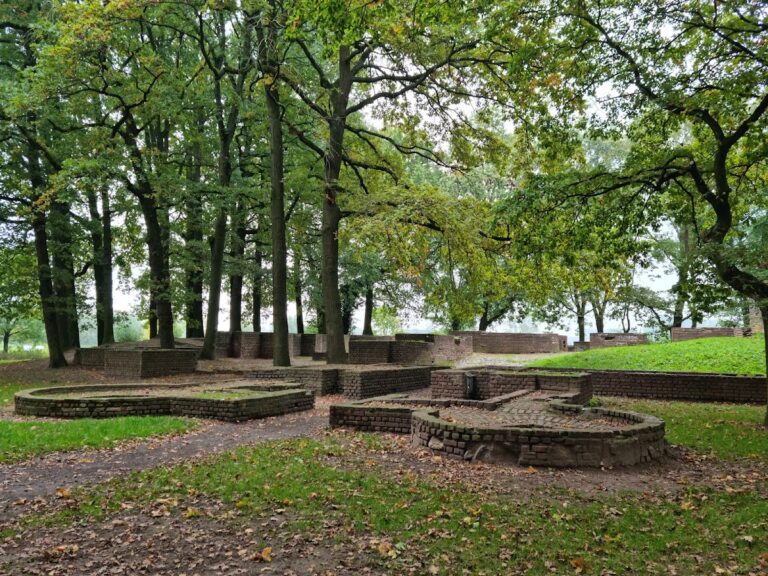
About two kilometres south of the present castle, on the Nette River, stood Old Krickenbeck, also called the Old Castle. Heinrich, Count of Krickenbeck, is named as its first documented owner in 1104, while Reginar of Krickenbeck held the countship between 1149 and 1167. Reginar’s daughter, Alveradis of Krickenbeck-Millendonk, married Friedrich, Count of Berg-Altena.
Their son Adolf I, who held the titles Count of the Mark, Altena, and Krickenbeck, sold the lordship of Krickenbeck to his brother-in-law Otto of Geldern on 3 March 1243. By that time, the old castle appears to have been destroyed or uninhabitable, and it was not mentioned again. The cause is uncertain, although military conflicts associated with the Isenberg disturbances, which began in 1232, may have contributed. Adolf I fought the heirs of Friedrich von Isenberg, executed in 1226 as the principal conspirator against his relative Engelbert of Berg, the archbishop of Cologne.
A new castle was established in the Hinsbeck Niers lowland, probably between 1244 and 1251. It was then known as Bona de Crikenbeke. By the end of the fourteenth century, the castle and its territory belonged to the County of Kleve, a medieval and early-modern territorial state in the Lower Rhine region. In 1391, Count Adolf I of Kleve and his wife Margaretha transferred their hereditary rights over the castle to their son Adolf II.
The Schaesberg estate
The four Krickenbeck Lakes were formed at the beginning of the fifteenth century when peat was extracted from low moors. They took their name from the castle situated among them. The estate appears in a marriage contract dated 21 November 1604, drawn up for Arnold of Wachtendonk, the Kempen official, and Anna Salome of Holthausen. In 1623, the castle entered the von Schaesberg family when Johann Friedrich von Schaesberg married Ferdinanda von Wachtendonk.
Krickenbeck entered its period of greatest splendour under Johann Friedrich von Schaesberg, who served as governor at the Düsseldorf court of Elector Johann Wilhelm. Wolfgang Wilhelm von Schaesberg transformed the fortified water castle into a noble residence. French troops occupied and plundered it in 1684. Several occupations during the Thirty Years’ War, the major European conflict of 1618 to 1648, led to the complete rebuilding of the outer bailey in 1695.
From 1708 to 1721, Johann Friedrich II von Schaesberg commissioned Simon Sarto to remodel the castle as a Baroque manor house. Baroque architecture is associated with formal monumentality and theatrical decoration. Between 1856 and 1860, Count Rudolf von Schaesberg and his wife Mathilde, born Countess von Waldburg-Zeil-Trauchburg, commissioned another conversion. Designs by Vincenz Statz, the Cologne diocesan architect, created a Neo-Gothic representative residence intended to recall the history of the Schaesberg estate.
Fire, war, and changing uses
A fire on 7 September 1902 destroyed the manor house. Count Wilhelm Heinrich von Schaesberg then commissioned the Hanoverian architect Hermann Schaedtler to rebuild it. A three-winged Neo-Renaissance castle, reviving Renaissance architectural motifs, was erected from 1903 to 1904.
In 1943, the von Schaesberg family moved to Schloss Tannheim in Württemberg and removed the castle’s furnishings. A children’s home from Mönchengladbach and the Dernbach Sisters moved into Krickenbeck in June 1943, but they were relocated to Olpe in October 1944. In March 1945, the unoccupied castle became the headquarters of the 363rd Tactical Reconnaissance Group of the United States Army Air Forces, the American military air service that existed before the independent United States Air Force.
In 1947, the Congregation of the Sisters of Saint Catherine, Virgin and Martyr, moved into the castle. The order had been expelled from East Prussia in 1945, and Krickenbeck subsequently served as an old people’s home for the former Kempen-Krefeld district until 1969.
Decline and restoration
Krickenbeck stood unused from July 1969. Its building fabric deteriorated during the 1970s, while proposals for a hunting museum and luxury apartments failed. A planned state subsidy for roof repairs was refused in 1981 because the listed monument had no established use. Parts of the castle were also used as a setting for the television film The Crocodiles of the Suburbs in 1977.
In autumn 1986, WestLB decided to establish an academy for professional training and continuing education at Krickenbeck. Extensive renovation, restoration, and expansion began in 1989, and the redesigned complex was inaugurated in May 1991 in the presence of North Rhine-Westphalia Minister-President Johannes Rau. WestLB used the castle as a conference and training venue until August 2011.
The work was carried out in close cooperation with the state conservator of North Rhine-Westphalia, the official responsible for supervising historically important monuments and archaeological sites. It included the reconstruction and restoration of the castle park, together with an ecological programme intended to preserve the built monument and the archaeological ground monument. After the European Commission ordered WestLB in December 2011 to wind down by the end of 2016, the bank no longer had a use for the property. It sold Krickenbeck Castle to the French Châteauform group in 2015, and the group marketed it as a seminar house.
Remains
Krickenbeck is a Lower Rhine moated castle comprising a manor house and an outer bailey. The core of the new castle dates from the mid-thirteenth century, while the buildings of the outer bailey are substantially later. Water surrounds the castle area, and the four Krickenbeck Lakes occupy former low moors altered by peat extraction in the early fifteenth century.
The manor house and outer bailey
Manor house
The present manor house is the three-winged Neo-Renaissance building erected in 1903 and 1904 after the fire of 1902. It incorporates the changes made during the nineteenth-century conversion, including a new eastern tower on the lakeside façade and a south-eastern oriel, a projecting upper-floor window structure. The north-eastern wall carries the alliance coat of arms of the Wachtendonk and Holthausen families.
WestLB’s restoration programme repaired the stucco and fireplaces while following the appearance of the aristocratic residence around 1850. The Knights’ Hall and library received original furnishings from that period. The manor house was restored as part of the wider renovation and reconstruction of the complex.
Outer bailey
The outer bailey forms the second principal part of the moated castle. Its buildings are substantially later than the thirteenth-century core, and occupations during the Thirty Years’ War resulted in their complete rebuilding in 1695. The outer bailey was restored during the late twentieth-century works alongside the manor house.
Later accommodation and leisure buildings
The 1990s redevelopment added a hotel wing containing 160 single rooms. A leisure centre with a gymnasium and swimming pool was built on the site of a former farm. These additions formed part of the conversion of the historic complex for professional training and continuing education.
Park and surrounding lakes
Castle park
The castle park was reconstructed and restored during the late twentieth-century programme. Ecological work addressed both the park and the archaeological ground monument, linking the care of the landscape with the preservation of the historic site.
Krickenbeck Lakes
The four Krickenbeck Lakes surround the castle area. They were created in the early fifteenth century through peat extraction from former low moors and preserve the physical setting from which the castle and the lakes derive their shared name.