Holtmühle Castle: A Historic Castle Complex in the Netherlands


Site at a Glance
- Rating
- 4.5
- Popularity
- Very Low
- Country
- Netherlands
- Primary era
- Early Modern
- Eras represented
- Medieval, Early Modern, Modern
- Civilizations
- Holy Roman Empire
- Site type
- Domestic
- Remains
- Castle
On this page10 sections
History
Holtmühle Castle is a historic castle complex in Tegelen, the Netherlands, probably built during the second half of the fourteenth century and shaped mainly in its present form during the seventeenth century. It was associated with the lordship of Tegelen, a territorial jurisdiction held by a lord with rights over land, administration, and revenues, and with substantial dependent fiefs.
Fourteenth-century origins
Otto van Holtmeulen is the first known owner by name. In 1394, the Duke of Guelders, ruler of the medieval Duchy of Guelders, formally granted him the lordship of Tegelen and its associated possessions. The lords of Tegelen had previously lived at De Munt and Bongertshof. A branch of the family later established itself at Holtmühle, where the seventeenth-century principal building retained fragments of the earlier structure.
Seventeenth- and eighteenth-century ownership
During the seventeenth century, members of the German Metternich noble family occupied the castle. In 1702, they sold their rights to the lordship and the already dilapidated Holtmühle Castle to the von Hundt zum Busch family. The new owners made the castle habitable again and commissioned a raised road through the marshy ground below the escarpment. Running from the Kaldenkirchen Gate toward Kaldenkirchen and Wambach Castle, the road became known as the Huntsleich, Hondsdiekerweg, or Hondsdijk.
In 1744, the young Baroness Anne Elisabeth von Hundt married the Prussian military officer Joachim Reinhold von Glasenapp. Three years later, von Glasenapp inherited the castle and the title Lord of Tegelen from his father-in-law. The castle was later associated with the Dutch stadholder and military commander Frederick Henry. Jacobus Craandijk described it as Frederick Henry’s headquarters during the siege of Venlo in 1646.
Nineteenth-century decline and rebuilding
After von Glasenapp left Tegelen around 1780, Holtmühle Castle was repeatedly unoccupied for long periods. In 1879, it was described as uninhabited but apparently well maintained. By about 1850, however, the complex had become so dilapidated that half of its buildings was demolished when Louis de Rijk took up residence. He extensively remodelled the surviving building in 1852. His daughter, Theodora, married Henri van Basten Batenburg in 1883.
Municipal ownership and restoration
The municipality of Tegelen purchased the castle, its outbuildings, and surrounding lands from the Van Basten Batenburg family in 1968 for 800,000 Dutch guilders. Restoration followed in stages. The corner turrets of the tithe barn were repaired in 1978, the Kaldenkirchen Gate was restored in 1985, and the Venlo Gate in 1986. The tithe barn was restored to its original state in 1988, including the removal of a later storage shed.
A ceramic training workshop was established in the tithe barn in 1985, and the Tiendschuur Ceramics Museum has occupied the building since 1987. After extensive restoration in 1993, the castle complex became the hotel and restaurant Château de Holtmühle, part of the Bilderberg hotel chain. Holtmühle Castle is protected as a Rijksmonument, a site legally designated in the Netherlands for its national cultural or historical value.
Remains
Principal building
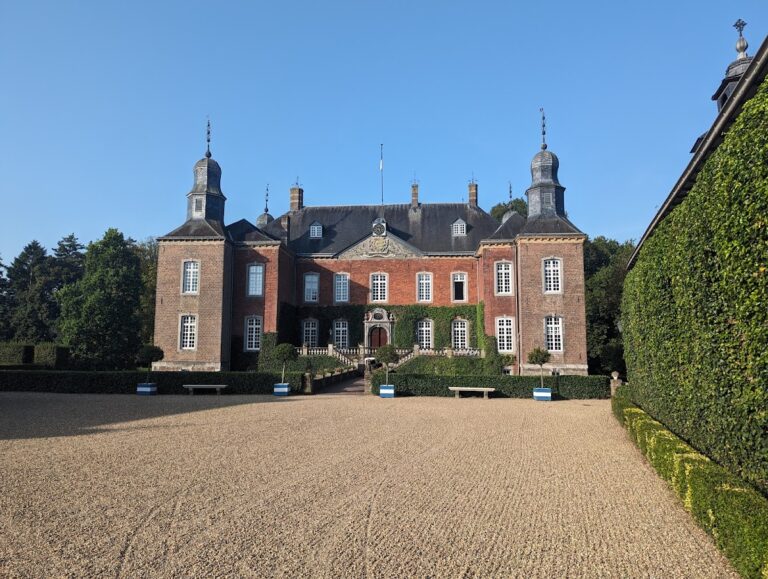
The castle’s principal form dates mainly from the seventeenth century, although fragments of the fourteenth-century structure survive within it. The main building is constructed of brick and bluestone and has two tower-like corner pavilions. Its principal entrance has a nineteenth-century bluestone door surround. The surviving building reflects both the earlier medieval foundation and the remodelling that followed the complex’s deterioration in the nineteenth century.
Gatehouses and forecourt
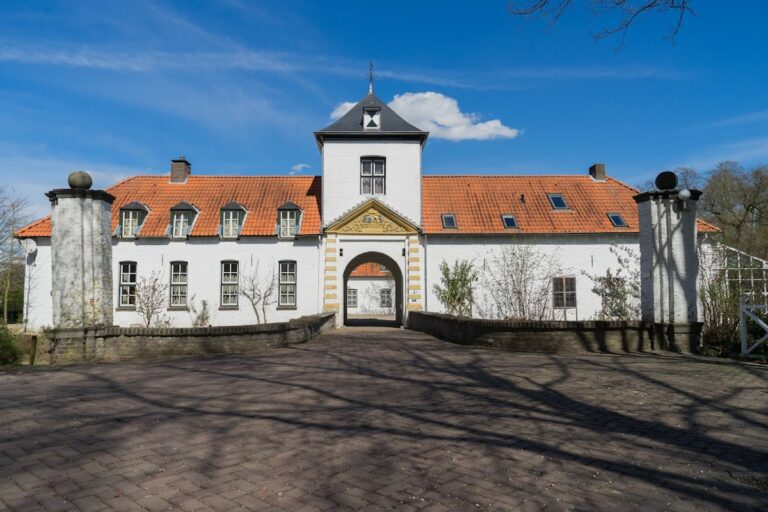
Two freestanding gatehouses form part of the complex. The Kaldenkirchen Gate and the Venlo Gate were restored in 1985 and 1986 respectively. The castle also includes a walled forecourt and a broad moat, features described in the nineteenth century. Their relationship with the gatehouses expresses the defensive and access arrangements of the historic complex.
Tithe barn
Holtmühle contains one of the few completely preserved tithe barns in the Netherlands. A tithe barn stored tithes, agricultural payments traditionally made in produce, often to a church or ecclesiastical institution. The barn has corner turrets and was restored in 1988 after a later storage shed was demolished. It now houses the Tiendschuur Ceramics Museum.
Grounds and historic road
The wider complex includes outbuildings, gardens in several styles, moats, ponds, and surrounding lands. The historic raised road connected the Kaldenkirchen Gate with Kaldenkirchen and Wambach Castle, crossing marshy ground below the escarpment. Known by several names, including Huntsleich, Hondsdiekerweg, and Hondsdijk, it formed part of the historical landscape associated with the castle.