Ruine Bussen: A Medieval Summit Castle in Germany


Site at a Glance
- Rating
- 4.8
- Popularity
- Very Low
- Country
- Germany
- Primary era
- Medieval
- Eras represented
- Medieval
- Civilizations
- Holy Roman Empire
- Site type
- Military
- Remains
- Castle
On this page6 sections
History
Ruine Bussen is a medieval summit castle in Germany, probably built toward the end of the eleventh century on Mount Bussen near Uttenweiler. By the middle of the thirteenth century, it had become a Staufer imperial castle. The Staufers, also called the Hohenstaufens, were a medieval German dynasty whose rulers held the imperial crown of the Holy Roman Empire.
Medieval Lords and Administration
In the fourteenth century, Ruine Bussen became a Habsburg fief held by the Truchsessen of Waldburg. A Habsburg fief was land granted by the Habsburg rulers in return for service and loyalty. The castle was associated with the ministerial class, a medieval group of officials, often of unfree or formerly unfree status, who served rulers and noble lords in military and administrative roles.
Destruction and Preservation
Swedish troops under King Gustav Adolf destroyed the castle in December 1633 during the Thirty Years’ War, the major European conflict of 1618 to 1648 that involved religious, dynastic, and territorial struggles across the Holy Roman Empire and beyond. The ruin remained in a decaying state until Prince Anselm of Thurn and Taxis acquired it in 1785 and paid to secure the surviving remains.
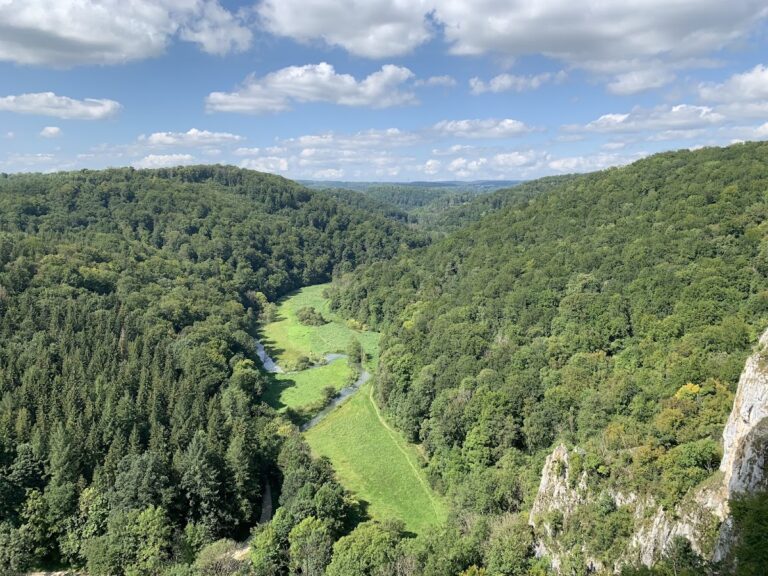
The Landkreis Biberach acquired Ruine Bussen in 1997 and restored the keep. The castle’s later history also includes a literary commemoration. A plaque on the tower carries an inscription by Michel Buck, a German dialect poet who lived from 1832 to 1888. The inscription celebrates the exceptionally wide panorama from the tower across Upper Swabia toward Lake Constance, Ulm, the eastern Alb, the Swabian-Bavarian plateau, and the Alps from Pilatus to the Benediktenwand. It also describes the more limited outlook toward the nearby Alb and the villages beyond the Teutschbuch.
Remains
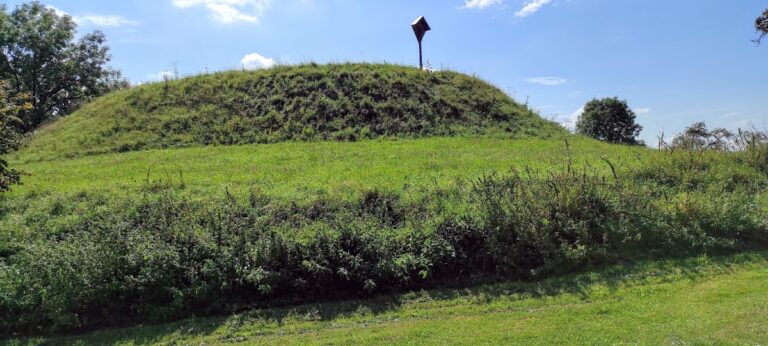
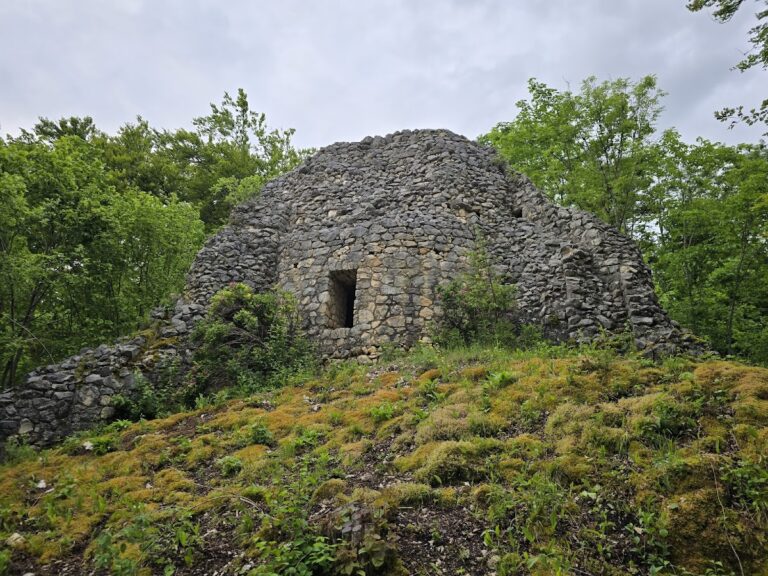
Ruine Bussen occupies the 767-metre-high summit of Mount Bussen near Offingen and Bussen in Upper Swabia. The castle complex was arranged in two principal parts: an outer ward on the central area of the mountain and a main castle to the east. The surviving fabric consists of the rectangular tower of the former main castle together with secured wall remains.
Main Castle Tower
The rectangular keep of the former main castle survives as the dominant architectural feature. Its restored masonry rises 13 metres and the structure now serves as a lookout tower. The plaque bearing Michel Buck’s inscription is fixed to the tower, linking the surviving defensive structure with the historical description of its extensive views.
Outer Ward and Pilgrimage Church
The outer ward occupied the central part of the summit, while the main castle stood farther east. Only secured sections of the castle walls survive beyond the restored tower. West of the former outer ward stands the pilgrimage church of St. John the Baptist, built in 1516.