Zwiefalten Abbey: A Benedictine Monastery and Imperial Abbey in Germany
Site at a Glance
- Rating
- 4.7
- Popularity
- Medium
- Country
- Germany
- Primary era
- Early Modern
- External website
- Open
- Eras represented
- Early Modern
- Civilizations
- Holy Roman Empire
- Site type
- Religious
- Remains
- Monastery
On this page14 sections
History
Zwiefalten Abbey is a former Benedictine monastery in Zwiefalten, Germany, founded on 8 September 1089 during the Investiture Controversy, the medieval struggle over the appointment of bishops and other church officials. The Counts Kuno of Wülflingen and Liutold of Achalm established it as a retreat and burial foundation for their family. Bishop Adalbero of Würzburg and Abbot William of Hirsau advised them, and the abbey followed the stricter Benedictine observance associated with the Hirsau reforms.
Foundation and early development
The first community arrived from Hirsau Abbey and comprised twelve monks and five lay brothers. Zwiefalten initially remained dependent on Hirsau, but became an independent abbey in 1091, gaining the right to elect its abbot and lay protector, or bailiff, who was responsible for protection and certain legal affairs. In 1092, the founders transferred their ownership rights to Count Mangold of Veringen on the condition that the monastery be placed under the protection of the Roman Church. Pope Urban II confirmed that protection in 1093 in return for an annual symbolic payment of one gold piece. The abbey was dedicated to the Virgin Mary.
Count Kuno died in 1092. Count Liutold spent his final years as a monk at Zwiefalten and died on 18 August 1098. Most of the brothers’ inheritance passed to the abbey, strengthening its economic foundation. The first church was consecrated in 1109 by Bishop Wido of Chur. Under Abbot Ulrich I, who governed from 1095 to 1139, Zwiefalten also sent monks to establish or support communities at Kladrau and Neresheim.
Religious and intellectual centre
During the twelfth century, Zwiefalten became a regional religious and cultural centre. Donations associated with Count Heinrich I of Berg, his daughter Salome of Berg, and her sister Richeza of Berg and her husband Vladislav I greatly expanded the abbey’s possessions. A women’s religious community was established at Zwiefalten around 1100 and survived until the fourteenth century, when its nuns moved to the dependent monastery of Mariaberg. In 1293, Zwiefalten took over the Dominican convent there, which later adopted the Benedictine rule.
The monk Ortlieb began the Zwiefalten chronicles in the early twelfth century. Abbot Berthold, who died in 1169, continued them, opposed Emperor Henry IV, and promoted the abbey’s writing school and library. Hildegard of Bingen, the influential twelfth-century Benedictine abbess, writer, composer, and preacher, visited Zwiefalten during a preaching journey around 1170. The Zwiefalten Letter Manuscript, produced between 1154 and 1170, demonstrates the abbey’s connection with her. The possibility that the Liber Scivias was written and illuminated at Zwiefalten remains a scholarly hypothesis.
Abbot Ernst, who governed from 1141 to 1146, died during the Second Crusade and was later venerated within the community as a martyr. Members of important Swabian noble families, including Adalbert of Oberstetten and Otto of Steußlingen, also entered the monastery. In 1226, a papal document confirmed Zwiefalten’s patronage rights over the church at Kladrau.
Territorial lordship and political protection
Through donations and purchases, Zwiefalten gradually formed a largely contiguous territorial lordship in the area of the modern Reutlingen district. The acquisition of Oberstetten for 9,350 gulden on 19 July 1497 and the donation of Mochental Castle in 1192 were among the transactions that enlarged its possessions. The abbey also held villages and scattered estates extending toward the region of Chur and Alsace. Its court in the imperial city of Reutlingen served as an important economic centre.
From the early fourteenth century, Zwiefalten’s territory was in practice protected by the Counts and later Dukes of Württemberg. The Habsburgs held its protective bailiwick from 1303 to 1491, after which the office passed to Württemberg. In 1461, Count Ulrich of Württemberg defended Zwiefalten’s rights against an imperial force sent by Emperor Frederick III during a dispute over Kohlberg.
Abbot Georg II Fischer, who led the abbey from 1474 to 1513, became known as its “second founder.” He promoted strict observance of the rule, scholarship, artistic work, and humanism. Württemberg forces under Duke Ulrich plundered Zwiefalten in 1525 during the Reformation, the sixteenth-century movement that challenged the authority and practices of the Catholic Church. The abbey nevertheless prevented Protestantism from becoming established throughout its territory. The Treaty of Speyer in 1570 confirmed Zwiefalten’s special status within Protestant Württemberg.
War, independence, and dissolution
Zwiefalten joined the Upper Swabian Benedictine Congregation in 1603 and the Confederation of the University of Salzburg in 1653. During the Thirty Years’ War, the Restitution Edict of 1629 restored the abbey’s ecclesiastical rights in Neuhausen an der Erms and Ödenwaldstetten. After the Swedish-Württemberg conquest, King Gustav II Adolf of Sweden granted the abbey and other possessions to Duke-Administrator Julius Frederick of Württemberg in 1632. Monks returned after the Battle of Nördlingen in 1634, but the abbey and its territory had suffered severe damage and disruption.
From 1686 to 1803, Zwiefalten maintained a lyceum at Ehingen an der Donau, including the first German church dedicated to the Sacred Heart. The monk Magnoald Ziegelbauer became a major historian of the Benedictine order. In 1750, after making substantial financial concessions, Zwiefalten freed itself from its obligations to Württemberg and obtained imperial immediacy. As a Reich Abbey, its abbot held direct status within the Holy Roman Empire rather than being subject to a territorial prince. From 1751, the abbey was represented on the Swabian College of Imperial Prelates. It ceded Neuhausen an der Erms, Ödenwaldstetten, and disputed possessions in Großengstingen and Derendingen to Württemberg.
Secularization dissolved Zwiefalten Abbey on 25 November 1802, and its possessions passed to Württemberg, which became a kingdom in 1806. From 1812, the former monastic buildings housed a state psychiatric institution and later a psychiatric hospital. Since 2003, the complex has also included the Württemberg Psychiatry Museum. The former abbey church continues as the Münster of Zwiefalten, while the wider complex remains associated with psychiatric care.
Remains
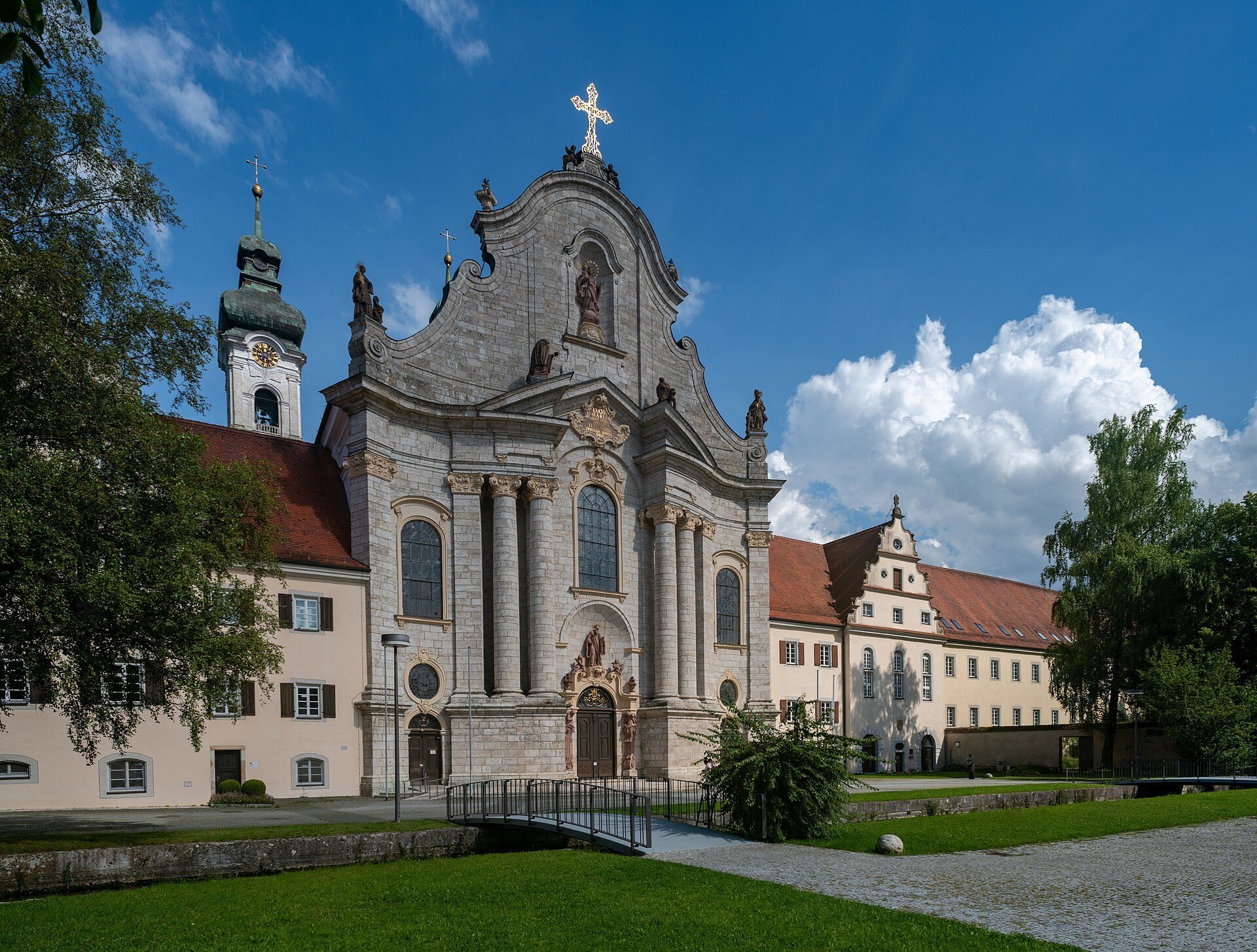
Zwiefalten’s surviving complex combines a large late Baroque church with abbey buildings constructed around the earlier monastic centre. The present Münster replaced a Romanesque basilica, while the surrounding wings preserve the scale of the abbey’s early modern rebuilding. The church is built largely from Gauingen travertine and is associated with the Vorarlberg architectural school, an influential church-building tradition linked to builders from the Alpine region of Vorarlberg.
The abbey church
Romanesque and Gothic predecessors
The first church was a three-aisled Romanesque basilica with a transept and bell turret. It belonged to the architectural tradition of the Hirsau school and was consecrated in 1109. In the fifteenth century, the building was remodelled in the Late Gothic style, reflecting the abbey’s economic expansion. The older church was demolished in 1739 to make way for the present Münster.
The late Baroque Münster
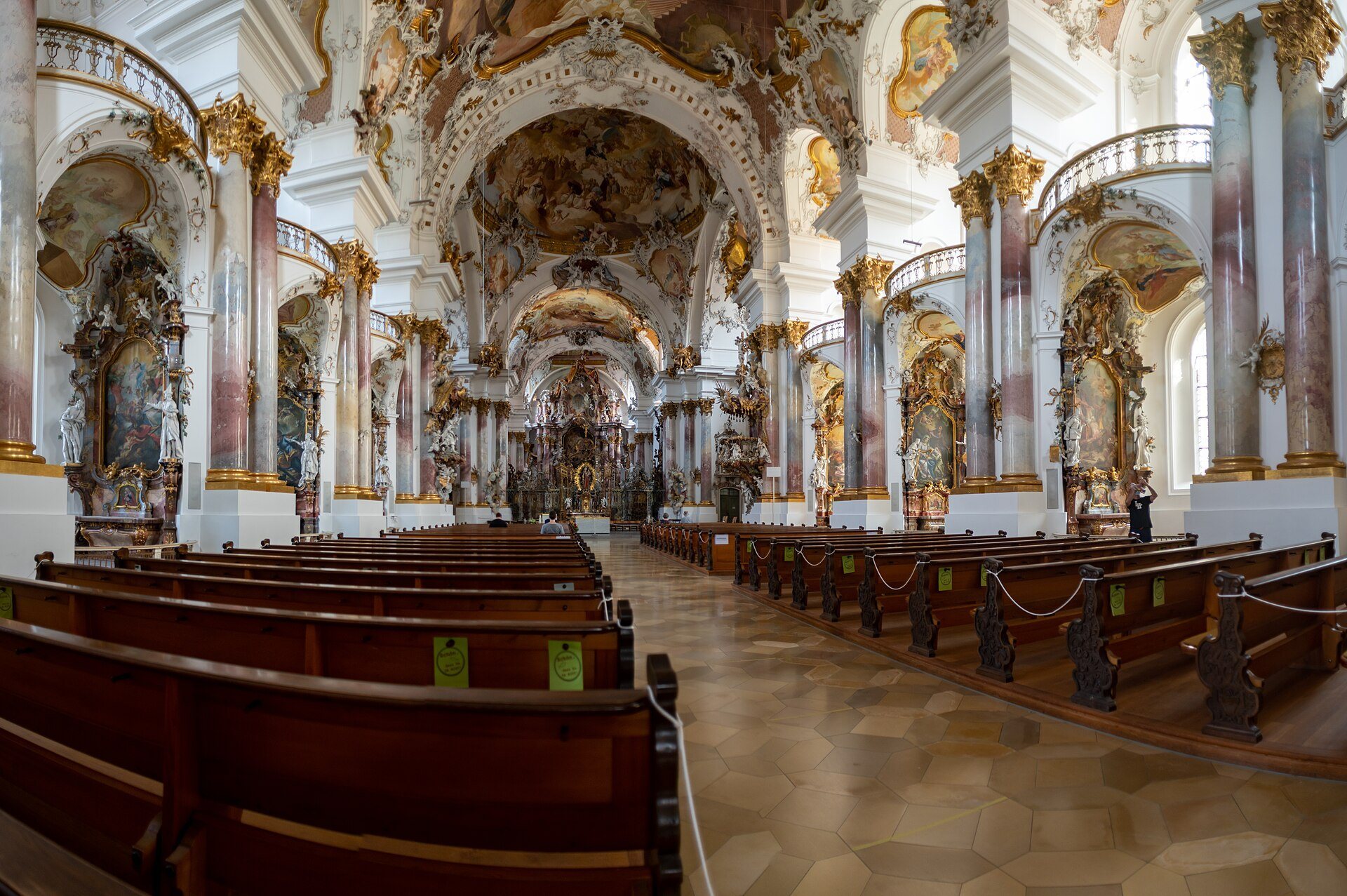
The present church was rebuilt between 1741 and 1753. Franz Beer initiated the project, while Joseph Benedikt and Hans Martin Schneider prepared the first design. Johann Michael Fischer took over after the foundations had been laid. The result is a major late Baroque building, designed as a wall-pillar church in which the nave supports are attached to the side walls and form chapel spaces between them. Its interior is regarded as a total work of southern German Rococo.
The Münster is 99 metres long. The nave measures 30 metres in length and 27 metres in width, while the presbytery is 30 metres long and 14 metres wide. The dome is approximately 17 metres across and 28 metres high. The west facade is integrated into a 126-metre-long west wing and rises 45 metres. The towers beside the presbytery reach 94 metres, with finial crosses more than 6.5 metres high.
Interior decoration
The interior was completed by 1765. Johann Joseph Christian created the sculptural decoration and choir stalls, Franz Joseph Spiegler painted the ceiling frescoes, and Johann Michael Feuchtmayer the Younger executed the stucco. Franz Sigrist painted the three vestibule frescoes in 1758, while Spiegler’s nave ceiling painting dates from 1751.
The high altar incorporates a fifteenth-century Madonna transferred from the earlier church, with Baroque additions by Christian dating from about 1750. Christian also made the choir stalls. One stucco composition depicts Nebuchadnezzar fighting the Jewish king Zedekiah and includes a plan of Jerusalem.
Abbey buildings
The abbey buildings in their present form were erected beside the earlier church from 1668 onward. Tommaso Comacio supplied the plans, and Michael Thumb and Franz Beer carried out the construction. The west wing and school were remodelled between 1668 and 1673, the east wing was built from 1684 to 1686, and the north wing followed between 1693 and 1700. The building campaign resumed in 1739 after an interruption caused by the War of the Spanish Succession.
Treasury and bells
Medieval treasury objects
The former medieval treasury includes an eleventh-century staurotheke, a reliquary made to preserve a relic of the True Cross, and a twelfth-century reliquary cross decorated with rock crystal. These objects preserve material connections with the abbey’s medieval religious life.
Church bells
Eleven new bells were cast between 29 June and 6 July 1979 by the Albert Bachert foundry of Heilbronn. The largest weighs 4,170 kilograms and measures 191 centimetres in diameter. The smallest has a diameter of 65 centimetres and weighs 197 kilograms.
The Münster was restored between 1976 and 1984, and the entire abbey complex underwent comprehensive restoration from 1974 to 1984.