Buchau Abbey: A Former Imperial Abbey in Germany
Site at a Glance
- Rating
- 4.5
- Popularity
- Very Low
- Country
- Germany
- Primary era
- Early Modern
- External website
- Open
- Eras represented
- Medieval, Early Modern, Modern
- Civilizations
- Holy Roman Empire
- Site type
- Religious
- Remains
- Monastery
On this page11 sections
History
Buchau Abbey was a Roman Catholic foundation in Bad Buchau, Germany, dedicated to Saints Cornelius and Cyprian. According to foundation tradition, the Frankish count Warin and his wife Adelindis established it around 770 on an island in the Federsee. The foundation formed part of the Frankish-Carolingian effort to consolidate and secure newly acquired royal authority in Alemannia, the region that later developed into the Duchy of Swabia.
Foundation and Carolingian patronage
Another tradition links Adelindis with a chapel and monastery established where her husband Atto died fighting the Huns. Later historical research places the identifiable Adelindis about a century later and regards her as the wife of Count Warin. The surviving evidence therefore combines an early foundation tradition with a later historical identification of its principal female founder.
In 819, Louis the Pious granted Buchau property at Mengen, a church at Saulgau, and a separate court for the members of the institution. The charter surviving from the period is a twelfth-century forgery, but it preserves a genuine historical basis for the abbey’s possessions. In 857, Louis the German treated Buchau as a private religious house of the Carolingian imperial family. At the request of his daughter Irmengard, probably shortly after she became abbess, he transferred the Saulgau possessions to Reichenau and compensated Buchau with royal property at Heidenhofen. Irmengard led the foundation from 850 to 866.
Hungarian incursions affected Buchau in 902. During the tenth century its communal life was reorganized, temporarily following the Benedictine Rule, a code governing monastic discipline and daily life. In 925, Eleusina, the sister of Bishop Ulrich of Augsburg, was confined at Buchau after a moral offense. Otto III guaranteed the restoration of the abbey’s possessions in 999. A first recorded fire destroyed or damaged the institution in 1032.
From religious house to noblewomen’s foundation
During the thirteenth century Buchau was regarded as a community of Augustinian canonesses. Over time it became an unregulated secular foundation, meaning that its members lived communally for worship and administration without following a fully enclosed monastic life. The canonesses were principally noblewomen from Upper Swabian families. The foundation also admitted women from Tyrol, Alsace, Carinthia, Bohemia, and other Habsburg territories. Members included daughters of the Fugger, Waldburg, Montfort, Gundelfingen, Lupfen, and Königsegg families.
The town of Buchau was first recorded as an independent town in 1320. The town and abbey developed as separate self-governing bodies and entered into prolonged disputes, including a major conflict in 1435. Buchau’s town government later received protection and support from Ulm, Württemberg, and other political authorities.
Buchau held the lordship of Straßberg by 1345. In 1347 it became an imperial estate, a territory whose ruler held authority directly from the Holy Roman Emperor rather than from an intermediate prince. This status gave the abbess a place and vote in the Imperial Diet, and Abbess Anna of Weinburg became the first leader explicitly described as an Imperial Princess. From the sixteenth century, the abbey also exercised high criminal jurisdiction.
Secular foundation and territorial rule
In 1415 the monastery was converted into a secular foundation. Its constitution, regulated by Pope Martin V and the Council of Constance in 1417, provided for an abbess, twelve choir canonesses, four secular canons, and two permanent chaplains. Choir canonesses belonged to the collegiate religious community, participated in worship and chapter life, and shared responsibility for domestic order and the administration of the foundation’s property. The abbess appointed the six clerical officeholders.
The abbey expanded its landed possessions and developed a small territorial state. In 1495 it obtained protection from the Bishop of Constance, the Count of Fürstenberg, and the Abbot of Kempten. A new statute in 1501 restricted the freedoms of the canonesses, while the abbey’s authority over the town of Buchau was recorded in 1509. A wall enclosing the foundation precinct is first mentioned in the same period. Buchau joined the Swabian League in 1524, but insurgent peasants expelled the abbess in 1525. In 1538 the foundation received nuns expelled from Biberach.
Buchau joined the Catholic League in 1610. In 1616 the abbess received a seat on the princes’ bench of the Swabian district assembly. The lordship of Straßberg returned to the abbey in 1625 and remained under its authority until 1803. That year, the abbess’s Spaurschen Grace Charter released the subjects from serfdom. In 1637 the town of Buchau placed itself under the abbey’s protection for twenty years.
War, rebuilding, and secularization
The abbey’s buildings were rebuilt in 1657 after destruction during the Thirty Years’ War, the seventeenth-century conflict that devastated much of central Europe. During the late seventeenth and eighteenth centuries, several religious confraternities were established, including associations devoted to the rosary, scapular, perpetual prayer hours, the Blessed Sacrament, Saint John of Nepomuk, and Saint Sebastian.
At the beginning of the nineteenth century, the abbey controlled a scattered territory containing villages around Buchau, the lordship of Straßberg with Straßberg, Frohnstetten, and Kaiseringen, several Austrian fiefs and bailiwicks, twelve abbey farms, tithes in thirty-five places, and patronage rights in eighteen places. Its territory covered about two square miles in 1803, although the administration was financially distressed and had suspended interest payments several years before secularization.
Secularization dissolved Buchau Abbey in 1803, transferring its territory and assets to the House of Thurn and Taxis. The final princess-abbess, Maria Maximiliana Esther von Stadion, and the canonesses received lifelong pensions and withdrew from institutional life. The abbey church became the town church. One canon served as its parish priest, while the chaplains received parish appointments in surrounding communities.
In 1806, the former abbey territory passed constitutionally to the Kingdom of Württemberg, while the lordship of Straßberg went to the Principality of Hohenzollern-Sigmaringen. The former administration was divided between the Buchau revenue office and the Oberamt of Riedlingen, which handled public, judicial, criminal, and police matters.
Later uses of the foundation complex
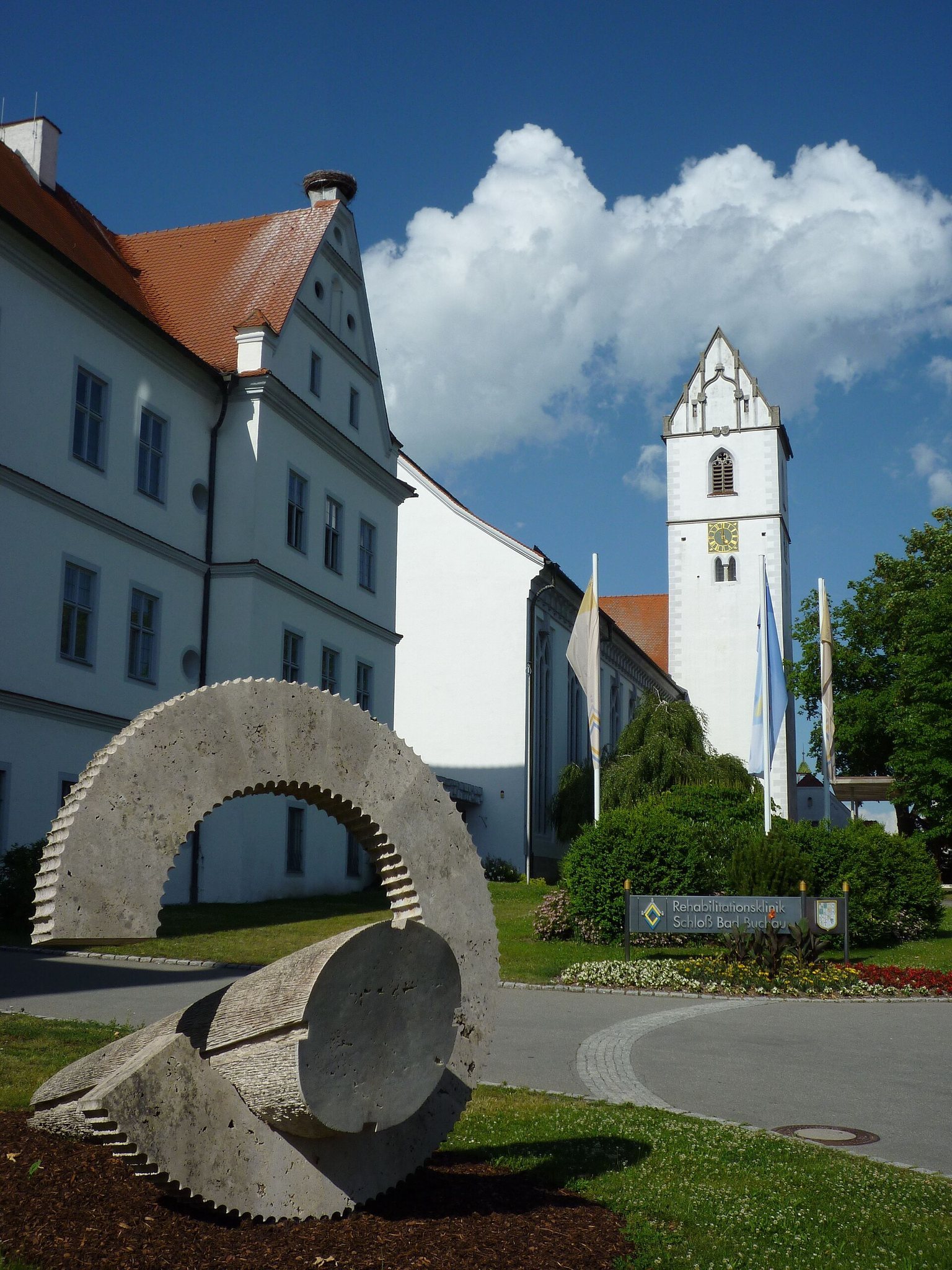
The former foundation buildings remained with the House of Thurn and Taxis until 1937 and served as an administrative seat and residences. During the National Socialist period, they housed a training institution of the National Socialist People’s Welfare organization. After 1945 they were briefly used as French barracks. The Diocese of Rottenburg then acquired them and operated a Caritas children’s sanatorium there from 1947 to 1979. The buildings passed into private ownership in 1986. Restoration, extensions, and modernization in 1991 and 1992 converted the complex into a rehabilitation clinic for neurology and psychosomatic medicine. The former abbey church remains a Catholic parish church.
Remains
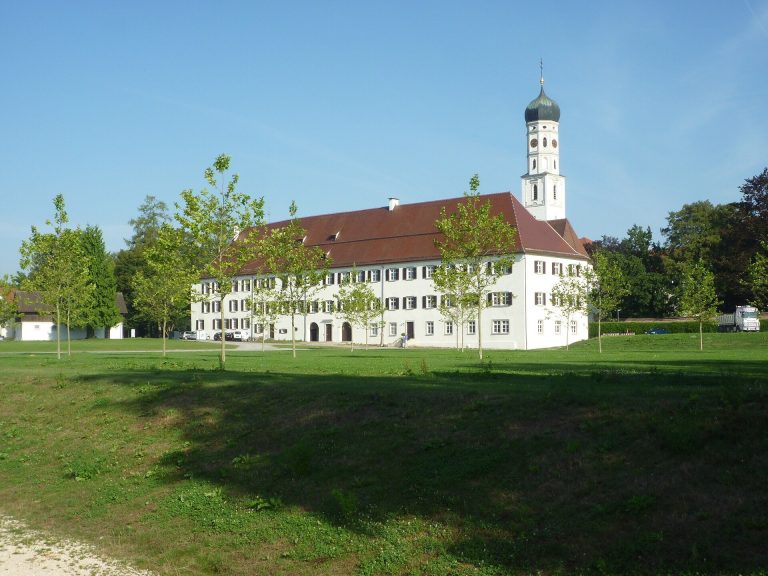
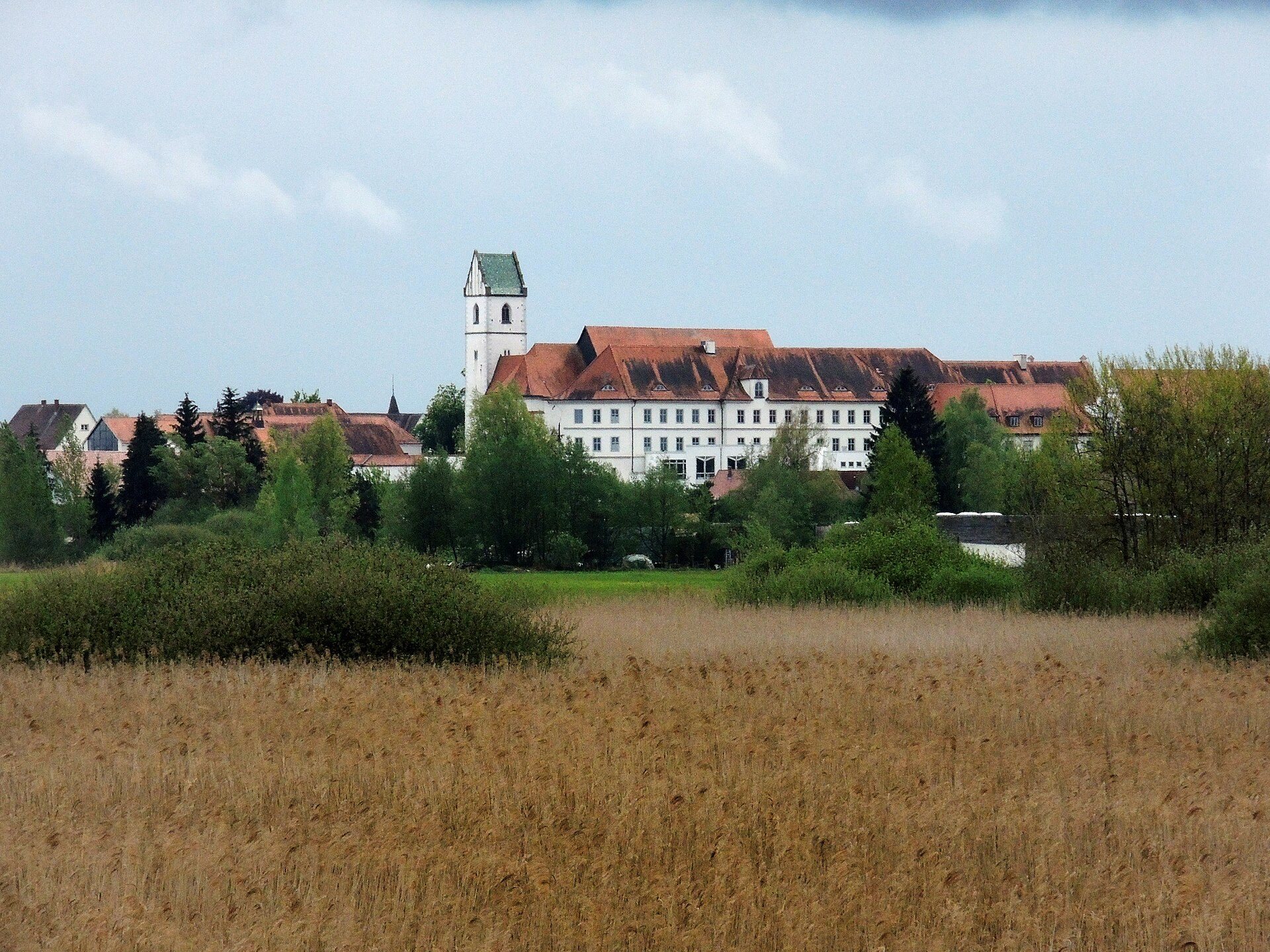
The surviving complex combines the former abbey church, a Romanesque crypt beneath its choir, and foundation buildings rebuilt after the Thirty Years’ War and renewed during the eighteenth century. The buildings and enclosed precinct preserve the physical framework of an institution that developed from an early medieval religious house into an imperial and territorial foundation.
Abbey church
The church of Saints Cornelius and Cyprian stands on the site of an earlier Gothic church. Pierre Michel d’Ixnard rebuilt and refurbished it during the 1770s, completing the present building in 1776. It is regarded as one of the earliest Neoclassical buildings in southern Germany, while retaining late Baroque features. Neoclassicism drew on Greek and Roman architectural forms, whereas late Baroque design was associated with more ornate decoration. The interior contains stucco sculptures by Johann Joseph Christian, made from moldable plaster used for architectural ornament.
Romanesque crypt
A three-aisled Romanesque crypt, a partly underground chamber beneath a church, survives beneath the choir. Dating from the middle of the eleventh century, it was rediscovered in 1929. The crypt contains the sarcophagus of Adelindis, the traditionally venerated founder of the monastery. A grave associated with Adelindis was rediscovered in 1939, and the sarcophagus is placed within the crypt.
Foundation buildings
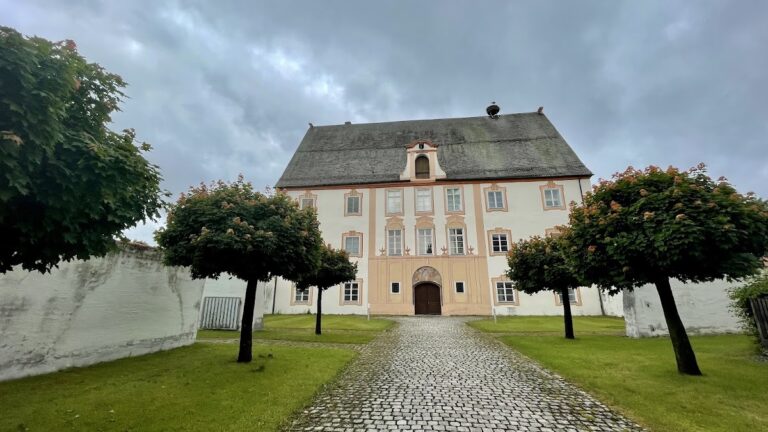
The foundation buildings were rebuilt in 1657 and extensively renewed during the eighteenth century. Giovanni Gaspare Bagnato built a new main building for the abbess in 1747, after earlier involvement in the construction of the foundation buildings from 1767. A separate cavalier building, intended as an associated residence or administrative structure, was erected in 1709. The buildings later accommodated administrative, residential, military, medical, and rehabilitation uses. Their restoration, extension, and modernization in 1991 and 1992 created the present clinic complex.
Precinct and landed possessions
A wall enclosing the foundation precinct is first mentioned in 1508. The wider complex was connected with the agricultural possessions administered by the abbey, including its farms and the Cornelian estates distributed among numerous settlements. These lands, together with the abbey’s tithes, patronage rights, fiefs, bailiwicks, and lordship of Straßberg, supported the territorial administration that Buchau exercised before secularization.