Schweppermannsburg: A Medieval Hilltop Castle Ruin in Germany


Site at a Glance
- Rating
- 4.6
- Popularity
- Very Low
- Country
- Germany
- Primary era
- Medieval
- External website
- Open
- Eras represented
- Medieval
- Civilizations
- Duchy of Bavaria, Holy Roman Empire
- Site type
- Military
- Remains
- Castle
On this page6 sections
History
Schweppermannsburg is a hilltop castle ruin in Germany, above Pfaffenhofen in the market town of Kastl, Bavaria. Its construction date is undetermined, but the castle probably dates from the twelfth century and was associated with the medieval ministerial class, a service nobility whose members held administrative, military, or courtly roles for rulers and religious institutions.
Early settlement and medieval development
Ceramic finds indicate settlement activity in the castle area from the ninth or tenth through the eleventh or twelfth century. Pfaffenhofen formed part of the original endowment of Kastl Monastery, a medieval religious foundation at Kastl, and its settlement may have continued from the eighth or ninth century. Archaeological excavations in 2004 also revealed more extensive building activity during the thirteenth century.
The castle first appears in written evidence in the Treaty of Pavia of 1329. At that time, half of the complex passed to Ludwig the Bavarian, the fourteenth-century Duke of Bavaria who later became German king and Holy Roman Emperor. Hartung Schweppermann, the son of the Bavarian nobleman Seyfried Schweppermann, held part of the castle from 1335 to 1352. By the end of the fourteenth century, Ulrich Schweppermann was its lord, and the Schweppermann family subsequently gave the castle its present name.
Destruction and conservation
Swedish troops destroyed the castle during the Thirty Years’ War, the European conflict fought from 1618 to 1648. The complex was provisionally rebuilt afterward, but it began to deteriorate in the early nineteenth century. Toward the end of the twentieth century, the ruin was incorporated into a conservation plan. On 24 October 2007, ownership passed from the Free State of Bavaria to the chair of the Amberg section of the German Alpine Club.
Schweppermannsburg is protected in Bavaria as both an archaeological monument and a listed architectural monument. The archaeological protection includes evidence of hilltop settlement from the Late Hallstatt and Early La Tène periods, successive phases of Iron Age Central European culture, as well as settlement from the Early Middle Ages. The archaeological monument is listed under file number D-3-6635-0121, while the architectural monument is recorded as D-3-71-132-63.
Remains
Setting and castle layout
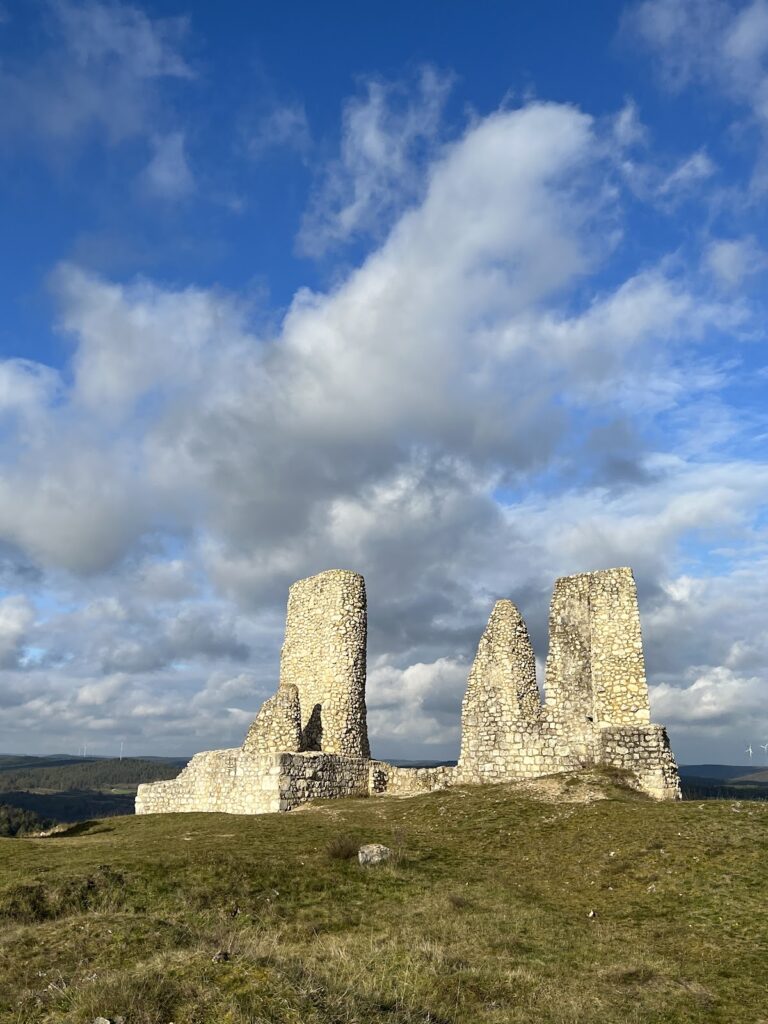
The restored ruin stands at approximately 420 metres above sea level directly east of Pfaffenhofen. It occupies a mountain spur of the Pfarrberg, whose summit reaches 570.2 metres, and the spur projects approximately northwest into the Lauterach valley. The castle is a spur castle, a fortified site built on a projecting ridge that uses the surrounding slopes for defence. Its layout consists of a fore-castle and a main castle. The main castle contains a bergfried, the principal defensive tower of a medieval German castle, which was generally separate from the residential hall.
Archaeological evidence
The castle area preserves archaeological evidence of hilltop settlement during the Late Hallstatt or Early La Tène period and the Early Middle Ages. Ceramic material also indicates earlier settlement activity extending from the ninth or tenth through the eleventh or twelfth century. These remains place the medieval castle within a longer sequence of occupation on the hilltop.
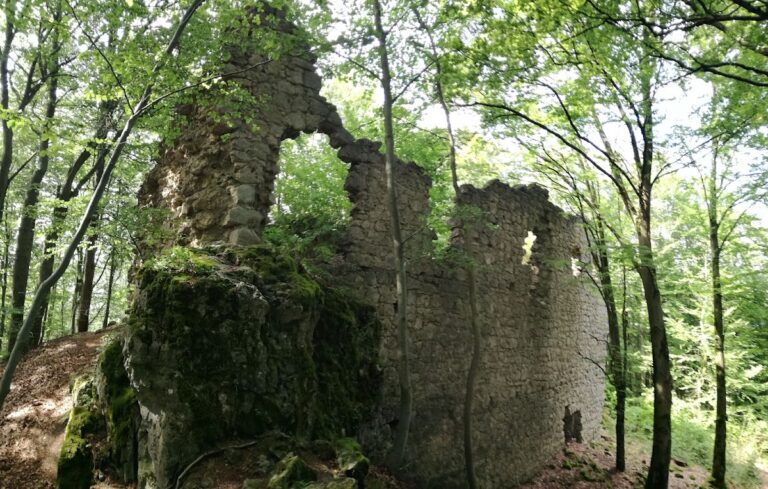
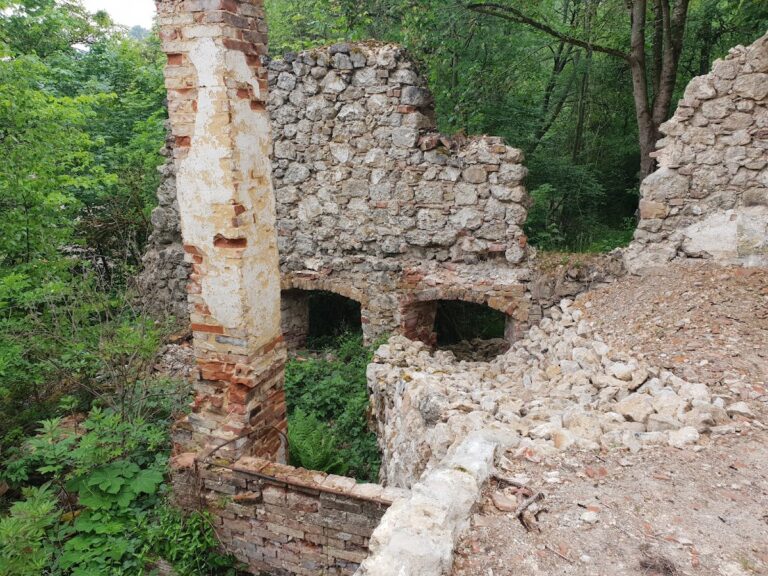
Today, Schweppermannsburg survives as a restored ruin. The fore-castle remains accessible, while the main castle and its bergfried are closed to access.
Nearby sites