Fast Castle: A Coastal Courtyard Fortress on Scotland’s North Sea Coast


Site at a Glance
- Rating
- 4.7
- Popularity
- Very Low
- Country
- United Kingdom
- Primary era
- Medieval
- External website
- Open
- Eras represented
- Medieval
- Civilizations
- Kingdom of Scotland
- Site type
- Military
- Remains
- Castle
On this page13 sections
History
Fast Castle is a ruined coastal fortress near Eyemouth in the United Kingdom, occupying a narrow promontory above the North Sea. Its first fortification date is unknown, but the site was inhabited during the Iron Age and later stood within the British kingdom of Bryneich and its Anglo-Saxon successor, Bernicia. Its position between steep cliffs and the sea may also have made it strategically useful on the route between England and Scotland.
Medieval stronghold
Fast Castle is first recorded in 1333. An English garrison occupied it in 1346 and used the fortress as a base for raids into the surrounding countryside. In 1410, Patrick Dunbar, the second son of the 10th Earl of Dunbar and March, seized the castle and imprisoned its governor, Thomas Holden. Under its new Scottish governor, William Haliburton, the castle remained involved in border warfare. Haliburton captured Wark Castle in Northumberland in 1419.
The fortress later passed to the Home family, a prominent Scottish noble family whose name is pronounced “Hume.” In 1503, members of the family hosted Margaret Tudor, the elder daughter of Henry VII of England, during her journey to marry James IV of Scotland. This royal marriage connected the castle with one of the important diplomatic events between the two kingdoms.
Destruction and rebuilding
The defeat of Scotland at the Battle of Flodden in 1513, where James IV was killed, led to a struggle for power during the minority of his successor. The Regent Albany, John Stewart, Duke of Albany, governed Scotland while nobles including Alexander Home, 3rd Lord Home and Chamberlain of Scotland, contested influence. Fast Castle was destroyed during the conflict in 1515. Alexander Home was executed in 1516 and his estates were forfeited.
The castle had been rebuilt by 1522, when the Home estates were restored to Alexander’s brother, George Home, 4th Lord Home. The fortress was captured again by English forces in 1547 during Henry VIII’s Rough Wooing, a military campaign intended in part to force a marriage alliance between Henry’s son Edward and Mary, Queen of Scots. Fast Castle had returned to Scottish control by Mary’s visit in 1566. Local tradition credits Madge Gordon, a widow from Coldingham, with encouraging its recapture.
Late sixteenth-century conflicts
After the castle returned to the Homes, the English ambassador Nicholas Throckmorton stayed there with Alexander Home, 5th Lord Home, on 11 July 1567. In April 1570, an English force led by William Drury briefly occupied Fast Castle while the Earl of Sussex besieged Hume Castle during operations against rebels and their Scottish supporters. Some of the castle’s artillery was then taken to Berwick-upon-Tweed, including two brass merlins and four falcons, types of early cannon.
Anne Percy, Countess of Northumberland, was lodged at Fast Castle in March 1570 after the Rising of the North, an unsuccessful Catholic rebellion against Elizabeth I of England. Ownership later passed through the widow of Lord Home to Sir Robert Logan of Restalrig. In April 1584, the keepers of Fast Castle, Innerwick, and Tantallon were ordered to surrender their castles to the Crown.
Logan, abandonment, and investigation
Logan became implicated in the Gowrie conspiracy, an alleged 1600 plot involving members of the Ruthven family to seize the young King James VI. In 1594, he employed the mathematician John Napier to search Fast Castle for hidden treasure, offering him one-third of anything found. Logan died in 1606, and his estates were forfeited in 1609. His exhumed corpse was subsequently put on trial.
By the early seventeenth century, Fast Castle was already ruinous. It passed briefly to the Douglas family, then to the Earls of Dunbar, the Arnot family, the Homes, and finally the Hall family. After the Battle of Dunbar, it was surrendered to forces under Oliver Cromwell, the English military and political leader whose forces controlled much of Britain during the Wars of the Three Kingdoms. The castle was abandoned soon afterward and was recorded as a ruin by 1703.
Much of the remaining structure disappeared between 1823 and 1880, probably following a lightning strike in 1871. The Edinburgh Archaeological Field Society excavated the site from 1971 through 1986. Fast Castle is now a Scheduled Monument, a legally protected archaeological or historic site designated as nationally important, and lies just outside the St Abb’s Head National Nature Reserve.
Traditions and literary associations
Fast Castle is traditionally associated with the name Fause Castle, interpreted as “False Castle.” According to the tradition, lights were hung at the fortress to mislead ships towards rocks, where wreckers waited to plunder the wrecks. Later stories connect a cave below the cliffs with smugglers and with treasure supposedly hidden by Robert Logan. These stories remain unverified.
The castle is thought to have influenced Sir Walter Scott’s fictional Wolf’s Crag in The Bride of Lammermoor, published in 1819. Scott’s novel was later adapted by the Italian opera composer Gaetano Donizetti as Lucia di Lammermoor. Fast Castle also appears alongside Robert Logan in Nigel Tranter’s The Master of Gray trilogy and its sequel, Mail Royal.
Remains
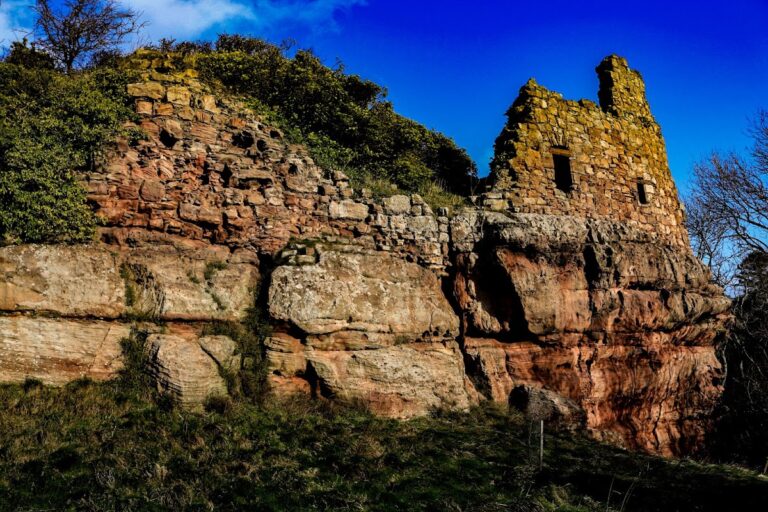
Fast Castle was a stone-built coastal courtyard fortress on a narrow, sloping promontory above the North Sea. The plateau measured approximately 27 to 30 metres across and 80 to 82 metres in length. Cliffs rising to about 45 metres on either side strengthened the natural defenses. The castle was arranged around a keep and enclosed courtyard spaces, with two courtyards set at different levels. A curtain wall, the enclosing defensive wall between towers, followed the edge of the plateau, while the keep stood at the northern end.
Fortifications and courtyards
Keep and defensive walls
The keep formed the principal fortified tower of the castle and occupied the northern end of the promontory. Rough stone masonry was used in the construction, whose arrangement closely resembles that of Dunnottar Castle in Aberdeenshire, although Fast Castle was smaller. The surviving fabric is concentrated in foundations and a section of the north-eastern wall, giving the remains their present ruinous form.
Courtyard spaces
The enclosed spaces included two courtyards at different levels. Their boundaries were formed by the curtain wall and associated towers along the edge of the plateau. The surviving foundations preserve parts of this arrangement and indicate how the built defenses occupied the restricted ground between the keep and the cliffs.
Entrances and sea access
Landward entrance
Approach from the land crossed a narrow ravine by means of a wooden drawbridge. A barbican, an outer defensive work protecting an entrance, guarded this crossing. A modern concrete bridge or footway now occupies the line of the former drawbridge.
Cliffside access
A pulley system with a basket provided access to the sea. A cave at the foot of the cliffs may also have served as an entrance route into the castle, although that function remains uncertain. The cave’s position beneath the promontory forms part of the physical setting associated with later stories about smugglers and hidden treasure.