Castle Tanstein: A Ruined Medieval Rock Castle in Germany


Site at a Glance
- Rating
- 4.5
- Popularity
- Very Low
- Country
- Germany
- Primary era
- Medieval
- External website
- Open
- Eras represented
- Medieval
- Civilizations
- Holy Roman Empire
- Site type
- Military
- Remains
- Castle
On this page8 sections
History
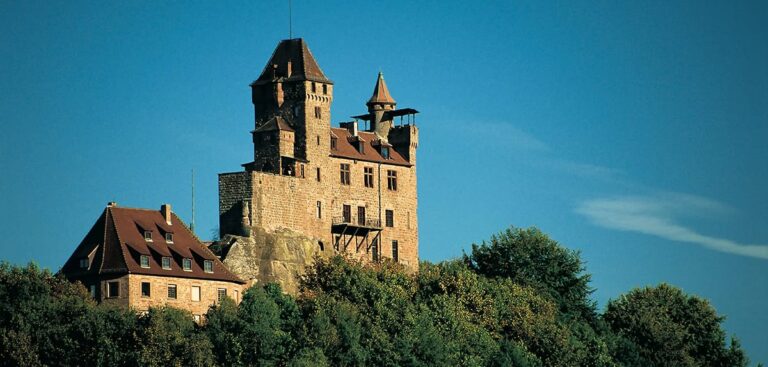
Castle Tanstein, also known as Tannstein, is a ruined medieval rock castle in Germany near Dahn. Built in the early twelfth century, it is the oldest of the three castles in the Dahn castle group, which also includes Altdahn and Grafendahn. The three fortifications were established at different times in close proximity along the ridge of a single hill.
Origins in the Twelfth Century
A document from 1127 names Anshelmus de Tannicka as the castle’s owner or administrator. This reference places the construction of Tanstein between 1100 and 1127, probably in the early twelfth century. The castle occupied a position on the ridge that later carried the three closely spaced fortifications.
Imperial and Ecclesiastical Lordship
A deed issued by Emperor Frederick Barbarossa in 1189 refers to Heinrich von der Than and describes Tanstein as an immediate imperial fief, meaning an estate held directly from the emperor rather than through an intermediate territorial lord. Later records name Ulrich of Dahn and Conrad of Dahn as imperial ministeriales, members of the medieval German service nobility who served as administrators, military retainers, and castle holders.
From 1328, Tanstein was held as a fief of the bishops of Speyer. Unlike an imperial fief, this arrangement placed the castle under the authority of the ecclesiastical prince-bishops of that diocese. Ownership changed frequently up to 1464, indicating that the fief was repeatedly reassigned and had not yet become hereditary.
Conflict, Damage, and Abandonment
Friedrich von Dahn acquired Tanstein in 1512. As an ally of the rebellious knight Franz von Sickingen, he became involved in Sickingen’s conflicts with the princes of southwestern Germany. After Sickingen’s defeat and death in 1523, the victors seized Tanstein. Troops of the Archbishop of Trier occupied the castle until 1544, an episode that probably caused irreparable damage to its fabric.
Tanstein was finally abandoned in 1585. French troops may have destroyed the ruins in 1689, at the beginning of the War of the Palatine Succession, a major European conflict fought from 1688 to 1697. French military operations caused widespread destruction in the Palatinate during that war.
Remains
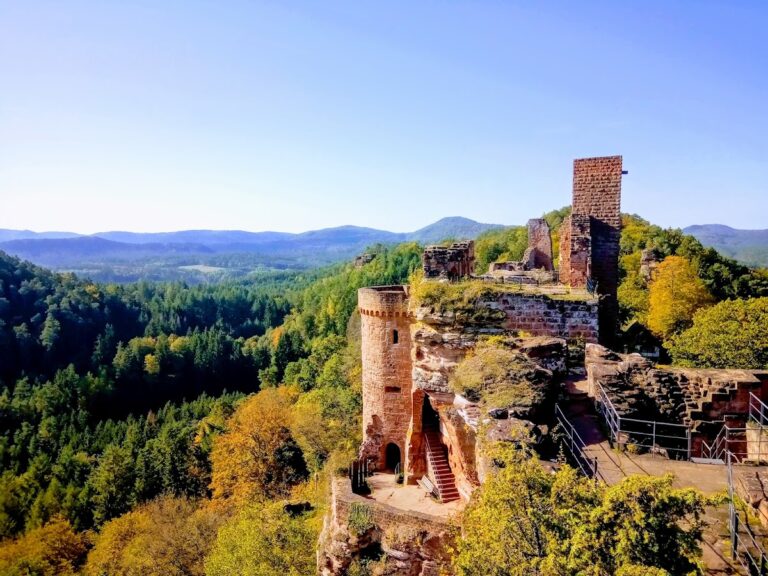
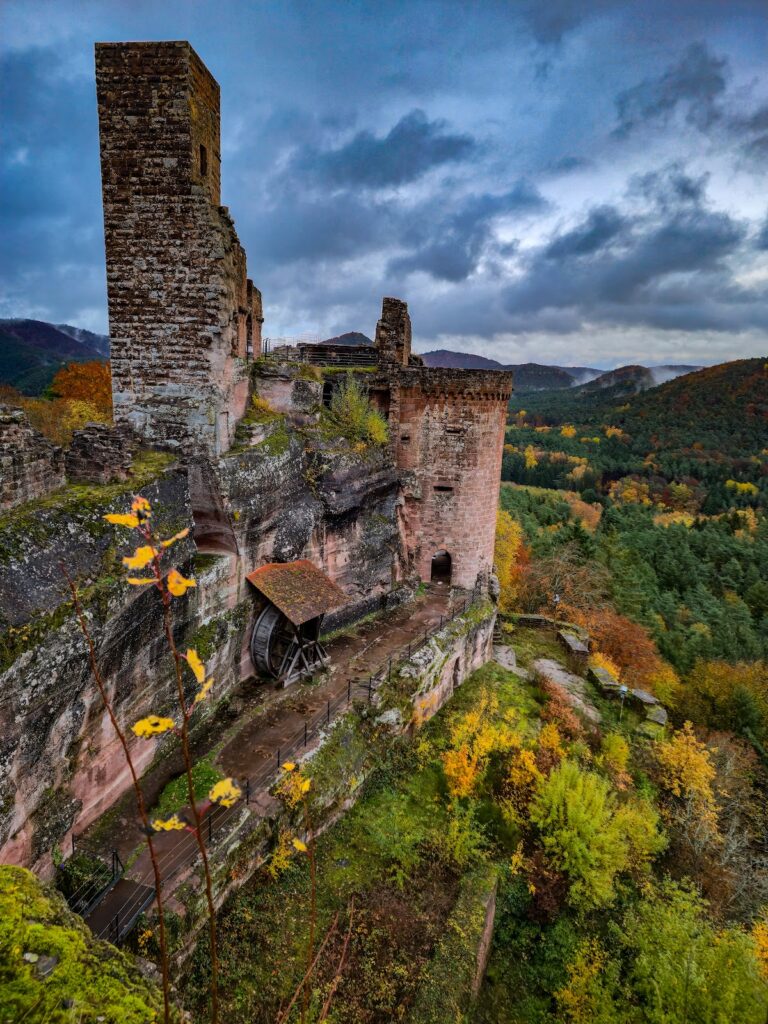
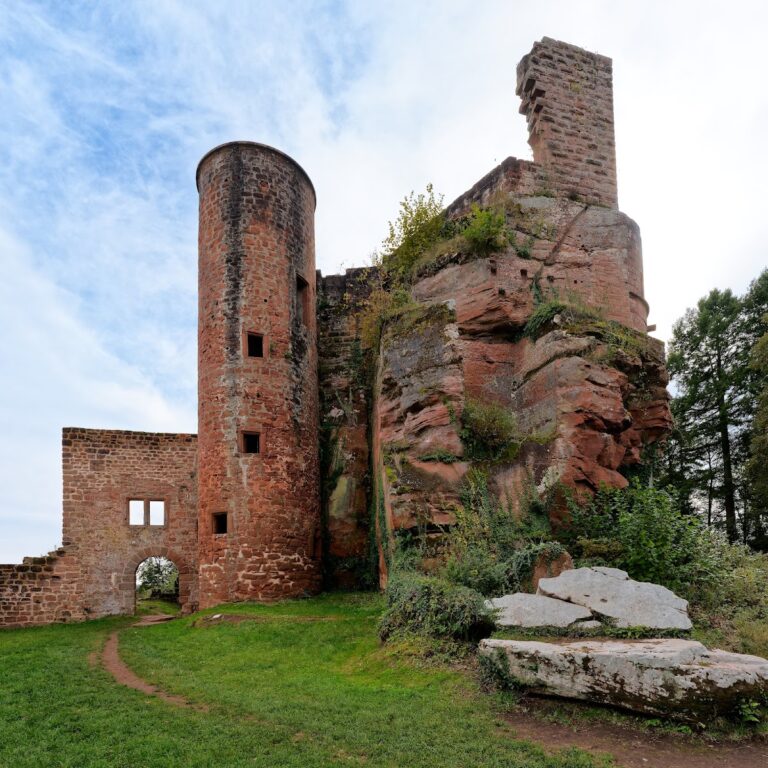
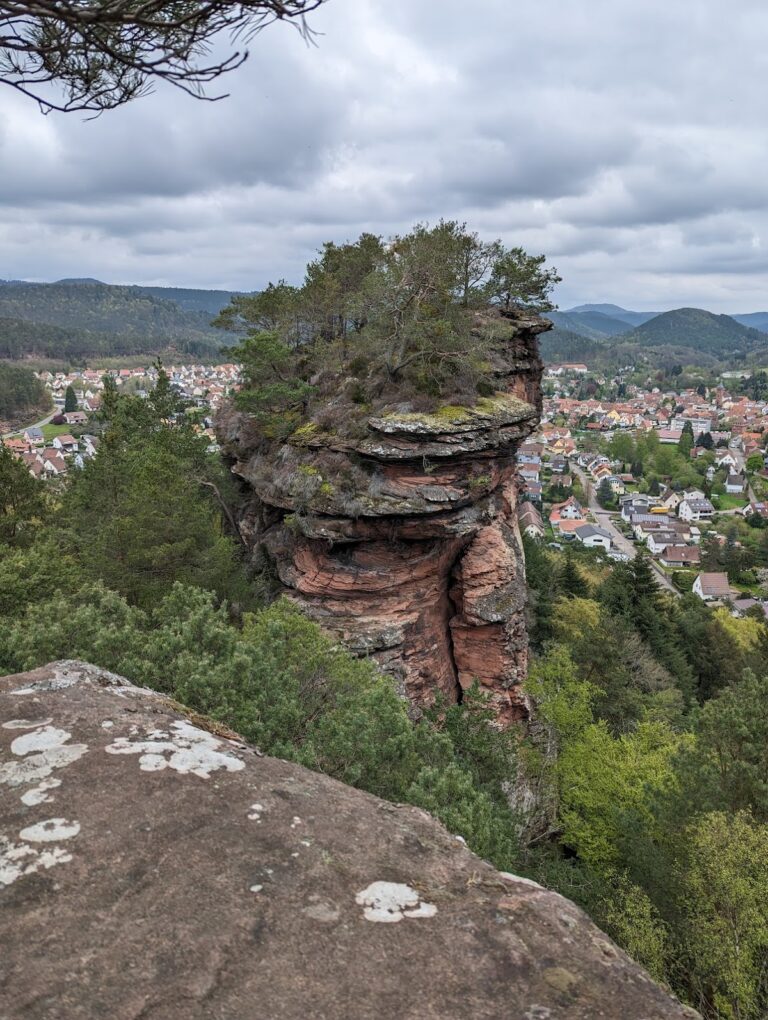
Tanstein occupies the two westernmost rock outcrops of the Dahn castle ridge. The castle formed the southwestern end of the group, while Grafendahn and Altdahn stood farther northeast. The remains lie on the 323.1-metre Schlossberg at an elevation of about 317 metres, just under one kilometre east of Dahn in Rhineland-Palatinate. The two outcrops were originally joined by a bridge, and the surviving complex is now ruinous.
Western Residential Outcrop
The western outcrop apparently carried domestic buildings constructed against the rock. Putlog holes, which held the ends of wooden building supports, together with other worked areas on the rock surface, indicate how structures were attached to it. A large cistern, a built reservoir for collecting and storing water, gathered rainwater from the roofs and formed part of the castle’s water system.
Southern Lower Ward
The southern lower ward, the lower part of a fortified complex often used for service and craft activities, retains original masonry from the fifteenth century. Its surviving features include a smithy and a smelting furnace used to extract metal from ore. The furnace remains consist of the base of a kiln and the foundation of an iron-ore smelting furnace.
Restored Rock Outcrops
Restoration work added modern parapet walls to the rock outcrops. These walls were placed arbitrarily and do not accurately convey the appearance of the former castle buildings. They stand within a complex whose surviving fabric remains in a ruinous condition.
Nearby sites