Castle Grafendahn: A Medieval Rock Castle Ruin in Germany


Site at a Glance
- Rating
- 4.4
- Popularity
- Very Low
- Country
- Germany
- Primary era
- Medieval
- Eras represented
- Medieval
- Civilizations
- Holy Roman Empire
- Site type
- Military
- Remains
- Castle
On this page11 sections
History
Castle Grafendahn is a medieval rock-castle ruin in Germany, just under 1 kilometre east of Dahn, built in 1287 by Conrad of Mursel, a vassal of the bishops of Speyer. It was designed from the beginning as a Ganerbenburg, a jointly owned castle in which several families or family lines held shares and lived or worked at the same time. Grafendahn forms the middle castle of the Dahn group, together with Altdahn and Tanstein.
Joint ownership and Sponheim control
By 1288, five other co-heirs held portions of Grafendahn alongside Conrad Mursel, including the counts of Sponheim. In 1339, Count John II of Sponheim acquired the shares held by the various parties. These included William of Winstein, who was Conrad Mursel’s son-in-law, and the count consequently became the castle’s sole owner.
The defences were strengthened in 1425. After the death of John V of Sponheim in 1437 ended the Sponheim line, an inheritance treaty transferred Grafendahn to the margraves of Baden. The castle’s later military importance was short-lived, however, because its fortifications failed to withstand a siege by Frederick the Victorious, Elector Palatine, in 1462. He captured and destroyed Grafendahn, and no systematic rebuilding followed.
Fief, ruin, and later ownership
In 1480, the Elector Palatine granted Grafendahn as a fief to Hans von Trotha, who already held a fief at Berwartstein Castle. Hans purchased the castle in 1485, but by about 1500 it was described as uninhabitable. The ruined site remained with the lords of Fleckenstein until 1637, then passed in 1642 to the Schenke von Waldenburg family, who held it for about 150 years.
In 1793, Grafendahn returned to the feudal authority of the Bishopric of Speyer, the ecclesiastical principality whose bishops held feudal power over the castle at different periods. The bishopric did not grant the ruin as a new fief. Today, Grafendahn is listed in the Rhineland-Palatinate architectural-heritage register.
Remains
Rocky ridge and wards
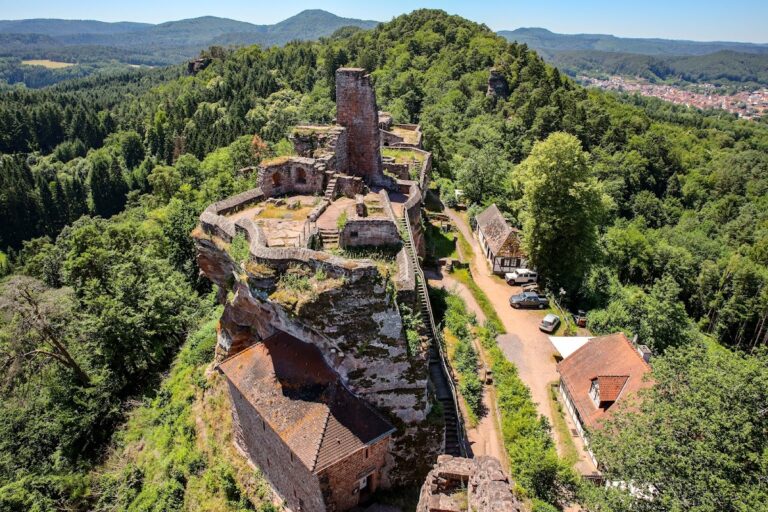
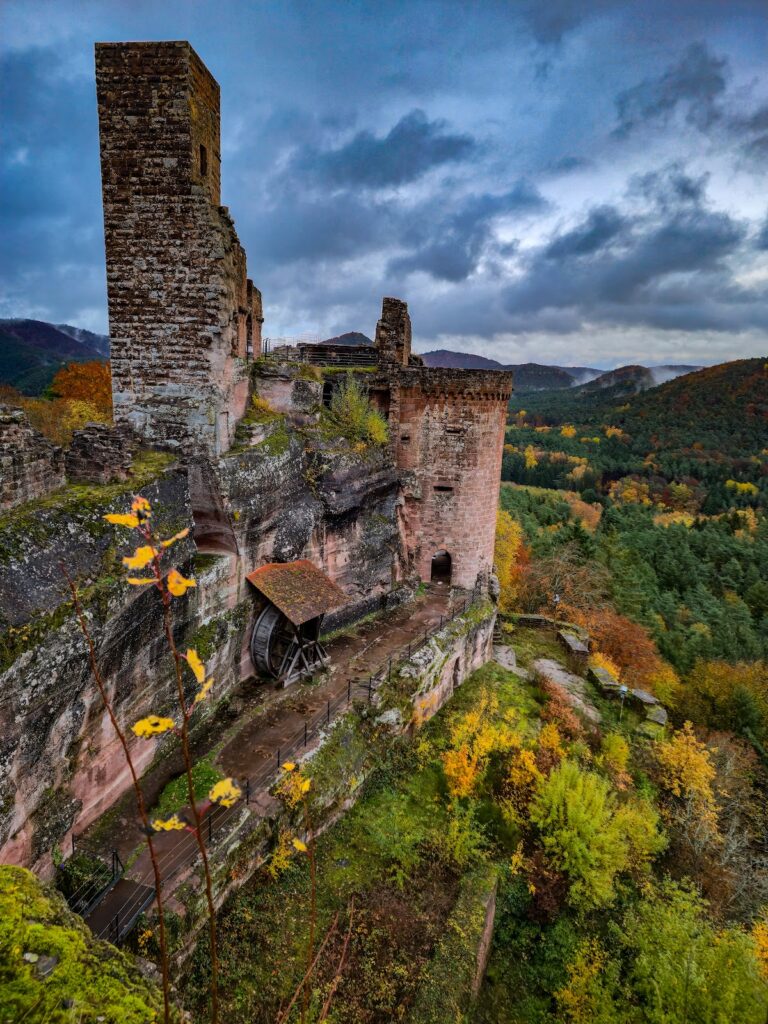
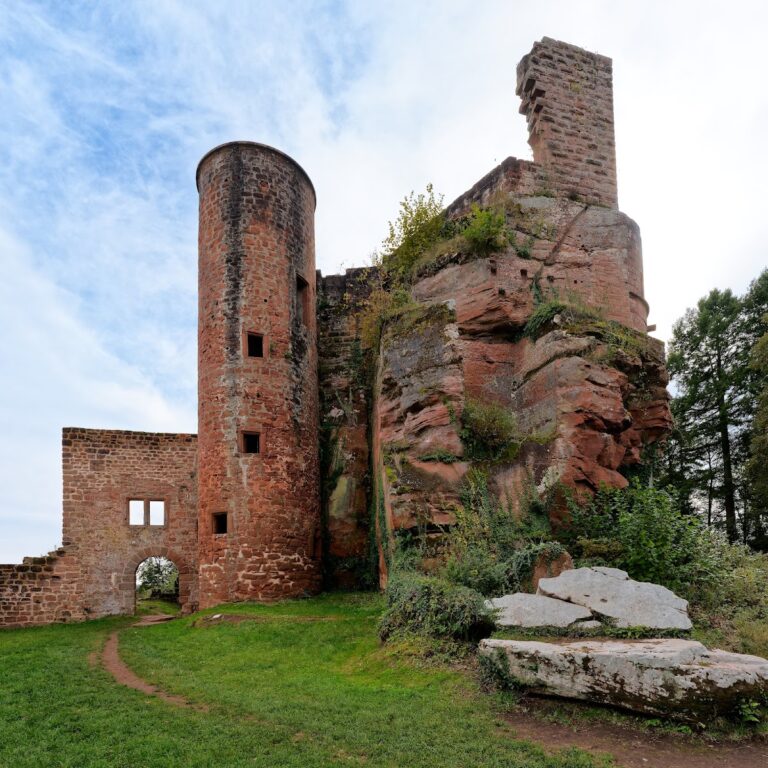
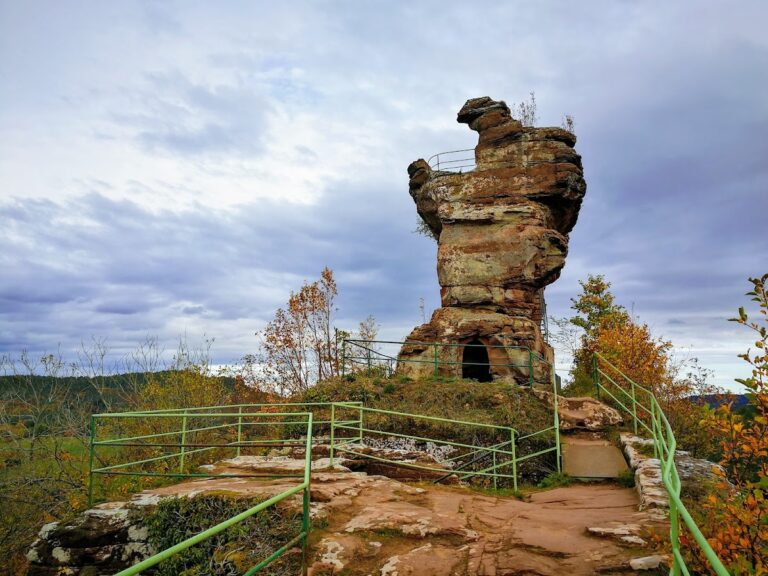
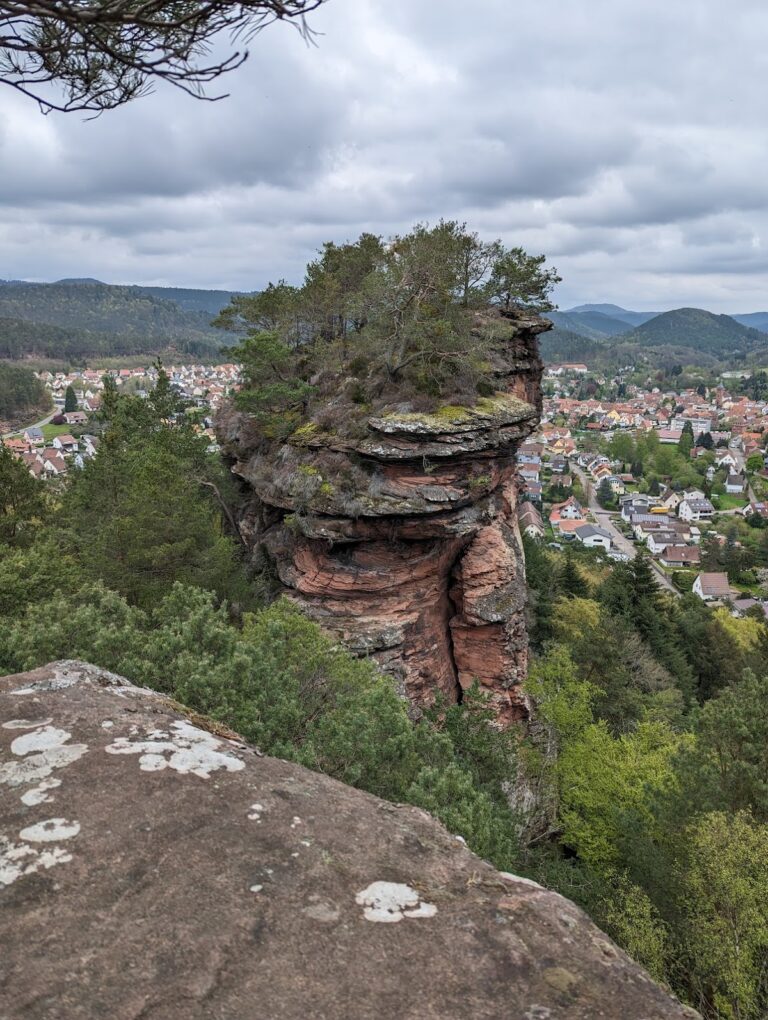
Grafendahn is the smallest of the three Dahn castles and occupies the middle of five rocky outcrops on a single ridge. Its remains stand at about 316 metres above sea level on the 323.1-metre Schlossberg in the southern Palatine Forest, the German part of the Wasgau region. The castle’s surviving layout is divided between an upper ward on the central rock and a lower ward on two narrow sandstone terraces.
Upper ward
The former arrangement of the upper ward is difficult to establish because modern parapet walls were later constructed there. In the western part, a prominent shield wall faces Tanstein. It was built from rusticated ashlar, dressed stone blocks whose outer faces project or retain a deliberately rough texture, and parts of the wall survive to their original height.
Lower ward
The lower ward preserves several chambers cut directly into the sandstone, along with cattle troughs and a well shaft. These rock-cut features occupy the two narrow terraces below the central rock and provide physical evidence of the castle’s working and residential spaces.
Residential buildings and museum
Buildings beside the shield wall
A small residential hall and further living quarters were formerly attached to the shield wall. Their position shows how the western defensive structure also formed part of the upper ward’s built accommodation.
Restored stable
A restored stable building survives within the castle complex and has housed the castle museum since 1987.
Inscribed wall
An engraved inscription on one of the castle walls gives the names Ulla Abele, Mr Bachmann, Mr Petry, and P. Löffel, together with the date 22 June 1883.