Altdahn Castle: A Medieval Rock Castle in Germany


Site at a Glance
- Rating
- 4.7
- Popularity
- Medium
- Country
- Germany
- Primary era
- Medieval
- External website
- Open
- Eras represented
- Medieval
- Civilizations
- Holy Roman Empire
- Site type
- Military
- Remains
- Castle
On this page15 sections
History
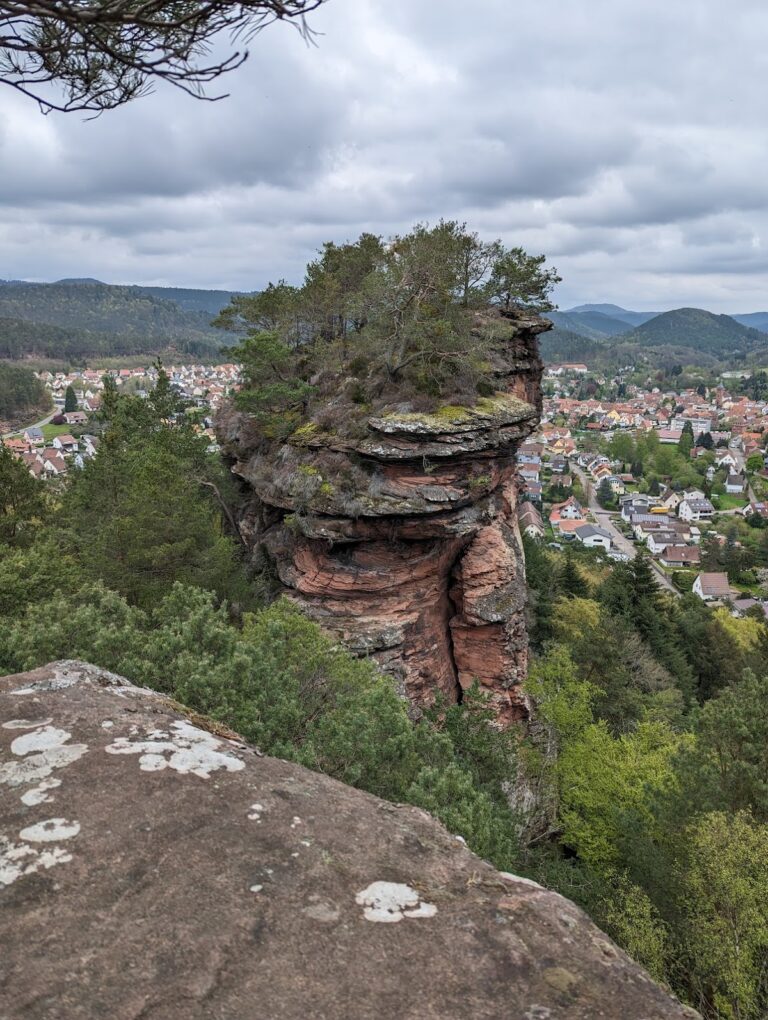
Altdahn Castle is a medieval rock castle ruin in Germany, near Dahn in Rhineland-Palatinate, built in the early thirteenth century as part of the medieval Dahn castle group. Together with Grafendahn and Tanstein, it occupies the northeastern part of a group of castles built at different times on adjacent positions along the same rocky ridge.
Foundation and feudal service
The castle was probably constructed between 1200 and 1236. In 1236, Friedrich von Dahn administered it as a feudal vassal of Konrad of Dahn, Bishop of Speyer, who was probably his relative. The occupants belonged to the ministeriales, medieval dependent nobles who served rulers or ecclesiastical lords in military, administrative, and courtly roles.
Destruction and rebuilding
Altdahn was first destroyed in 1363 during a feud between the Dahn and Fleckenstein families. A young squire seized the castle afterward and made temporary repairs, but it was destroyed again in 1372, and the squire was expelled. The Bishop of Speyer then arranged for its repair.
Further damage came in 1406 during the War of the Four Lords, a conflict fought from 1405 to 1408, particularly in the Bliesgau to the west. The walls and towers were rebuilt, but the castle burned again in 1426 and 1438, on those occasions without military action.
Decline and final destruction
After roughly two centuries of relative prosperity, Altdahn suffered during the Thirty Years’ War, a major European conflict that began as a religious and political struggle within the Holy Roman Empire before expanding into a wider war. From about 1570, the Lords of Dahn preferred their residence at Burrweiler. When the family became extinct in 1603, the castle was left to decay.
French troops finally destroyed Altdahn or made it unusable, probably in 1689, at the beginning of the War of the Palatine Succession. This European conflict, fought from 1688 to 1697, arose from a disputed succession to the Electoral Palatinate. The destruction took place under General Ezéchiel de Mélac, and the castle was not rebuilt.
Ruins and conservation
On 11 May 1820, a rockfall caused large sections of the remaining ruins to collapse, including the southern part of the main residential hall. Felix Mendelssohn Bartholdy, the nineteenth-century German composer, pianist, and artist, visited the ruins on 5 August 1844 and made drawings of them.
The Dahn Beautification Society began the first conservation work in 1877 under the Bavarian government. Restoration resumed in 1936 during the Nazi period, was interrupted by the Second World War, and continued from 1960 onward. In 2007, large cracks were found in a sandstone block weighing about 1,100 tons. Experts warned that its failure could destroy approximately one-third of the castle. Geologists installed monitoring devices, and after no further movement was recorded, they gave the all-clear in June 2008. Electronic sensors were replaced by manually readable rock monitors for continued observation. Altdahn is municipal property and remains a ruin.
Remains
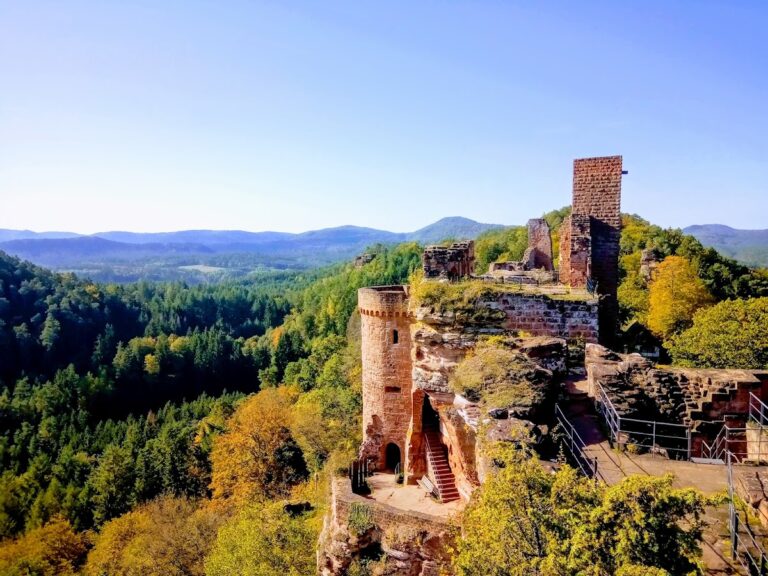
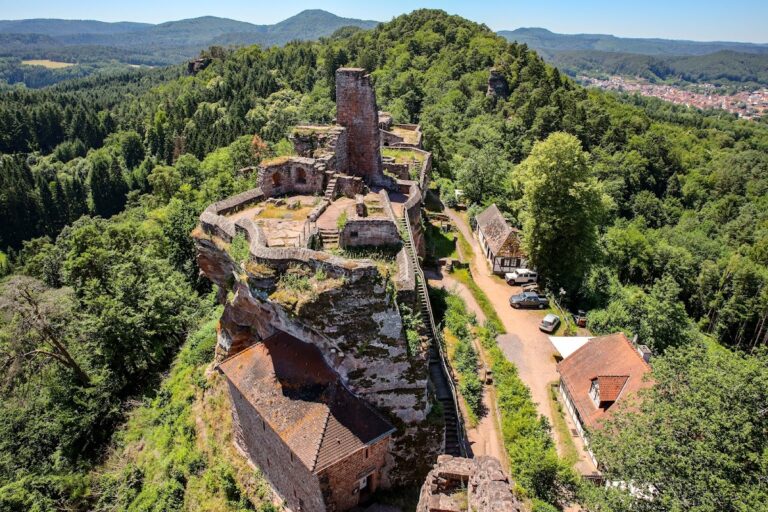
Altdahn occupies the two largest and easternmost rock outcrops of the Dahn ridge, a low rocky formation running approximately from east-northeast to west-southwest. The two outcrops extend for about 100 metres and stand on the Schlossberg, approximately one kilometre east of Dahn, at an elevation of about 318 metres above sea level. The castle is principally built of stone, and rusticated ashlar, carefully shaped blocks with deliberately rough outer faces, survives in the eastern walls.
Approach and defensive works
Gateway and neck ditch
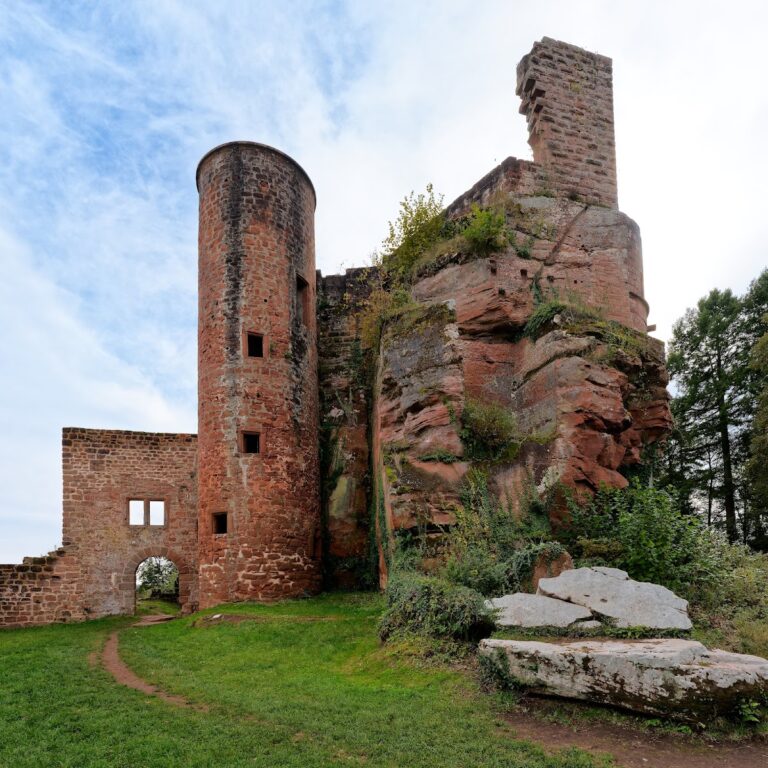
The entrance lay on the northeastern side of the castle. Its gateway system survives together with a small water-filled neck ditch, a channel cut across the ridge to strengthen the approach. The isolated eastern rock can be reached through narrow passages or by a narrow gangway.
Lower ward towers
The lower ward is dominated by two horseshoe-shaped gun turrets, one on the north and another on the south. A large lifting wheel is associated with the southern tower, forming part of the surviving defensive equipment.
Upper ward and water supply
Residential hall and watchtower
Important remains survive on the western rock outcrop, including the north wall of the palas, the principal residential or representative hall of a medieval castle, and a watchtower. An oriel, a projecting architectural feature, indicates that the watchtower may also have served as a garderobe tower, a structure containing a castle latrine.
Rock-cut cavern and cistern
The 1820 rockfall exposed a round cavern cut into the rock and widening downward in an inverted-cone shape. Its function remains uncertain, with interpretations identifying it either as a cistern or as a dungeon. Rainwater was collected in a deep rock-cut cistern, and the exposed cavern may represent that installation.
Eastern rock and museum finds
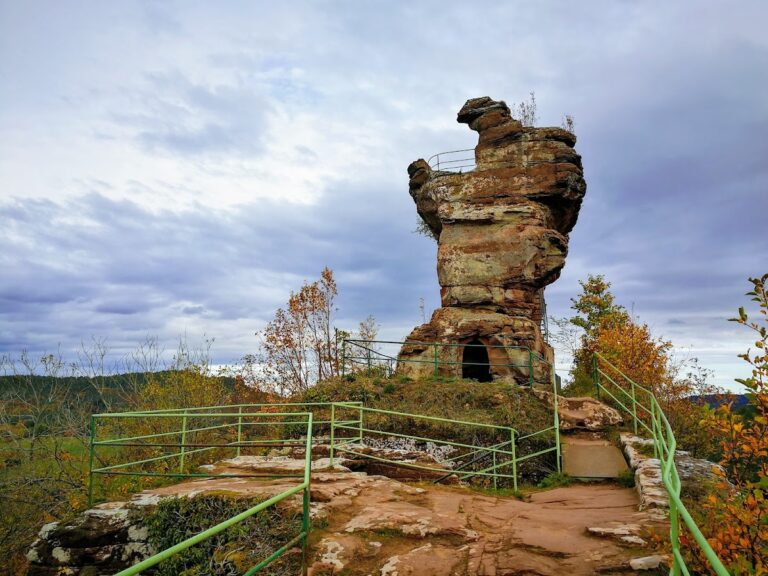
Isolated eastern rock
The isolated eastern castle rock once supported a small tower. It remains accessible through narrow passages, preserving the relationship between this outcrop and the main castle ridge.
Objects from the castle
The castle museum displays copies of Mendelssohn’s drawings of the ruins. It also contains a medieval silver spoon found during excavations, bearing the coat of arms of the Lords of Dahn.