Gamberk Castle: A Medieval Hilltop Castle Ruin in Slovenia


Site at a Glance
- Rating
- 4.2
- Popularity
- Very Low
- Country
- Slovenia
- Primary era
- Medieval
- Eras represented
- Medieval, Early Modern
- Civilizations
- Holy Roman Empire
- Site type
- Military
- Remains
- Castle
On this page9 sections
History
Gamberk Castle is a medieval hilltop castle ruin near Zagorje ob Savi in Slovenia, probably built in the late twelfth or early thirteenth century. First mentioned in 1248, it stood near an important trade route linking Ljubljana with the Savinja Valley through Moravče and Marija Reka. The castle is regarded as the ancestral seat of the Gallenberg noble family, which held an important place in Carniola, the historical region centred largely in present-day central Slovenia.
Medieval Gallenberg Seat
The castle was known in the Middle Ages as Gallenberch and also became known as Gallenberg. In 1248, Wilbirge, daughter of Konrad Gall of Gallenberg, issued a charter associated with the family. A repeated claim that Ortolf III of Scherfenberg built the castle has no documentary support, so the early history of its construction remains uncertain beyond its probable foundation period.
Sternberg and Habsburg Ownership
At the beginning of the fifteenth century, Gamberk passed to the Sternberg family. The Sternbergs sold it to the Habsburgs in 1443. The Habsburgs were a European ruling dynasty whose territories included parts of the Austrian lands and Central Europe. After the sale, the castle was repeatedly leased or pledged, reflecting changes in the administration and control of the estate.
Early-Modern Enlargement
From 1553, Jacob of Lemberg expanded the castle in a palace-like form, probably incorporating the earlier buildings into the enlarged complex. Johann Weichard von Valvasor, a seventeenth-century Carniolan nobleman and author of illustrated works on the region, recorded its appearance in an engraving after this enlargement.
Bartholomäus Valvasor acquired the Gallenberg lordship and castle in 1640. The property was sold to the Leuenburg family in 1661, and the Poor Clares of Ljubljana bought it in 1677. The Poor Clares are a Catholic female religious order in the Franciscan tradition. Later that year, Kaspar of Lichtenturn took possession and retained the property until 1769.
Abandonment and Decline
Ownership changed rapidly during the nineteenth century. From the mid-nineteenth century until 1875, a mining joint-stock company owned the castle and used it as a health resort. It then passed to other private owners and was abandoned around 1900. Valvasor’s engraving and the ruins observed around 1900 show that many features of the sixteenth-century enlargement remained recognizable before the site began to deteriorate rapidly.
Remains
Hilltop Layout and Defences
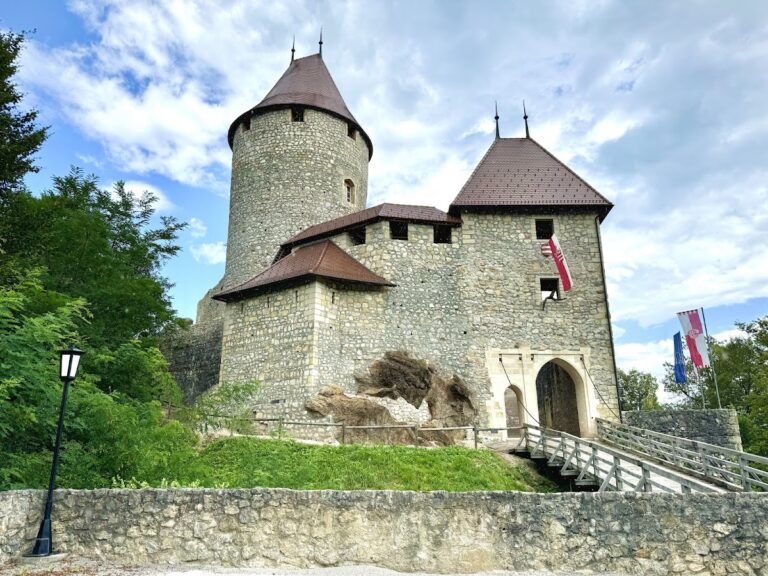
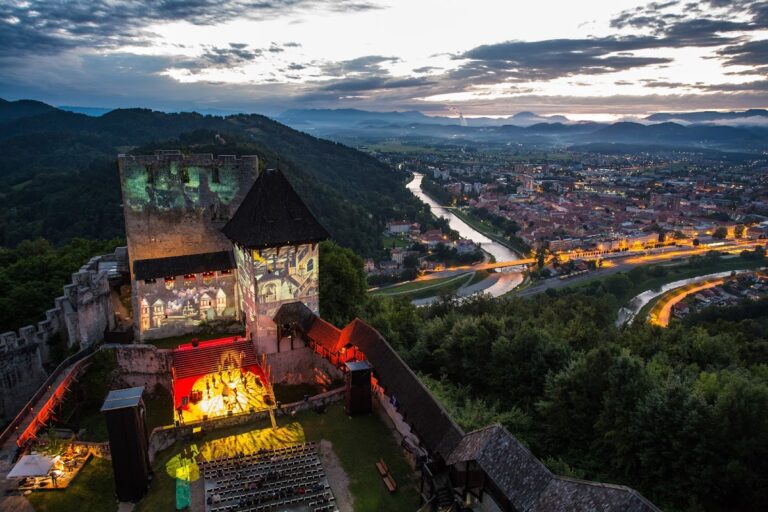
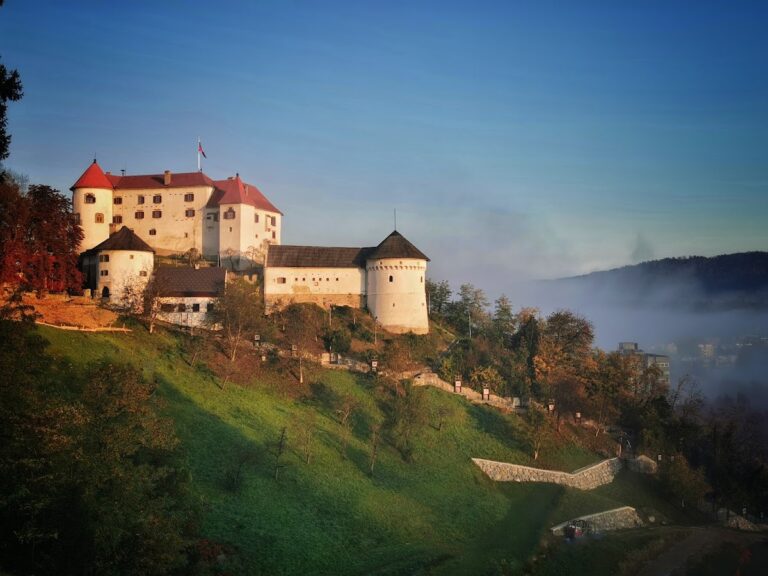
Gamberk survives as a stone castle ruin on a hilltop at approximately 525 metres above sea level. The enlarged complex had a bent, multi-storey palas, the principal residential and ceremonial building of a medieval castle. A raised round tower protected one corner. The original entrance was secured by a square bergfried, a fortified tower intended primarily as a strong defensive refuge. Substantial parts of the bergfried and multi-storey sections of the palas’s outer walls remain.
Residential Towers
At the highest point of the hill stood a rectangular residential tower or donjon, a major residential or defensive tower. The oldest building is believed to have occupied this position. Its surviving walls reach the third storey, and the upper storey still contains a projecting latrine structure. Together with the palas and bergfried, the tower preserves the principal elements of the castle’s medieval and early-modern vertical arrangement.
Gateway and Heraldic Detail
Information panels are installed below the gateway passage. Within the ruin, a Baroque double coat of arms survives with a scroll bearing a motto, providing a later decorative element among the castle’s remaining fabric.
Nearby sites