Berwartstein Castle: A Medieval Rock Fortress in Germany


Site at a Glance
- Rating
- 4.7
- Popularity
- Medium
- Country
- Germany
- Primary era
- Medieval
- External website
- Open
- Eras represented
- Medieval, Modern
- Civilizations
- Electoral Palatinate, Holy Roman Empire
- Site type
- Military
- Remains
- Castle
On this page17 sections
History
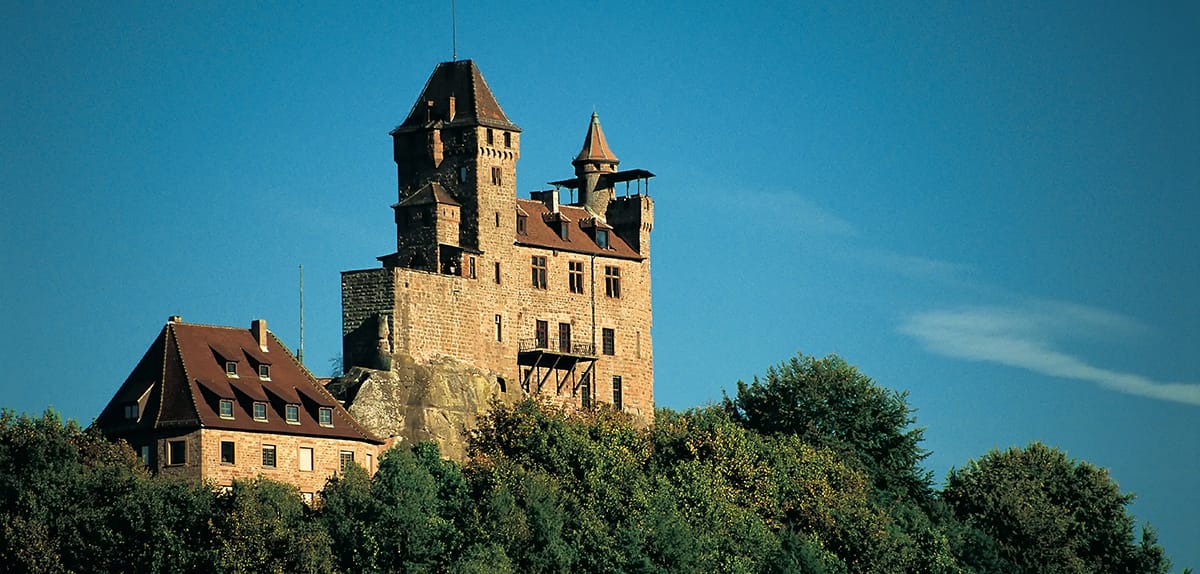
Berwartstein Castle is a medieval rock castle in Germany, situated above Erlenbach in the southern Palatinate Forest. Established before 1152 and first recorded in that year, it may originally have been an imperial castle connected with the Salian and Staufen ruling houses of the German southwest.
Imperial Origins and the Berwartstein Family
In 1152, Emperor Frederick I Barbarossa, the Holy Roman Emperor who ruled from 1155 to 1190, granted Berwartstein to Günther, Bishop of Speyer. The grant placed the castle within the emperor’s legal sphere as an imperial fief, meaning property held from the emperor. This connection has led to the interpretation that Berwartstein belonged to the network of castles associated with the Salian and Staufen rulers.
During the thirteenth century, the Berwartstein family administered the castle as ministerials of Speyer. Ministerials were service nobles who carried out administrative or military duties for a bishop, ruler, or territorial lord. The family’s position ended in a conflict over raiding. Troops from the Alsatian cities of Strasbourg and Hagenau besieged Berwartstein for five weeks, captured it, and destroyed or dismantled its defenses in 1314. The castle was later rebuilt and remained with the family until its male line died out in 1345.
Weißenburg Abbey and the Palatine Electors
The related Lords of Weingarten sold Berwartstein and its associated properties to Weißenburg Abbey in 1347 for 800 gulden. Weißenburg Abbey was a Benedictine institution in Alsace. Because Berwartstein was an imperial fief, Emperor Louis the Bavarian confirmed the transaction in 1347, followed by King Charles IV in 1348.
In 1453, the abbey placed itself under the protection of the Elector of the Palatinate. This arrangement included an opening right, a feudal privilege that allowed the protecting lord to occupy and use a dependent institution’s fortifications during wartime. During a feud in 1472, the Eckbrechte of Dürkheim seized Berwartstein and sold it to the elector. Weißenburg Abbey continued to claim ownership, but Elector Philip the Upright granted the castle as an hereditary fief to his marshal Hans von Trotha in 1480.
Hans von Trotha and the Water Feud
Hans von Trotha strengthened Berwartstein’s defenses and contributed to its reputation as impregnable. In 1484, he built the nearby outwork later called Klein-Frankreich. The name Hans Trapp, associated with regional legends about his conduct, became attached to him in later tradition.
The transfer of Berwartstein’s rights to Hans von Trotha led to the dispute known as the Water Feud. He dammed the nearby Wieslauter, depriving Weißenburg, about 8 kilometers downstream, of water. After Abbot Heinrich complained, the dam was demolished, causing a major flood at Weißenburg. Emperor Maximilian I placed Hans under the imperial ban in 1496. An imperial ban was a formal exclusion from imperial protection and law. After the monastery appealed to Pope Innocent VIII, Pope Alexander VI imposed a church ban, or excommunication, in 1499.
The elector eventually had to distance himself from Hans von Trotha, although Hans retained effective control of Berwartstein until his death in 1503. The sanctions were lifted posthumously in 1505. The Water Feud entered regional legend, and wall paintings in the castle’s Knights’ Hall represent its events.
Fleckenstein, Waldenburg, and the Ruin
After Hans von Trotha’s son Christoph died without male heirs in 1545, Berwartstein passed to Christoph’s son-in-law Friedrich of the Fleckenstein family. A lightning strike caused a major fire around 1590 or 1591, after which Berwartstein remained a ruin. The Fleckenstein-Niederrödern line held the fief until it died out in 1637, when the property reverted to its lord.
In 1641, Freiherr Gerhard von Waldenburg received Berwartstein, Grafendahn, and their associated properties. The Waldenburgs held the lordship until 1793. The ruin then changed owners several times. Klein-Frankreich was severely damaged during the seventeenth century, either in the Thirty Years’ War, fought from 1618 to 1648, or in the War of the Palatine Succession, which lasted from 1688 to 1697. Both conflicts caused extensive destruction in the castles and settlements of southwest Germany.
Nineteenth-Century Reconstruction and Later Use
Theodor von Baginski acquired the ruins in 1893 and rebuilt and enlarged Berwartstein during the 1890s. Much of this work did not follow the medieval structure closely, and several visible parts were reconstructed without historical accuracy. Baginski moved into the castle in 1899 and lived there until his death in 1929.
The partially restored castle remains privately owned and inhabited. It is officially designated as the residential locality “Berwartstein (Castle and Restaurant)” and is described as the only still-inhabited castle in the Wasgau. Restoration of the surviving remains of Klein-Frankreich began in 2005.
Remains
Setting and Rock-Cut Construction
Berwartstein occupies a western spur of the 410.9-meter Grünberg at approximately 277 to 280 meters above sea level. It stands above Erlenbach and historically controlled the side valley through which the Erlenbach flows. The valley joins the Lauter, known in its upper course as the Wieslauter, about 3 kilometers south of the castle. The position places the castle within the southern Palatinate Forest, in the German part of the Wasgau.
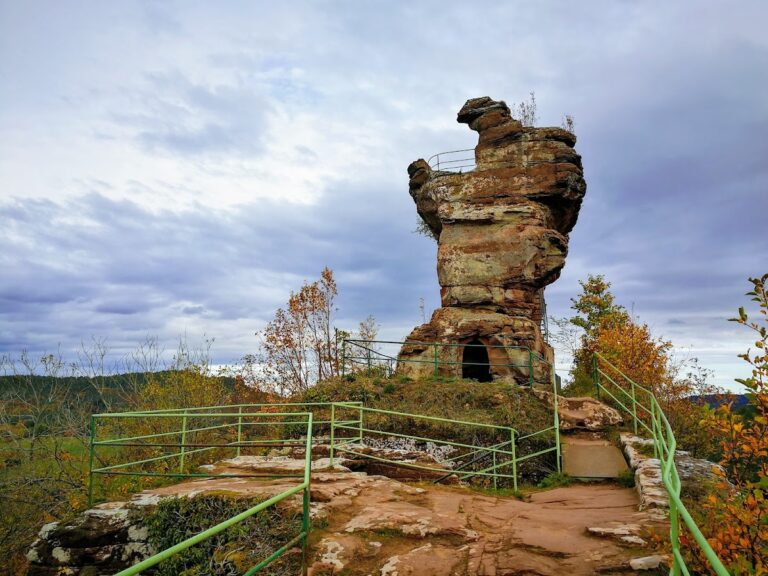
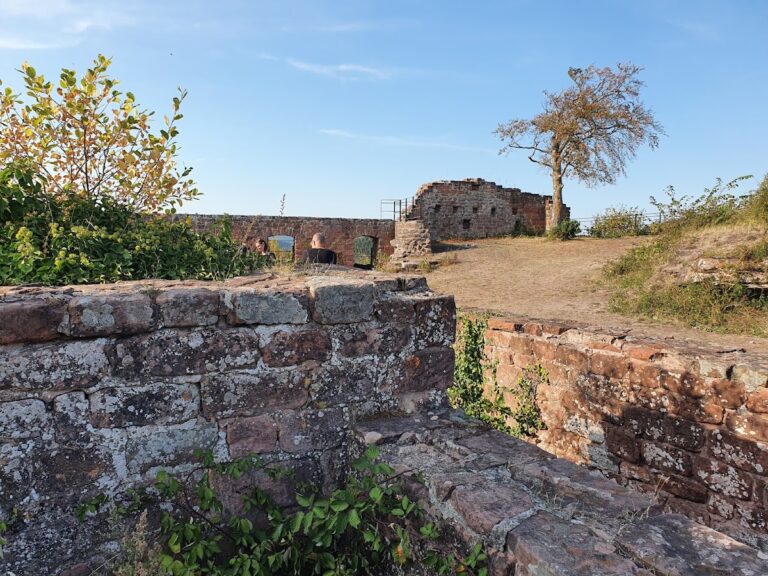
The upper castle extends across more than 400 square meters and is largely cut into naturally formed sandstone. Stairs, corridors, chambers, and other interior spaces penetrate the large upper rock, creating a complex cave system. The surviving masonry includes bossed ashlar, stone blocks with raised rough faces, and clamp holes. Although the complex appears largely intact, much of the visible construction belongs to the nineteenth-century rebuilding rather than to the original medieval rock castle.
Rock-Cut Interior and Defensive Works
Castle Well
A castle well was cut vertically by hand through the rock to the water-bearing layer beneath the valley floor. Its depth is given as approximately 100 meters, with another measurement of about 104 meters, while a depth of 75 meters would have reached the groundwater level. The shaft remains about 2 meters in diameter throughout its depth and supplied water during sieges.
Underground Passages and Casemates
The deepest rock-cut areas, apart from the well shaft, comprise extensive underground passages and casemates. Casemates are protected enclosed spaces used for defense, storage, or artillery. These areas served defensive purposes. A concealed passage is traditionally said to have connected Berwartstein with Klein-Frankreich, but that claim remains unsubstantiated. It arose after the discovery near the outwork of a ditch covered with stone slabs and hidden beneath soil and vegetation. The ditch has largely collapsed.
Ascent Chimney
A distinctive ascent chimney is cut into the southeastern side of the castle rock. This steep, smooth natural shaft rises through rock more than 50 meters high and overhangs in places. It was formerly the only route upward from that side, giving the approach a defensible character.
Knights’ Hall and Castle Buildings
Knights’ Hall
The surviving southern wall of the Knights’ Hall is formed from weathered gray bedrock. The hall could accommodate about 150 people. A lift shaft cut into the wall allowed food and drink to be lowered from the kitchen above. Wall paintings inside the hall depict the Water Feud and preserve the castle’s connection with the regional tradition surrounding Hans von Trotha.
Kitchen, Armory, and Chapel
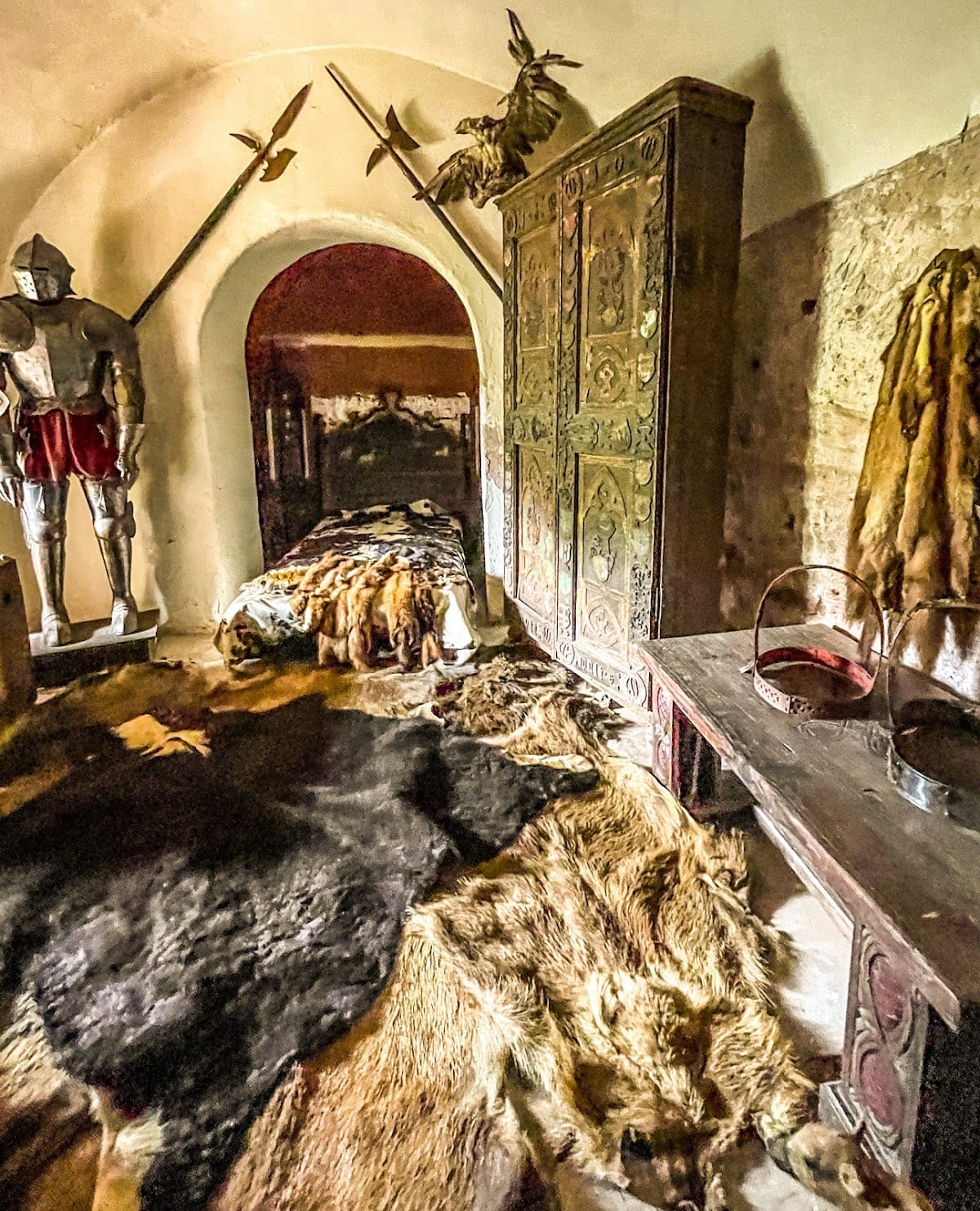
The castle kitchen, armory, and torture chamber contain replicas of medieval equipment. Historical catapults and guns are displayed on the castle grounds. A castle chapel is also identified within the complex. The principal buildings, the keep, rock-cut passages, parts of the original fortifications, and the chapel survive in differing states of preservation.
Klein-Frankreich
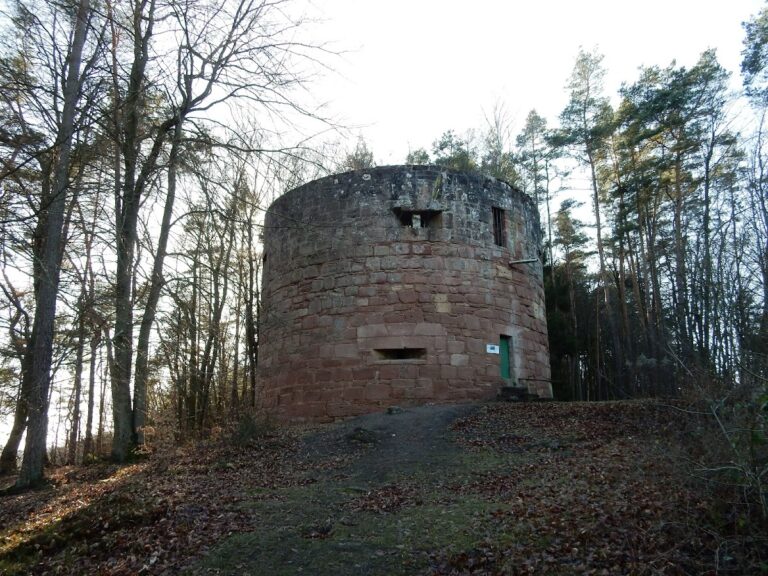
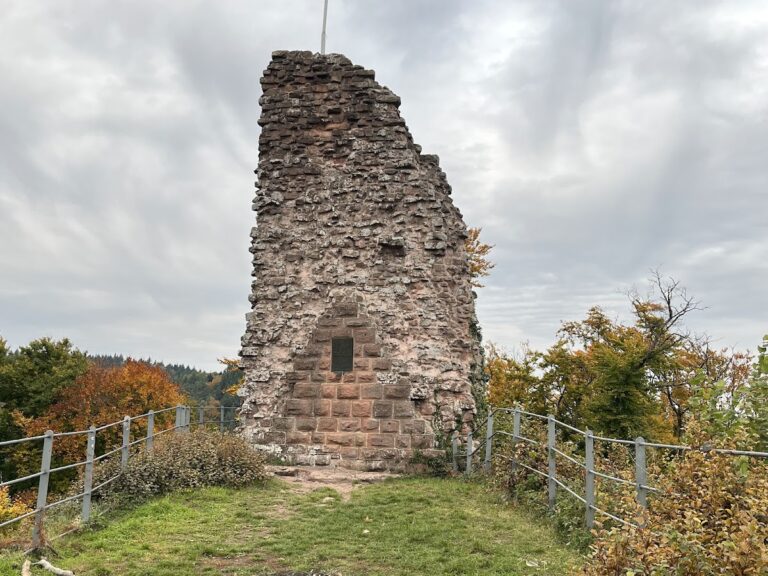
Klein-Frankreich was a fortified outwork of Berwartstein. An outwork is an advanced fortification placed in front of a principal castle to delay or obstruct attackers. The ruin lies on the northern slope of the 401.5-meter Nestelberg, south of the main castle and about 370 meters away in a straight line across the valley. Its remains include a tower described as 14 meters thick. The surviving structure has undergone restoration since 2005.
Keep and Surviving Views
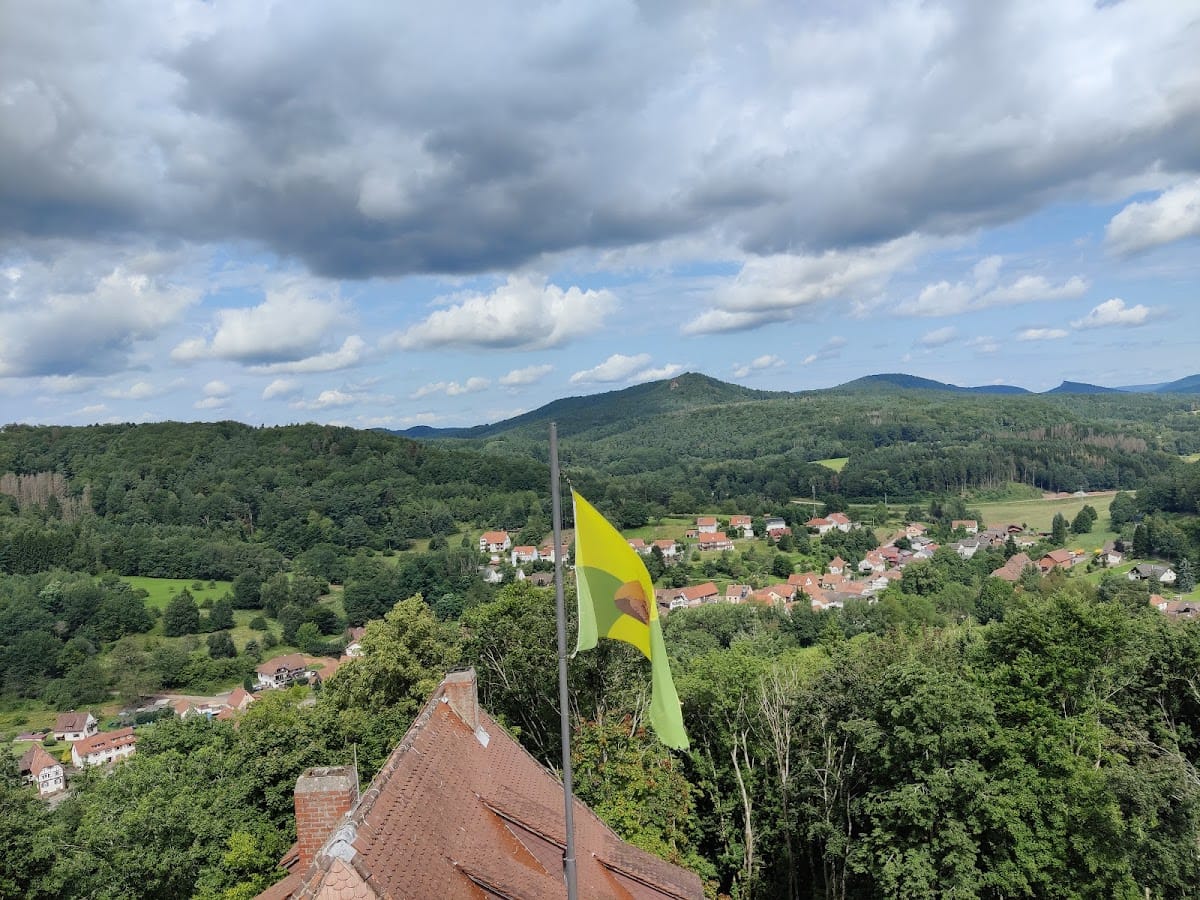
The keep, the castle’s principal fortified tower, forms part of the surviving complex. A viewing platform below the summit provides a view across the southwestern Wasgau toward Alsace. Together with the rock-cut rooms, underground defenses, chapel, Knights’ Hall, and surviving fortification sections, it forms a complex whose present appearance combines medieval remains with extensive nineteenth-century reconstruction.