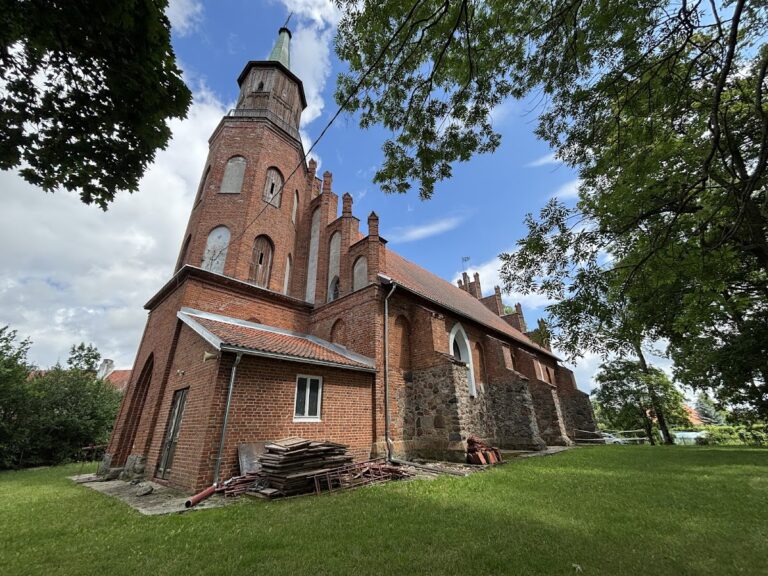
Boyen Fortress: A Prussian Defensive Stronghold in Poland


Site at a Glance
- Rating
- 4.4
- Popularity
- High
- Country
- Poland
- Primary era
- Modern
- External website
- Open
- Eras represented
- Modern
- Civilizations
- Kingdom of Prussia
- Site type
- Military
- Remains
- Fort
On this page15 sections
History
Boyen Fortress is a Prussian fortification in Giżycko, Poland, built between 1843 and 1856 in the 19th-century military tradition to protect the eastern borders of East Prussia from the Russian Empire. It formed a principal link in the region’s defensive chain and occupied an isthmus between the Masurian lakes, whose wetlands and waterways strengthened its strategic position.
Planning and construction
Plans for the fortress began in 1818, shaped by the experience of the Napoleonic Wars and the work of Generals von Grolman and von Boyen. The decision to proceed was taken on 9 August 1841. After Generals von Grolman, von Krauseneck, and von Aster inspected the proposed site in 1842, it was approved for construction.
Initial work started on 5 April 1843 with the levelling of the ground and the digging of wells near the planned keep. The foundation stone was laid on 4 September 1844. Johann Leopold Ludwig Brese, also known as Leopold von Brese-Winiary, designed the project. Work begun under General von Aster was completed in 1846 according to plans by Major Westphal. Major fortification works continued from 1847 to 1855, and completion was recorded in 1856.
On 24 December 1846, King Frederick William IV of Prussia, who ruled from 1840 to 1861, officially named the fortress Feste Boyen. The name honoured Hermann von Boyen, a Prussian military officer and war minister who had persuaded the king to establish the stronghold near Lötzen. Three bastions received the names Leopold, Ludwig, and Hermann, corresponding to von Boyen’s given names. The remaining three were called Recht, Schwert, and Licht, words associated with his family motto.
First World War
During the First World War, about 4,000 soldiers, including auxiliary units, were stationed at the fortress and in its vicinity under Colonel Hans Busse. During the Battle of Tannenberg and the wider East Prussian campaign, Russian forces encircled Giżycko and the fortress area but halted about 16 kilometres from the town. Boyen itself was not attacked, although its artillery supported field units and the defence of Giżycko.
The fortress commandant rejected a Russian surrender proposal on 27 August 1914. A German division broke the encirclement on 7 September. The garrison also maintained communications with higher command by carrier pigeon. The station enabled messages from Giżycko to reach Königsberg, Szczecin, and Wrocław.
Interwar change and Second World War uses
After the First World War, the fortress was considered obsolete. Some facilities were placed in storage, while major buildings were adapted for rear-area purposes, including use as a hospital and storage space.
From 1941 to 1944, the site housed a field hospital. General Franz Halder arrived there on 10 October 1941 for treatment of a broken collarbone sustained in a riding accident at Mamerki. After the failed assassination attempt against Adolf Hitler at the Wolf’s Lair on 20 July 1944, Dr Giesing, the hospital’s chief laryngologist, travelled to Hitler’s headquarters on 22 and 23 July for medical consultations. The Wolf’s Lair was Hitler’s wartime headquarters in East Prussia.
A section of the German Army High Command’s Foreign Armies East department also operated at Boyen. This department analysed military intelligence concerning the Soviet Union and Eastern Europe. Under Colonel Alexis Freiherr von Roenne and subordinate to General Reinhard Gehlen, the facility was code-named “Emma” and occupied a barracks building where captured front-line documents were examined.
The same facility recruited Soviet officers for cooperation with Germany. Officers came from several prisoner-of-war camps. Those who refused could be sent to the prison in Ryn, while those who agreed were held in a separate fortress sector equipped with a dining hall, cinema, and library. The sector was intended for about 100 people. Andrei Vlasov was held at Boyen from 16 July to 4 September 1942 before being transferred to Vinnytsia in Ukraine. The fortress may also have contained a training centre for officers of the Russian Liberation Army, a German-sponsored formation recruited mainly from Soviet prisoners and anti-Soviet collaborators, although this attribution remains probable rather than certain.
A laboratory at the fortress tested the quality of food supplied to the Wolf’s Lair. German forces abandoned Boyen without a fight in 1945.
Polish administration and preservation
After the Second World War, the Polish Army administered the fortress. Parts of the complex were later transferred to civilian food-processing enterprises, most of which closed after 1989. A 200-place youth hostel operated on the grounds for an extended period. Following the military withdrawal, unrestricted public access contributed to deterioration, and fires damaged granaries in 1996 and 1997.
Boyen Fortress was recognized as an architectural monument in 1975 and entered Poland’s monument register as A-984 on 6 January 1994. The Society of Friends of Boyen Fortress was formed in September 1993 and began caring for the site. It received most of the fortress from the city in 1994 and the central courtyard area in 2001. Its work has included supervision, repairs, conservation, historical exhibitions, organized routes, and guided access. The complex continues to contain a museum and exhibitions, and it is used for historical reconstructions and cultural events.
Remains
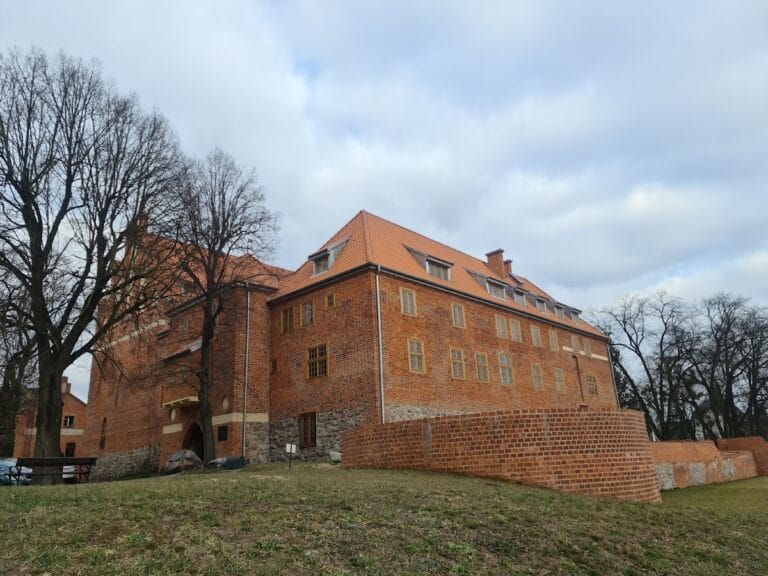
Boyen Fortress occupies approximately 100 hectares on a narrow isthmus in western Giżycko, between Lake Kisajno, the southern part of the Mamry lake complex, and Lake Niegocin. The central fortification follows a seven-pointed star plan, reinforced by substantial earth ramparts, walls, and moats. Bastions, casemates, barracks, powder facilities, wells, and other military buildings formed a permanent stronghold prepared for a garrison of about 3,000 soldiers.
Fortifications and defensive works
The star-shaped central fortification is enclosed by earthworks and water-filled defensive features. The complex includes external bastions, a Carnot wall, and vaulted casemates. A Carnot wall is a defensive wall associated with a rampart and intended to provide protected positions for infantry. A casemate is a protected, usually vaulted chamber used for troops, storage, artillery, or other military purposes. Most of the fortification structures have been repaired, and most are open to visitors.
Entrances and transport connections
Lötzen and Giżycko gates
Four entrances are associated with the fortress: the Giżycko Gate, the Kętrzyn Gate, the Water Gate, and the Powder Gate. The principal entrance is the double Lötzen Gate, approached across a drawbridge before the inner gate. The Giżycko Gate is linked with a barracks building and the defensive area between the Ludwig and Leopold bastions.
Kętrzyn Gate
The Kętrzyn Gate faces the building that housed the fortress’s carrier-pigeon station. One of the two approach roads to the fortress led from Kętrzyn, while the other came from Giżycko.
Water Gate and railway branch
The Water Gate served as an auxiliary entrance and had a lifting drawbridge. It was closed when the railway line was built. A railway branch was connected to the fortress during its development.
Barracks and specialist facilities
Giżycko Gate barracks
A barracks building beside the Giżycko Gate, between the Ludwig and Leopold bastions, was designed for approximately 500 soldiers. During the Second World War, it housed the “Emma” intelligence facility. Later, it accommodated a youth hostel and the Boyen Fortress Museum. The former hostel has since been converted into an exhibition gallery.
Carrier-pigeon station
A separate building near the Kętrzyn Gate housed the fortress’s carrier-pigeon station. During the First World War, the station supported rapid communication between Giżycko and Königsberg, Szczecin, and Wrocław.
Open-air theatre and exhibition spaces
An open-air theatre was established outside the main walls, within the fortress moat and a ravelin. A ravelin is an external triangular defensive work placed in front of a fortress wall or gate. The grounds also contain exhibition galleries, a museum, and food-service premises. Historical displays concern the fortress and its past, and the site includes a relief of General Hermann von Boyen.