Przemyśl Fortress: An Austro-Hungarian Defensive Complex in Poland


Site at a Glance
- Rating
- 4.7
- Popularity
- Low
- Country
- Poland
- Primary era
- Modern
- External website
- Open
- Eras represented
- Modern
- Civilizations
- Austria-Hungary, Habsburg
- Site type
- Military
- Remains
- Fort
On this page9 sections
History
Przemyśl Fortress is an Austro-Hungarian defensive complex in Poland, surrounding Przemyśl on both banks of the San. Built during the mid-nineteenth century, it guarded the Przemyśl Gate between the Sandomierz Basin and the Carpathians, where an old trade route linked Poland and Ruthenia with Hungary. Its importance grew after Przemyśl became a major railway and road junction on the Vienna to Lviv route in the late nineteenth century.
Planning and construction
After the First Partition of Poland in 1772, Galicia came under Austrian rule as the Kingdom of Galicia and Lodomeria. Worsening relations between Austria and Russia, particularly after the Crimean War, encouraged the fortification of Austrian cities. A State Fortification Commission considered several locations, including Stryi, Lviv, Andrychów, Zalishchyky, and Przemyśl. Major Staff officer and quartermaster Emmerlich Blagojevič supported Przemyśl as a position on both sides of the San and as Galicia’s principal barrier protecting the routes to Hungary. Archdukes Charles and John also supported the choice, and Emperor Franz Joseph ordered construction to begin in 1871.
The project plan was completed in 1873, with an estimated cost of 24 million florins and a planned construction period of 24 years. Intensive work began in 1878, after the Russo-Turkish War of 1877 to 1878 further strained relations with Russia. Fortification continued until the First World War but was never fully completed because of financial limitations. Barracks, housing, stables, bakeries, hospitals, and stores built for the garrison contributed to Przemyśl’s rapid expansion. The population rose from 10,140 in 1860 to 54,692 in 1910, including Roman Catholic, Jewish, and Greek Catholic communities.
Preparation for war
Military manoeuvres held in the unfinished fortress in 1892 and 1896 led to improvements in several positions. By 1914 the complex had three defensive lines, although insufficient funds, interruptions, and the long construction cycle meant that only the outer ring was adequately prepared. Przemyśl was one of approximately 200 major permanent fortifications in Europe in 1914 and was then the third-largest fortress after Antwerp and Verdun.
The fortress was commanded successively by Anton Werner, Fryderyk Pollini, Julian Roszkowski, Edward Pucherna, Ferdynand Siedler, Fryderyk Solwegen, Jan Terkulja, Hermann von Colard, and Hermann Kusmanek. At the outbreak of war, its garrison comprised approximately 128,000 people, 14,500 horses, 1,022 guns, and about 4,000 wagons. The force was later increased to about 131,000 people and 21,000 horses. It included the 23rd Honved Infantry Division, the Honved being the Hungarian component of the Austro-Hungarian forces, several Landsturm brigades made up chiefly of reserve and auxiliary troops, fortress artillery, railway-security units, and marching formations. The complex was divided into eight defensive sectors.
Between 14 and 18 August 1914, approximately 27,000 workers carried out emergency improvements to the outer defenses. They added seven intermediate works, 24 shelters, 50 kilometres of protected communications and infantry lines, 200 gun positions, about 1,000 kilometres of wire entanglements, and new minefields. The fortress received 714 guns, 52 howitzers, 95 mortars, and 72 machine guns. Its medical services were based at the 3rd Garrison Hospital in Przemyśl. The hospital commander, senior staff physician first class Paweł Jaglarz, was captured after the city fell and died in Kokand on 22 January 1916.
The First World War sieges
The first siege began on 17 September 1914, when Austro-Hungarian forces withdrew behind the San after defeats near Lviv and Rava-Ruska. The fortress was ordered to delay the Russian advance and protect the retreat. About 91,800 Russian troops under General Shcherbachov attacked the eastern forts on 3 October and the northern forts on 8 October. Russian troops briefly entered Fort I/1 Lysychka but were surrounded and defeated. The siege ended on 10 October with a Russian defeat. Russian losses were estimated at about 10,000 killed, wounded, or missing. The garrison lost approximately 313 killed, 1,282 wounded, and 290 missing.
The second siege began on 5 November 1914. Rather than immediately assaulting the defenses, the Russian army encircled the fortress and cut its supplies. Severe winter conditions, reduced rations, disease, and desertion weakened the garrison, which also slaughtered almost 10,000 horses. A breakout attempt between 17 and 19 March 1915 failed, causing approximately 5,500 casualties among the killed, wounded, and missing. On 20 March, after consultation with the Army High Command, the fortress command ordered its destruction and surrender.
From 18 March, the defenders destroyed food stocks and military material. On 22 March they blew up guns, forts, stores, bridges over the San, and other installations. The capitulation document reached Russian headquarters at 6:00 on 23 March 1915, after which Russian troops entered the city. Tsar Nicholas II visited the captured fortress on 2 April to honor the Russian forces. After the Russian front was broken at the Battle of Gorlice on 2 May, Austro-Hungarian and German troops advanced eastward while retreating Russian forces used the less-damaged forts and built additional defenses.
The fortress was encircled again on 18 May, and the decisive attack began on 31 May against the northwestern defenses. The 22nd Bavarian Infantry Regiment captured Fort X Orzechowce and Fort XI Duńkowiczki, while an Austrian rifle battalion captured Fort XII. Fort Xb Zagrodnia and Fort IXa Krzyż surrendered. Austro-Hungarian and German forces entered Przemyśl on 3 June after Russian troops destroyed the bridges over the San and withdrew. Archduke Frederick, commander-in-chief of the Austro-Hungarian army, arrived on 6 June.
Later history
During fighting between the Ukrainian Galician Army and Polish forces around Przemyśl in November 1918, 18 soldiers of the Husiatyn Battalion of the Ukrainian Galician Army were killed in the fortress area. After the First World War, the complex lost its strategic importance and gradually deteriorated. Its damaged forts were declared protected monuments of military architecture in 1968, and Przemyśl entered Poland’s National Programme for the Protection and Conservation of Military Architecture in 1997. In January 2019, President Andrzej Duda designated Przemyśl Fortress a Monument of History.
A legend connected with Fort XIII San Rideau claims that two Russian prisoners were forgotten inside the fort when it was destroyed in 1915. The story later formed the basis of the 1984 film Fort 13.
Remains
Przemyśl Fortress occupies Przemyśl and the surrounding hills on both banks of the San. Its outer defensive ring extended for approximately 45 kilometres and contained 17 principal forts, 14 permanent gun batteries, two permanent trench lines, and two permanent infantry bases. The inner defensive system contained 21 forts. Together, these works formed three defensive lines, supported by trenches, minefields, wire entanglements, shelters, protected communications, intermediate works, infantry lines, and numerous artillery positions.
Outer defensive ring
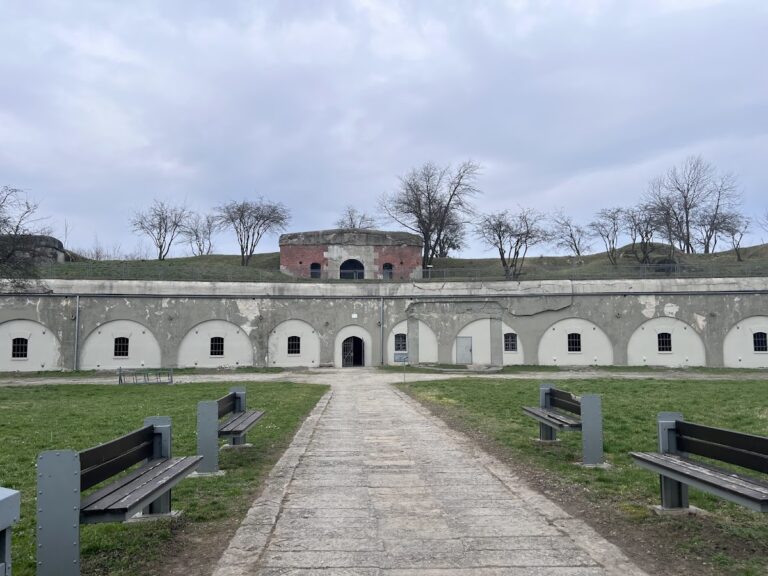
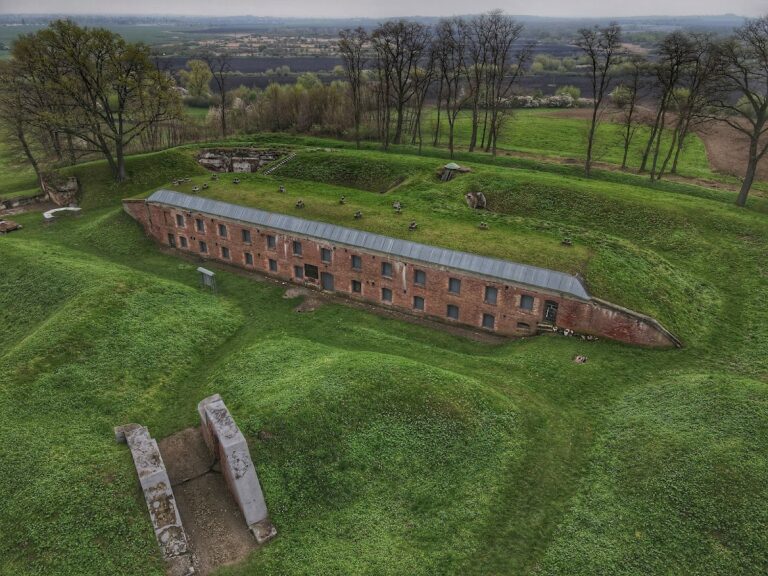
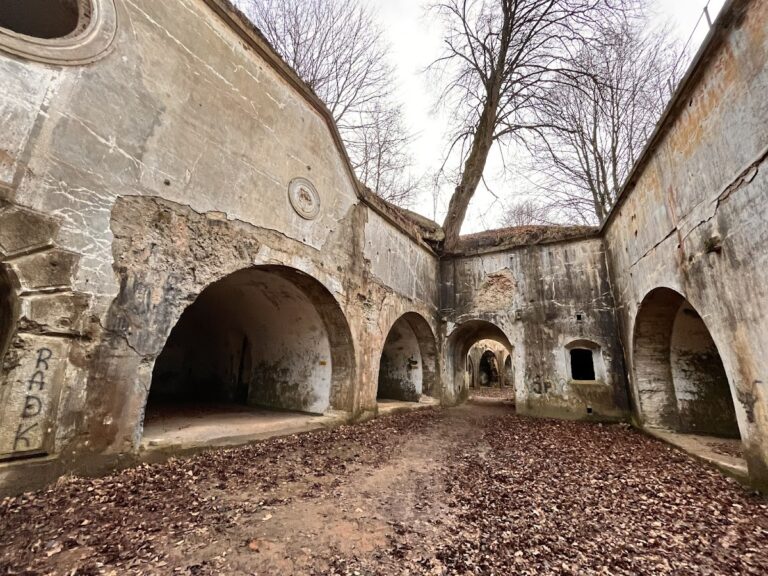
The surviving outer works include numbered and named forts such as I/1 Lysychka, I/2 Byków, I/3 Pleszowice, I/4 Maruszka Las, I/5 Popowice, I/6 Dziewięczyce, IV Optyń, IXa Krzyż, X Orzechowce, Xa Pruchnicka Droga, Xb Zagrodnia, XI Duńkowiczki, XIa Cegielnia, Fort XII, XIII San Rideau, XIV Hurko, and XV Borek. Their condition varies, and the fortress is now largely abandoned and in ruins. Russian artillery bombardments during the first siege caused little apparent damage to the forts, including from 180 mm and 210 mm shells. The defenders’ destruction in March 1915 and later Russian construction altered the surviving defensive landscape.
Inner defenses and support infrastructure
The inner defensive line followed older earth embankments and was strengthened in the mid-nineteenth century with new concrete forts. A large citadel, a fortified stronghold within the larger defended area, stood on Znesinnia Hill in Przemyśl. Hard-surfaced roads connected the installations, while radio communication linked the fortress with the outside world. Barracks, residential buildings, stables, bakeries, hospitals, stores, and other facilities supported the garrison.
Artillery and fieldworks
The fortress possessed heavy artillery, including four 305-millimetre mortars whose charges weighed 630 kilograms. Its defenses were considered capable of resisting all types of shells at 12 forts, while the remaining forts were judged resistant only to individual shell impacts. Before the First World War, settlements within a 15-kilometre radius were burned, and gardens and small wooded areas were cut down to provide artillery with a clearer field of observation.
The fortress area is crossed by a black-marked walking trail and the green Fortification Cycling Route. The cycling route has northern and southern loops with a combined length of 87 kilometres.
Nearby sites