Węgorzewo Castle: A Teutonic Order Fortress in Poland


Site at a Glance
- Rating
- 3.5
- Popularity
- Low
- Country
- Poland
- Primary era
- Medieval
- External website
- Open
- Eras represented
- Medieval, Early Modern, Modern
- Civilizations
- Duchy of Prussia, Teutonic Order
- Site type
- Military
- Remains
- Castle
On this page12 sections
History
Węgorzewo Castle in Poland is the oldest historic monument in Węgorzewo. The Teutonic Order built the present castle in 1398 as a Gothic fortress and the seat of a subordinate procurator, an official who administered a smaller territorial or economic unit, under Werner von Tettingen, commander of Königsberg.
Teutonic foundation and ducal administration
The site had an earlier wooden Teutonic fortification, which was destroyed by Lithuanian forces in the fourteenth century. The masonry castle that replaced it formed part of the Teutonic Order’s network of fortified administrative centers in Prussia. Its functions extended beyond defense. Fifteenth- and sixteenth-century inventories list a chapel dedicated to Saint Catherine, a brewery, storeroom, bakery, kitchen, and armoury.
After the Thirteen Years’ War, the fifteenth-century conflict between Poland and the Teutonic Order, the Order pawned the castle in 1469 to Hans and Anselm von Tettau. The arrangement secured unpaid military wages. The property then passed through various owners until 1525, when the secularization of the Teutonic Order transformed its Prussian territories into the secular Duchy of Prussia. The castle returned to state ownership and became the seat of a ducal starost, a senior official who administered territory for the duke.
Destruction and transformation
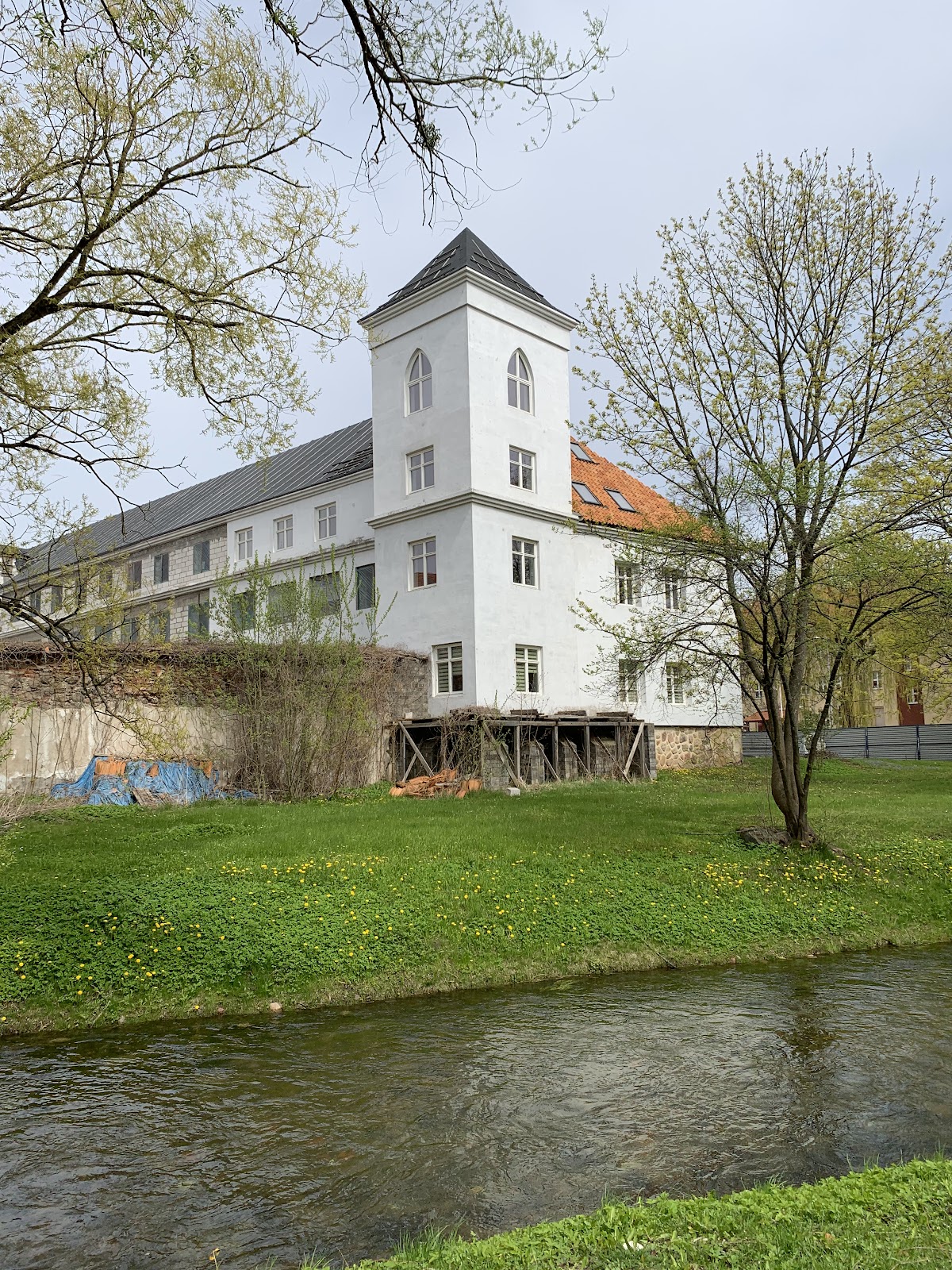
Tatar forces allied with Poland destroyed the castle in 1656 under Subchan Gazi Aga. Reconstruction changed its character. The medieval fortress became a Baroque residence, with more limited military value than its predecessor. The seventeenth-century rebuilding also added the courtyard stair tower.
During the first half of the eighteenth century, General H. H. Katt demolished the mill in the outer bailey and built a replacement after cutting a new canal. Additional windows were installed during this period. King Stanisław Leszczyński stayed at the castle in 1734 and 1736, before going into exile in France.
From 1752, the building housed the offices of the town and land courts and was also used temporarily as a prison. During the Napoleonic campaign of 1807, a military campaign that brought French and allied forces into conflict across Europe, the castle served as a military hospital. In June of that year, Polish forces commanded by Generals Jan Henryk Dąbrowski and Józef Zajączek occupied Węgorzewo and the castle.
Nineteenth-century rebuilding and wartime damage
A fire in 1835 led to another rebuilding for judicial purposes. The successive court adaptations of the nineteenth century largely erased the building’s historic form. It served first as a land and town court, then as a district court from 1849 and a local court from 1879.
On 24 January 1945, the Red Army, the armed force of the Soviet Union during the Second World War, burned almost the entire interior. The fourteenth-century walls survived the conflict with little damage. Remodeling in the 1970s was followed by rebuilding in the early 1980s, when the castle was adapted for the municipal library, town council, and civil registry office.
Recent ownership and protection
The municipality sold the castle in spring 2000 for 805,000 Polish zlotys during the mayoral term of Władysław Anchim. An earlier valuation had placed the property at approximately 4 million Polish zlotys. Two bids were submitted, and Leszek Szumełda’s offer exceeded that of an Italian company by 5,000 Polish zlotys. The municipality required adaptation for tourism, hotel, and service functions but imposed no sanctions for failing to meet the condition. When the castle was offered at an internet auction in 2005, it remained closed and inaccessible to tourists, with a starting price of 4 million Polish zlotys.
Ownership later passed through private investors, including Tanake Bud and Leszek Szumełda. On 30 December 2024, Węgorzewo mayor Krzysztof Kołaszewski announced that Marlena Ostaszewska had become the new owner. She announced plans for a hotel and catering facility with a museum function, including a collection devoted to interwar sports-club badges and former organizations operating in East Prussia. The castle entered Poland’s register of immovable monuments under number 436 (O/55) on 17 September 1957 and is identified as a Teutonic Order architectural heritage monument.
Remains
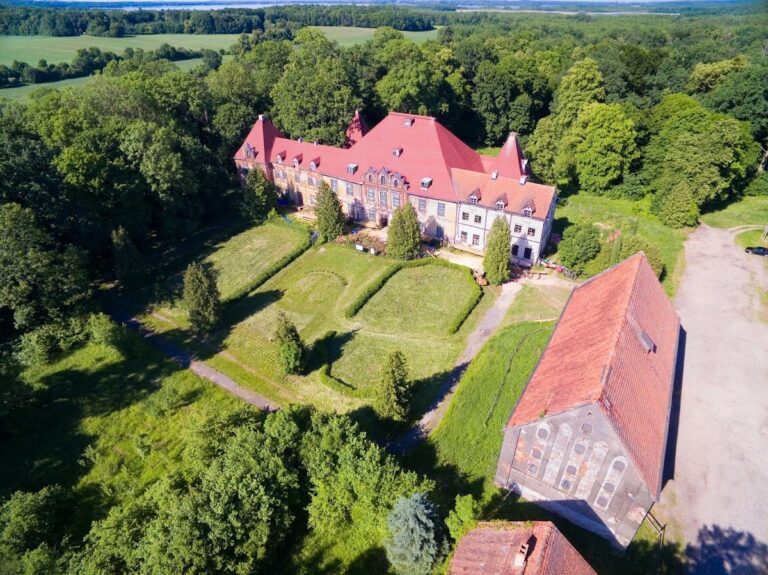
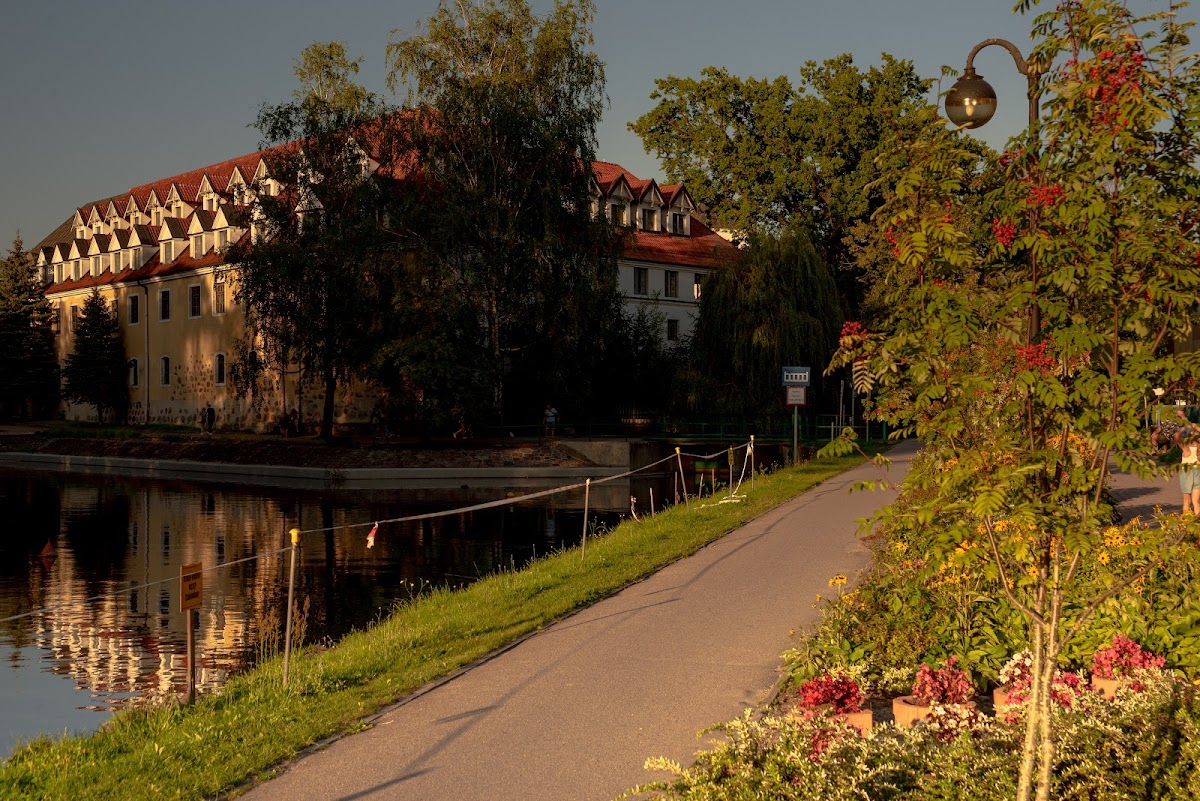
Węgorzewo Castle stands on a river island in the Węgorapa near Lake Mamry. Its irregular layout responds to the island’s restricted shape. The medieval castle was an irregular pentagon, while the present complex is approximately quadrilateral. Three unequal two-storey wings survive, together with evidence of the former enclosing walls, later additions, and the castle’s associated water-management installation.
Castle plan and surviving fabric
Wings and enclosing walls
The north-eastern wing measures approximately 72 metres and the north-western wing approximately 62 metres. They meet at a slight angle in a gently converging arrangement. A short, oblique annex projects eastward from the north-western wing. The remaining sides were originally enclosed by a perimeter wall, including curtain walls, which connected the fortified structures. The present outline probably preserves the medieval configuration of the complete castle.
Medieval fortress and later alterations
The original Gothic fortress had two or three masonry wings, three cylindrical corner towers, and a fourth small tower within the courtyard that served as a circulation link. A small outer bailey, an enclosed subsidiary area outside the main fortified core, lay to the east. The castle belongs to the late Teutonic Order tradition of fortress construction and is among the comparatively few Teutonic castles with an irregular ground plan. Its simple wings and island-shaped site soften the rigid geometric character associated with late Teutonic fortresses.
Gothic and Baroque features are combined in the surviving building. Later rebuilding, damage, plastering, and reconstruction removed many original stylistic and decorative characteristics, although the complex remains substantially preserved as a late and austere Teutonic Order building. The seventeenth-century rebuilding added the courtyard stair tower. During the later conversion for hotel use, the roof was substantially raised and fitted with two rows of dormer windows.
Castle waterworks and eel fishing
The eel weir
Beside the castle, the Teutonic Order constructed a specialized wooden eel-trapping installation in the Węgorapa. Known as an eel weir, it was first recorded in 1469 and formed part of the castle’s economic, administrative, and storage system.
The installation used two sluices and a square-section timber box made from logs below them. When the sluices were opened in the evening, water and eels flowed into the box. Water escaped through numerous small openings in its walls while the fish remained inside. Closing the sluices allowed the catch to be collected, after which it was stored in the castle cellars. Inventories from 1508 and 1514 list a regular reserve of two barrels of salted eels.
Depiction of the installation
The earliest known depiction of the Węgorzewo eel weir is a 1717 engraving published in Litographia Angerburica by Georg Andreas Helwing, a pastor, physician, and naturalist associated with East Prussia.