Yedikule Fortress: A Byzantine and Ottoman Treasury Fortress and Prison in Istanbul




Site at a Glance
- Rating
- 4.5
- Popularity
- Medium
- Country
- Turkey
- Primary era
- Medieval
- External website
- Open
- Eras represented
- Classical, Medieval, Modern
- Civilizations
- Byzantine, Ottoman, Roman
- Site type
- Military
- Remains
- Fort
On this page11 sections
History
Yedikule Fortress is a Roman, Byzantine, and Ottoman fortified complex in Istanbul, Turkey, built behind the Golden Gate of Constantinople’s Theodosian Walls. Its earliest phase probably began between AD 412 and the 440s, when it formed an inner defensive ring intended to block attackers who breached the ceremonial gate. The Mese, Constantinople’s principal processional avenue, passed through the fortified area before continuing into the city.
Roman and Byzantine foundations
The first fortress was known as Castrum Rotundum. Another tradition places its construction during the reign of the Byzantine emperor John I Tzimiskes, around AD 969 to 976, with completion under Manuel I Komnenos, who ruled from 1143 to 1180. The original five-towered enclosure was called Kyklovion or Strongylion and later became known as the Five-Towered Fortress.
The five-towered fortress was destroyed when Constantinople fell to the forces of the Fourth Crusade in 1204. Emperor John VI Kantakouzenos rebuilt it in 1350 and added two towers, creating the Fortress of the Seven Towers. Its position beside the main land entrance gave it both a defensive and ceremonial role within the capital’s fortifications.
Destruction and Ottoman rebuilding
In 1391, Sultan Bayezid I forced Emperor John V Palaiologos to demolish the fortress by threatening to blind John V’s captive son, Manuel. John VIII Palaiologos tried to restore the structure in 1434, but Sultan Murad II prevented the rebuilding. These episodes reflected the political pressure exerted by the expanding Ottoman state over the Byzantine capital before its final conquest.
After Mehmed II, known as Mehmed the Conqueror, captured Constantinople in 1453, he rebuilt Yedikule in 1457 and 1458. Three massive round towers were added to the older fortifications around the Golden Gate, producing the form of the Ottoman seven-towered fortress. Mehmed II initially assigned the complex as the official treasury fortress of the Ottoman Empire.
Treasury, prison, and later uses
The fortress garrison protected state financial reserves, while its commander, the dizdar, guarded the keys and had unusually direct access to the sultan. The treasury held precious goods, official documents, weapons, coins, and gold and silver bullion. In the sixteenth century, the imperial treasury moved to the inner section of Topkapı Palace, and Yedikule became a state prison.
The prison held prestigious captives, including foreign ambassadors from states at war with the Ottoman Empire, political opponents, and people caught in palace intrigues. Sultan Osman II was imprisoned and killed there by janissaries, the sultan’s elite military corps, during their revolt in 1622. Other prisoners included David Megas Komnenos, the last emperor of Trebizond; Constantin Brâncoveanu, prince of Wallachia; Miron Barnovschi, ruler of Moldavia; Simon I of Kartli; and several prominent Ottoman pashas.
Among the foreign prisoners were Andrea Gritti, who later became doge of Venice; the future Crimean khans Mehmed III Giray and Selâmet I Giray; Samuel Korecki, a Polish-Lithuanian nobleman; Jakab Harsányi Nagy, a Hungarian diplomat and Turcologist; Bálint Török, a Hungarian aristocrat; Vasile Lupu, voivode of Moldavia; Pëtr Andreevič Tolstoj, a Russian statesman and diplomat; Jean-Baptiste Barthélemy de Lesseps, a French diplomat, writer, and explorer; Kadri Prishtina, an Albanian politician; and François Pouqueville, a French writer and diplomat.
The Russian ambassador Aleksei Mikhailovich Obreskov and the Russian embassy staff were imprisoned at Yedikule in 1768, in an episode associated with the Ottoman declaration of war on Russia. During the Napoleonic Wars, Pouqueville was held there from 1799 to 1801 and later described the fortress extensively. The last prisoner was held at Yedikule in 1837.
The fortress ceased to operate as a prison during the 1830s. Its barracks and garrison houses were demolished, and a girls’ school was built on the site. The outer gate reopened in 1838, and the towers were later used for a period as gunpowder magazines. Yedikule became a museum in 1895. In 2025 it remained a museum under restoration.
Yedikule’s history also entered legends, historical narratives, and works of art. With the exception of its opening eleven and closing four sentences, Ivo Andrić’s novel The Damned Yard is set in the Yedikule prison. A Muslim cemetery lies in front of the Golden Gate, and an open-air theater was later created inside the fortress for cultural festivals.
Remains
Fortified enclosure and courtyard
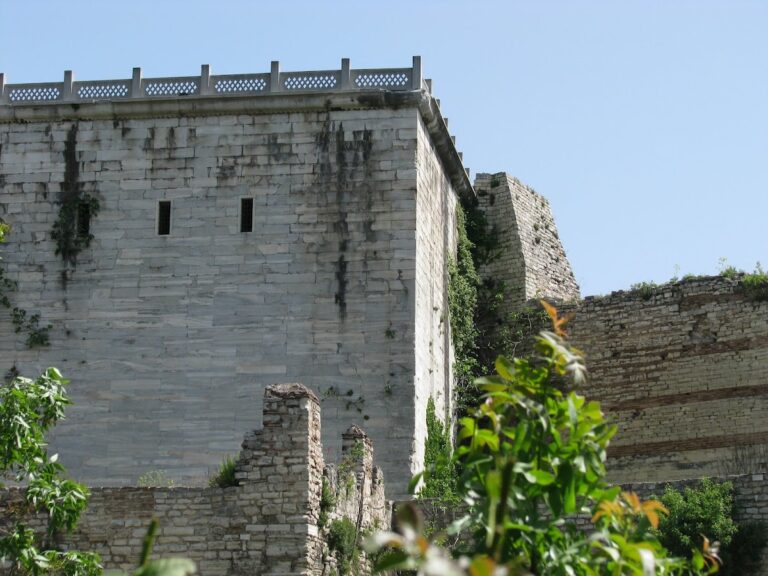
Yedikule forms a fortified enclosure adjoining the Theodosian Walls on the west and the sea walls along the Sea of Marmara on the south. At its greatest extent, the complex consisted of walls and towers surrounding a large area, although the precise historical outline and arrangement of the towers remain uncertain. Its Ottoman plan was approximately pentagonal and incorporated sections of the older Constantinople defenses.
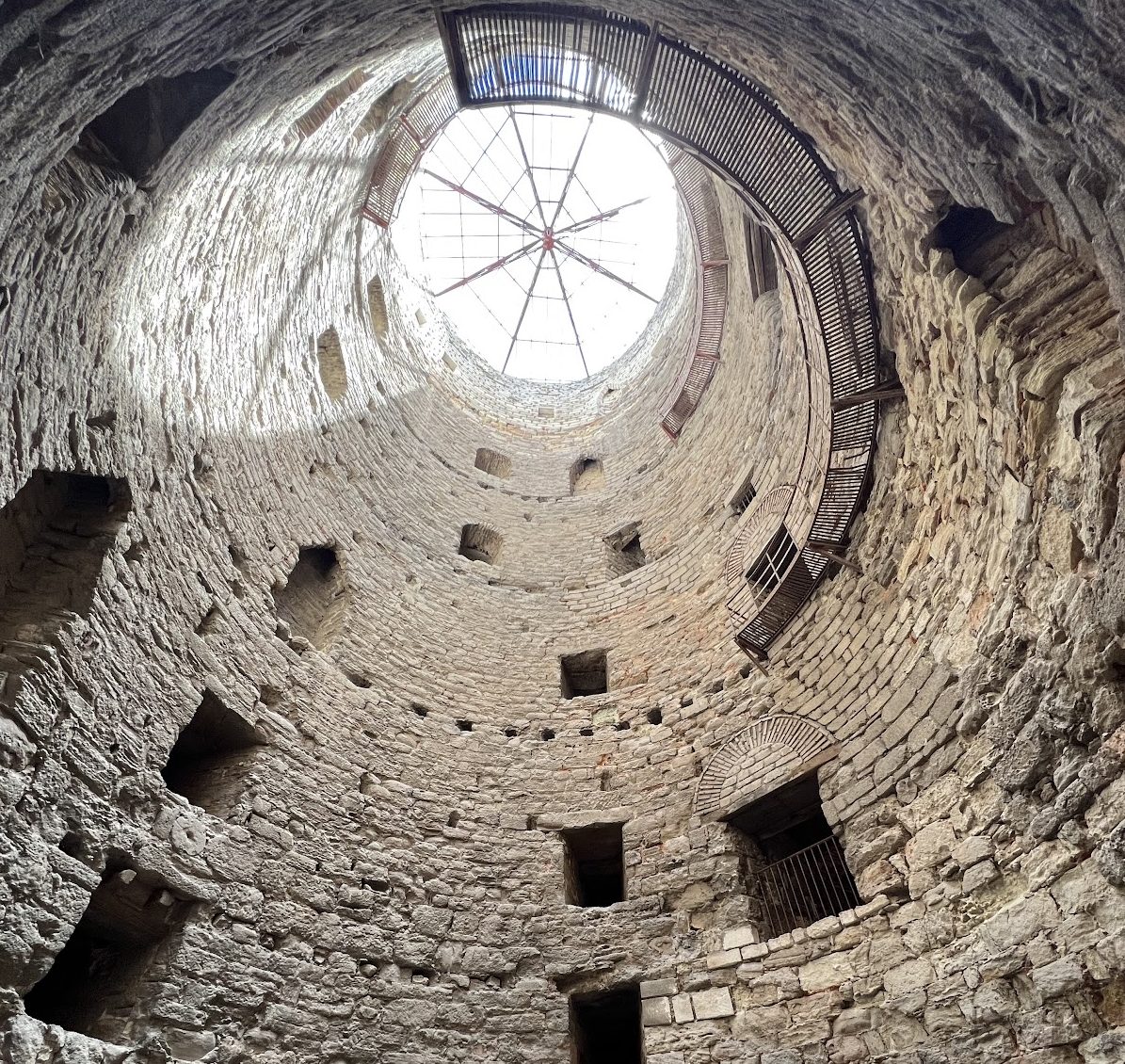
The complex had two principal gates. The outer gate was the Golden Gate, while an inner gate led directly into the city. The enclosure contains six principal towers, six small solid intermediate towers that functioned as bastions, one small gate tower, and the two main gates. Tower 8 is ruined, so the Watchtower or Gate Tower conditionally fulfills the role of the seventh tower in the traditional count.
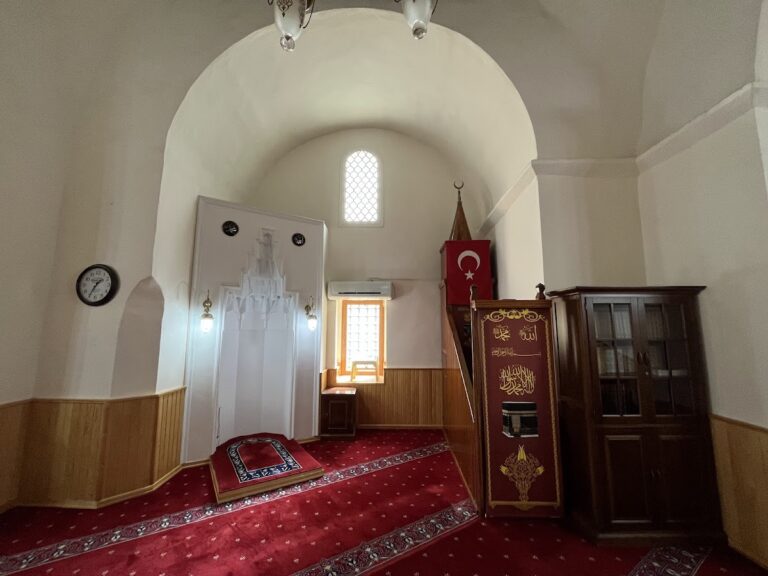
The inner courtyard contained a small mosque, or mescit, and a fountain. Garrison residential buildings once formed a separate urban quarter within the enclosure before they were demolished for the school. A line from the midpoint of the former Golden Gate to the central Ottoman tower divides the fortress into two symmetrical parts. The small domed Conqueror’s Mosque marks the midpoint of this axis.
Golden Gate and associated towers
The Golden Gate
The Golden Gate, also called Porta Aurea, was the principal ceremonial entrance of the Theodosian Walls. It first stood as a triumphal arch on the Via Egnatia, the major Roman road leading through the Balkans toward the Adriatic, and was later incorporated into the city walls. Built of white marble, the gate had doors covered with gold. Its name may derive from those doors, although another interpretation connects it with golden wings added as decoration in 425.
A monumental quadriga drawn by elephants stood above the gate. The entrance comprised a large central opening and two smaller side wickets, known as the Little Golden Gates. The name Golden Gate was also applied to entrances in the outer wall, at the rear of Yedikule, and to the Yedikule Gate. The central entrance was probably reduced in size during the tenth century, while the side wickets were eventually blocked. The gate is now sealed and forms part of the fortress.
The last recorded ceremonial entry through the Golden Gate was made by Emperor Manuel I Komnenos in 1156 after his return from a campaign in Pannonia. The surviving gate preserves the Byzantine inheritance of the fortress, while the later Ottoman towers transformed the former ceremonial entrance into the core of a fortified enclosure.
Marble towers
Marble towers numbered 9 and 10 flank the Golden Gate. The southern tower is also called the Genç Osman Tower, commemorating Osman II, who was killed there by janissaries during their revolt on 20 May 1622. The northern tower is known as the Arsenal Tower and also as the Prison Tower. Both towers were built between 404 and 413.
Tower 11 is known as the Ahmet III Tower. Sultan Ahmed III restored it after an earthquake, and its present identity preserves the connection between the later Ottoman structure and the repairs carried out under his rule.
Rear towers and bastions
Three towers stand along the rear of the fortress from south to north: the Cannon Tower, the Prison Tower, and the Treasury Tower. The Treasury Tower, or Hazine Kulesi, held the imperial treasury and archives when Yedikule served as the state treasury fortress.
Six small blind towers, functioning as bastions, were arranged around the enclosure. Two stood on the southern side, two on the northern side, and one each on the northeastern and southeastern walls. The first southern bastion is called the Watchtower, or Nobet. These smaller defensive structures formed part of the fortified ring surrounding the courtyard and its principal towers.
The Gate Tower
The Gate Tower is a small passage tower on the northeastern wall between the Prison Tower and the Treasury Tower. Its gate connected the fortress with the southern part of the Exakionion district. The tower was substantially rebuilt from 1457 onward, during Mehmed II’s reconstruction of Yedikule.
The altered walls, surviving towers, sealed ceremonial gate, courtyard, mosque, and fountain together express the complex’s successive Roman, Byzantine, and Ottoman forms. The towers were also used temporarily for gunpowder storage after the prison period, adding another phase to the physical history of the enclosure.