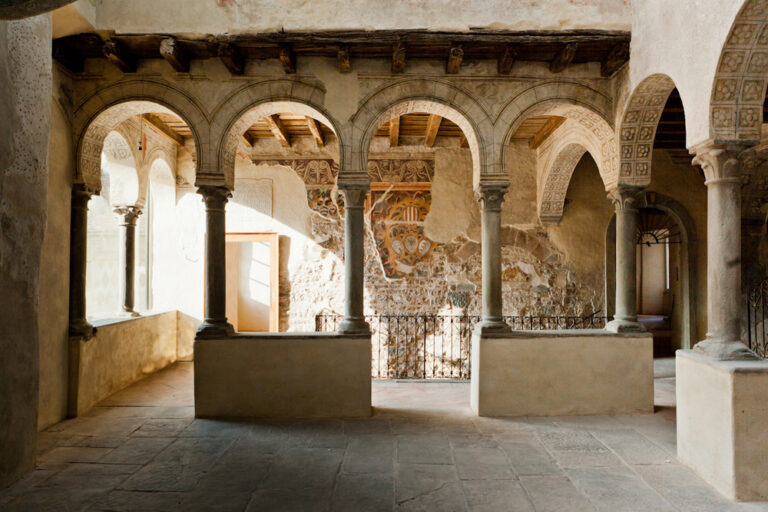
San Vigilio Castle: The Hilltop Fortress of Bergamo


Site at a Glance
- Rating
- 4.6
- Popularity
- Low
- Country
- Italy
- Primary era
- Medieval
- Eras represented
- Medieval, Modern
- Civilizations
- Duchy of Milan, Holy Roman Empire, Italian, Venetian
- Site type
- Military
- Remains
- Castle
On this page13 sections
History
San Vigilio Castle, or Castello di San Vigilio, is a hilltop fortress in Bergamo, Italy, built and expanded over successive medieval and early modern periods. Occupying the San Vigilio hill north of the upper city, it defended the surrounding heights and approaches, including routes toward the Brembana Valley.
Early fortification and the chapel
The elevated position may have supported a small Roman watchtower, although that attribution remains uncertain. The first known fortification dates approximately to the sixth century, and no major recorded event affected the site until the ninth century. During the early medieval period, a small religious community settled on the hill and built a very small place of worship dedicated to Saint Mary Magdalene, a widely venerated Christian saint. Because the building was regarded as a chapel rather than a church or sanctuary, the fortification became known as the Castle of the Chapel.
Arnulf’s conquest and municipal rebuilding
In 889, Arnulf of Carinthia, a Carolingian ruler who became king of East Francia and later emperor, conquered the site for military purposes despite resistance from the local religious community. The cleric Gotefrido was a prominent defender and was executed by Arnulf. In 1166, Bergamo’s municipal council decided to construct a larger castle on the hill. The Visconti, the powerful ruling family based in Milan, later enlarged and strengthened the fortress, completing its fortification in 1335.
Venetian military redevelopment
Under the Republic of Venice, which ruled Bergamo as part of its northeastern Italian territories, the castle became an important element of the city’s administration and defense. Numerous changes were made toward the end of the fifteenth century. The medieval central tower was demolished to provide more room for the garrison, while the castle was enlarged toward the city. This work added a castellan’s residence and soldiers’ quarters and formed part of a wider effort to create an exceptionally strong defensive position connected with Bergamo’s city walls.
Sixteenth-century sieges
The fortress was drawn into several conflicts during the sixteenth century. In 1509, French forces serving the Duchy of Milan attacked the Venetian provveditore, the senior Venetian official responsible for the stronghold. In 1512, Venetian forces regained control after months of fighting in which the French had held their opponents at bay. Further combat followed in 1513, when Spanish forces used cannon and culverins, long-barrelled early modern guns, and damaged the castle.
Decline, reuse, and restoration
The castle was linked to the northern section of Bergamo’s walls, known as the Fort of San Marco, by a concealed underground passage. After the Republic of Venice collapsed under the Treaty of Campo Formio, French troops of the Cisalpine Republic, a French-supported state in northern Italy during the Napoleonic period, occupied Bergamo and positioned themselves in the castle. About two decades later, Austrian forces began dismantling the city’s principal military structures. In 1829, parts of the castle, including its monumental entrance gate, were demolished.
Toward the end of the nineteenth century, the Soregaroli family acquired the entire complex and installed a restaurant. In 1912, it began constructing a funicular between the castle and the area beside Porta Sant’Alessandro. Pierino Soregaroli undertook extensive physical and financial work during the 1920s and 1930s to adapt the staircase and repair the deteriorated walkways after the fortress had remained without a garrison for about two centuries. The property later passed to the Municipality of Bergamo, which resumed its recovery. The entire castle opened to the public in 1962. The funicular operated until 1976 and was restored in 1991, when the restoration works were completed.
Remains
Hilltop setting and defensive plan
San Vigilio Castle stands at approximately 496 metres above sea level on the summit of the hill. Its position overlooks Monte Bastia, the settlements below, the former Val Breno area including Valbrembo and Paladina, the Almenno plain, villages along the route toward the Brembana Valley, and a broad stretch of the Orobie Pre-Alps. The surviving fortress took shape through Venetian redevelopment, with four towers joined by a polygonal curtain wall, a connecting defensive wall, and protected by a moat. Large cisterns were installed to collect water, supporting the stronghold’s operation.
Towers and concealed defenses
Gun towers
The late-fifteenth-century alterations created four towers equipped with gun ports and narrow openings for weapons or observation. They formed part of the polygonal defensive enclosure and remain among the principal elements of the restored castle.
Underground routes and casemate
The passage to the Fort of San Marco began at the northern part of Bergamo’s walls and connected the castle with that section of the city’s defenses. Another concealed route led from one tower to a casemate, a protected chamber used for defense or weapons. A landslide made this second passage unusable and created a very small lake along it. The underground connection with the Fort of San Marco has been made accessible through guided visits organized by the speleological group Le Nottole.
Cityward expansion and entrance
The castle was enlarged toward Bergamo, incorporating the castellan’s residence and soldiers’ quarters. Together with the elaborate entrance designed by Mauro Codussi, a Venetian Renaissance architect, this expansion gave the plan a form resembling a star. The medieval central tower was removed during the Venetian military redevelopment, while the monumental entrance gate was demolished in 1829. The complex is now restored, with its surviving defensive and residential elements forming the physical remains of the hilltop fortress.
Funicular connection
The funicular begun in 1912 connected the castle with the area beside Porta Sant’Alessandro. It covered 621 metres and overcame a difference in elevation of 91 metres. Its restoration was completed in 1991, preserving the later transport link associated with the castle’s modern history.