Guttenberg Castle: A Medieval Hill Fortress in Germany


Site at a Glance
- Rating
- 4.5
- Popularity
- Low
- Country
- Germany
- Primary era
- Medieval
- External website
- Open
- Eras represented
- Medieval
- Civilizations
- Holy Roman Empire
- Site type
- Military
- Remains
- Castle
On this page11 sections
History
Guttenberg Castle is a medieval rocky hill fortress in Germany, near Oberotterbach in Rhineland-Palatinate. Built around 1150 in the medieval period, it stood near the French border in the German part of the Wasgau and may have served as an imperial castle of the Hohenstaufen dynasty, a ruling family whose members held the throne of the Holy Roman Empire.
Early imperial connections
The castle may have been mentioned in 1151 as an imperial stronghold administered by Landolfo de Gudenburc, a ministerial, meaning a medieval official who performed administrative or military duties for a ruler. Another tradition connects the early reference with Ulrich von Guttenberg, who donated property to Eußerthal Abbey in 1174. The first certain reference dates from 1246, when Isengard von Falkenstein, acting for her husband Philipp I von Falkenstein, transferred the castle to King Conrad IV. Philipp held the office of imperial steward, a senior court position concerned with the ruler’s household and administration.
Division among territorial lords
From 1317, the Counts of Leiningen held one half of Guttenberg Castle as a fief, while the other half passed somewhat later to the Electoral Palatinate, the Palatine territory whose ruler also held an electoral office in the Holy Roman Empire. During the Palatinate partition of 1410, the castle was assigned to Duke Stephen of Palatinate-Simmern-Zweibrücken.
The Leiningen share changed hands during the fifteenth century. Count Schaffried, also known as Geoffroy, of Leiningen was captured at the Battle of Reichshoffen on 5 June 1451. In 1463, he secured his release by transferring Guttenberg Castle and Minfeld Castle to the Lords of Lichtenberg. The Leiningen portion later passed through the Hanau-Lichtenberg family to the Wittelsbach line of Palatinate-Zweibrücken. The Lichtenberg lord then sold it to Duke Louis the Black of Zweibrücken for 7,000 gold florins.
Destruction and administrative change
In 1525, during the German Peasants’ War, a group of peasants from Lorraine destroyed Guttenberg Castle. The fortress was not rebuilt, and the associated administrative office was moved to Dörrenbach. When the Heidelberg line became extinct in 1559, Palatinate-Zweibrücken inherited the other half of the Guttenberg lordship, including its share of the ruined castle.
The lordship was divided into Upper and Lower Communities. The Upper Community comprised the later-abandoned village of Guttenberg, Oberotterbach, Dörrenbach, Rechtenbach, Mundorf, Harwerden, and the Münchweiler exclave. The Lower Community included Minfeld, Kandel with Höfen and Minderslachen, Freckenfeld, Vollmersweiler, and Niederotterbach. After a territorial exchange between Palatinate-Zweibrücken and the Electoral Palatinate in the late eighteenth century, the former Guttenberg office became the Upper Office of Guttenberg, with the exchanged offices of Selz and Hagenbach placed under it.
French, Austrian, and Bavarian rule
Between 1680 and 1697, the region came under French supremacy through Louis XIV’s policy of reunions, an expansion policy by which France asserted control over territories claimed to have historic connections with lands already ruled by France. From 1792 to 1815, the area formed part of France and belonged to the Bas-Rhin department.
Under agreements connected with the Second Treaty of Paris in November 1815, the territory between the Lauter and Queich, including the ruins of Guttenberg, came under Austrian sovereignty. Austria ceded the Palatinate to the Kingdom of Bavaria in April 1816 under the Treaty of Munich.
Modern protection
After the Second World War, Guttenberg Castle became property of the state of Rhineland-Palatinate. French administration continued from 1949 to 1986. Safeguarding and restoration work followed between 1989 and 1995, supported by the organization responsible for preserving the Mundat Forest.
Remains
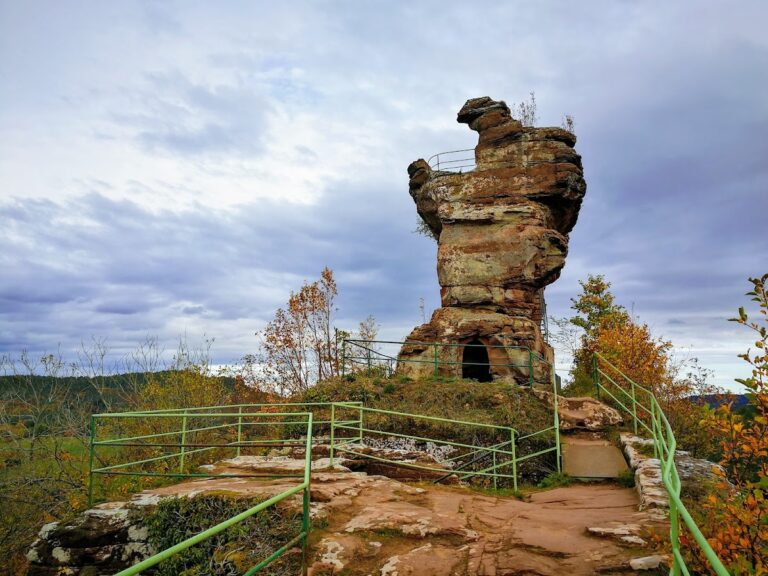
Guttenberg Castle occupies a summit crowned by a rocky reef in the Upper Mundat Forest, about three kilometres west of Oberotterbach. The site stands on the 503.1-metre-high Schloßberg, with the Hohe Derst roughly one kilometre to the northwest and the Hohe Kopf about one kilometre to the south. The Otterbach rises on the northeastern slope below the castle and forms a headwater of the Michelsbach.
Castle layout
The medieval fortress originally covered about 50 by 25 metres. Its plan consisted of an upper castle built on the rock reef and a lower castle, with the two areas linked by a stairway cut into the stone. The position of the upper castle on the summit gave the surviving rock platform an elevated setting above the Upper Mundat Forest and the Upper Rhine Plain.
Surviving structures
Upper castle
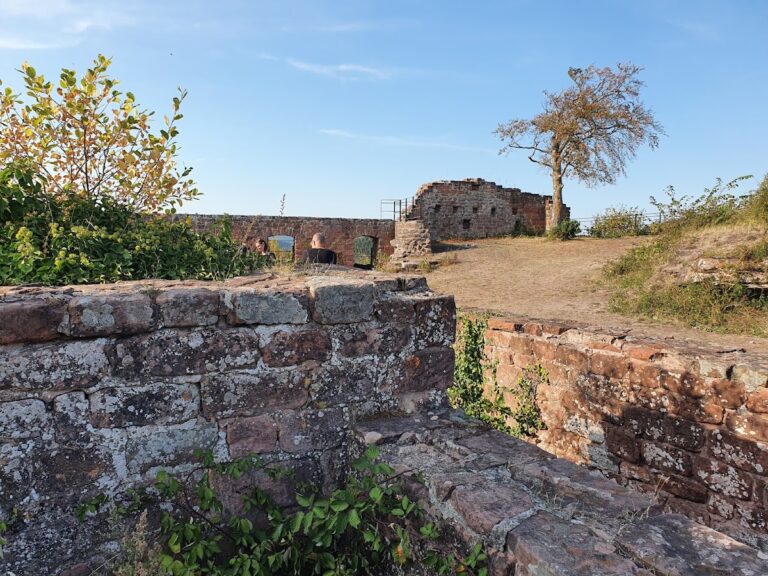
Only part of the keep, the principal defensive and refuge tower of a medieval German castle, survives from the three towers that once stood in the upper castle. Numerous holes for beams and upright posts remain in the rock and masonry area, preserving traces of the structures that once occupied the summit. The upper castle was later used as a quarry, which accounts for the limited survival of its fabric.
Lower castle and stairway
Fragments of the rock-cut stairway still survive between the upper and lower areas. Sections of the lower castle’s enclosing wall, along with building foundations and a gate, remain on the site. Together, these features preserve the basic relationship between the lower enclosure and the fortified summit, although the castle survives only in a fragmentary state.