Burg Limburg: A Romanesque Hilltop Castle in Germany


Site at a Glance
- Rating
- 4.7
- Popularity
- Low
- Country
- Germany
- Primary era
- Medieval
- External website
- Open
- Eras represented
- Medieval
- Civilizations
- Holy Roman Empire
- Site type
- Military
- Remains
- Castle
On this page9 sections
History
Burg Limburg is a former Romanesque hilltop castle in Germany, near Weilheim an der Teck, built around 1050 by Count Berthold I, known as “with the Beard.” It was one of the oldest Romanesque castles of the high nobility, and its first recorded mention dates to 1077.
The Bertholdine ancestral seat
The castle is regarded as Berthold I’s ancestral seat. He died there in 1078, placing Limburg at the centre of the family’s early history. Around 1100, his son Berthold II built Burg Zähringen near Freiburg and transferred the family seat there. He then adopted the title Duke of Zähringen instead of Count or Margrave of Lintburg. The Zähringers were a medieval noble dynasty whose territories and titles extended across southwestern Germany.
Destruction and rebuilding
Limburg was probably destroyed during the Investiture Controversy, an eleventh- and twelfth-century struggle between the papacy and the German kings and emperors over the appointment of bishops and other church officials. The castle was rebuilt and occupied by Zähringen vassals from the lower nobility of Weilheim. It was probably destroyed again around 1130 and reconstructed once more.
About 1150, the Zähringers built the stronger Burg Teck. Limburg consequently lost its importance and, together with Burg Teck, passed to Adalbert, who is identified as the founder of the dukes of Teck. The castle was abandoned and gradually fell into decay.
The chapel and later tradition
After the castle had decayed, a chapel dedicated to Saint Michael was built on the summit plateau in the fifteenth century. Local tradition connects the chapel with a dragon legend. According to the story, a mysterious knight killed a dragon that had terrorized the surrounding population, after which the people built the chapel in gratitude. The knight was variously identified with Saint George, a Christian martyr traditionally associated with dragon slaying, or with the Archangel Michael, who is associated in Christian tradition with protection and the defeat of evil.
Today, Burg Limburg is classified as a Burgstall, meaning a former castle site where the fortification is largely ruined or no longer standing.
Remains
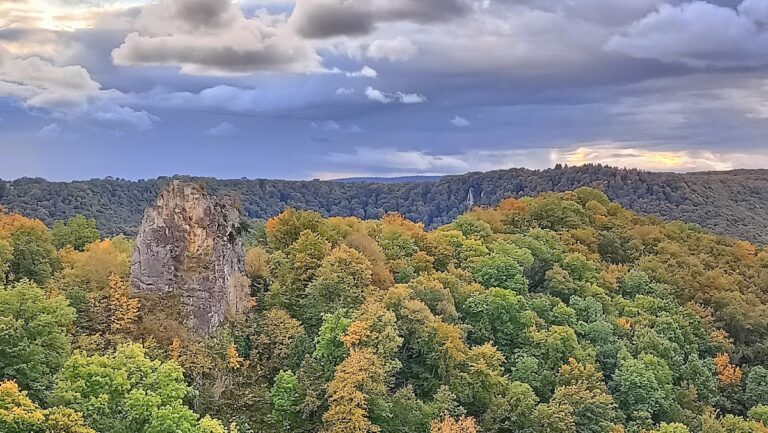
The castle occupied the summit of the 598-metre Limburg, a cone-shaped volcanic mountain that forms Weilheim an der Teck’s local mountain. The mountain stands north of the Albtrauf in the foreland of the central Swabian Jura. The former fortification consisted of an oval main enclosure divided into northern and southern sections by a section ditch.
Castle enclosure
Main enclosure
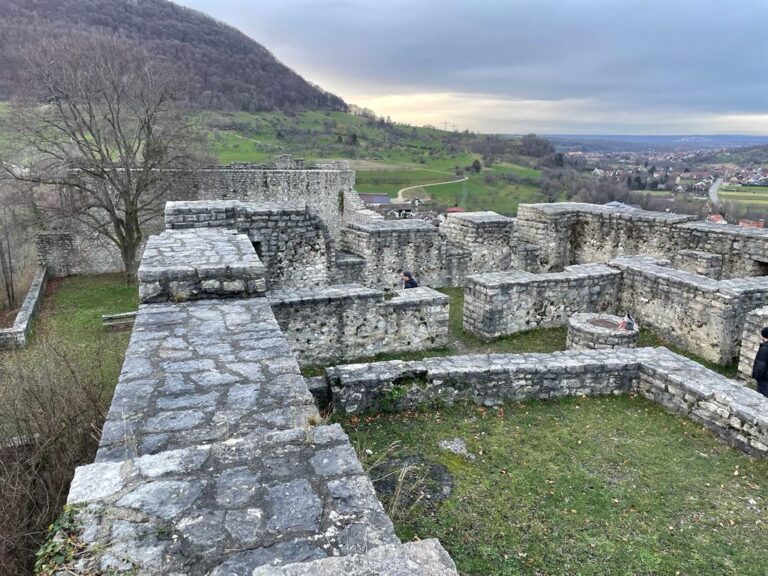
The oval enclosure was arranged around the summit and separated into two parts by the ditch crossing the site. No castle masonry survives above ground. Instead, some foundation outlines appear as raised features in the terrain, allowing parts of the former plan to be traced through the landscape.
Southern tower
A tower stood in the southern part of the castle. It had an approximately square ground plan measuring 8 by 8 metres. Its surviving evidence is limited to the archaeological traces preserved in the terrain.
Saint Michael’s Chapel
The fifteenth-century Saint Michael’s Chapel stood in the northern section of the former inner castle. Only buried wall remains survive, while the chapel’s position preserves the later religious use of the summit after the medieval fortification had fallen into decay.
Nearby sites