Little France: A Medieval Outwork of Berwartstein Castle


Site at a Glance
- Rating
- 4
- Popularity
- Very Low
- Country
- Germany
- Primary era
- Medieval
- External website
- Open
- Eras represented
- Medieval
- Civilizations
- Electoral Palatinate, Holy Roman Empire
- Site type
- Military
- Remains
- Fort
On this page8 sections
History
Little France is a ruined late-medieval outwork in Germany, built in 1484 by the knight Hans von Trotha, also known locally as Hans Trapp, as an auxiliary fortification of nearby Berwartstein Castle. Its position and artillery role placed it within the military transition from the Middle Ages to the early modern period. The fort was intended to help protect Berwartstein by controlling the open ground between the two strongholds.
Construction and military purpose
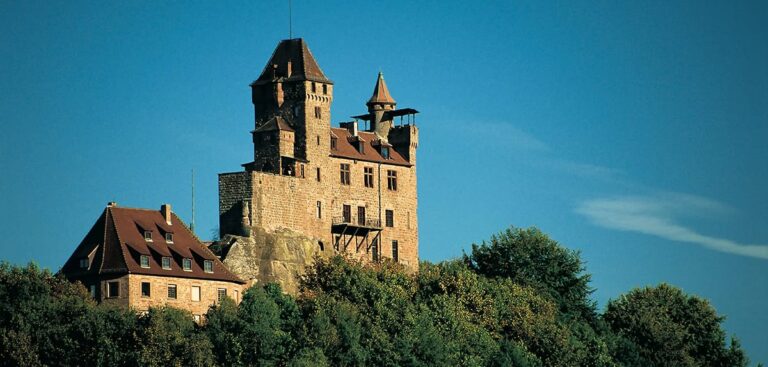
The ground between Little France and Berwartstein was known as the Leichenfeld, or “Corpse Field.” The two fortifications were arranged to subject this open area to crossfire, with Berwartstein to the north and Little France to the south. The saddle was the only place from which siege cannon of the period could be brought close enough to fire against Berwartstein.
Berwartstein resisted repeated attempts to conquer it before 1591, and Little France may have contributed to that defensive success. In 1591, however, the main castle burned after being struck by lightning. It then remained uninhabitable for three centuries, while the outwork continued as part of the abandoned defensive landscape.
Name and later destruction
The name Little France, also known as Klein-Frankreich, has no certain origin. The fort lies in the direction of France when viewed from Berwartstein, and the present French border is about 7 kilometres away. The site was called Thurm Frankreich in 1511.
After Berwartstein had already stood abandoned for decades, Little France suffered severe damage during the seventeenth century. The destruction may have occurred during either the Thirty Years’ War, the European conflict of 1618–1648, or the War of the Palatine Succession, fought from 1688 to 1697. The outwork subsequently became a ruin. Restoration of its surviving remains began in 2005.
Remains
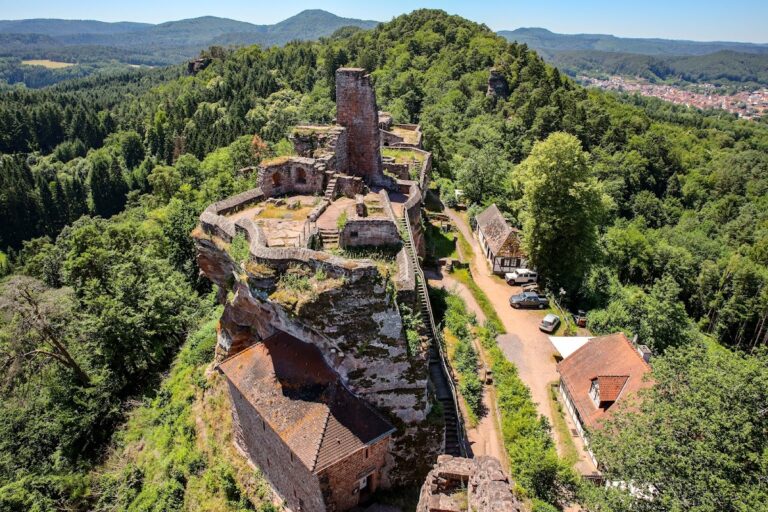
Little France occupies the northeastern slope of Nestelberg in the Dahner Felsenland, at an elevation of 322 metres above sea level. Nestelberg forms a southwest-to-northeast ridge about 1 kilometre long, with a summit approximately 401.5 to 402 metres high. Berwartstein Castle stands about 370 metres to the north across a saddle-shaped side valley, roughly 50 metres lower, at about 276 metres above sea level. The valley broadens westward into a basin near the main valley meadows of the Erlenbach and rises eastward toward the saddle between the two fortifications.
Battery tower and defensive perimeter
Battery tower
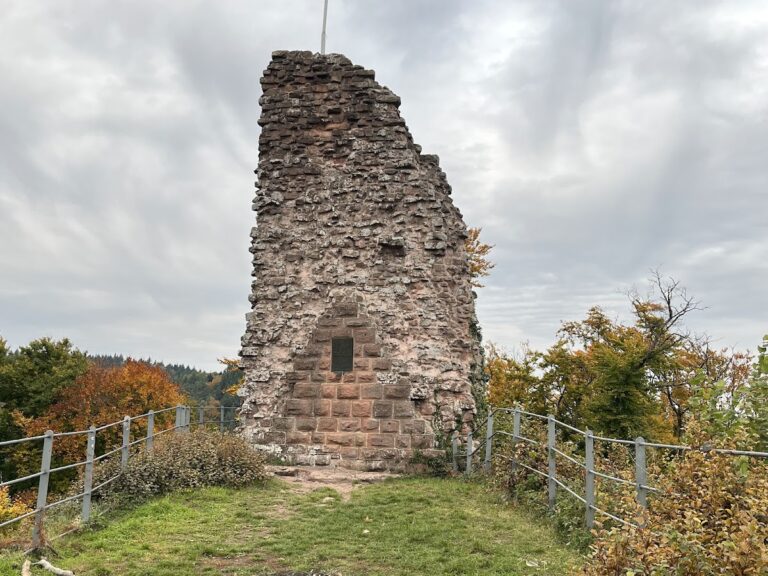
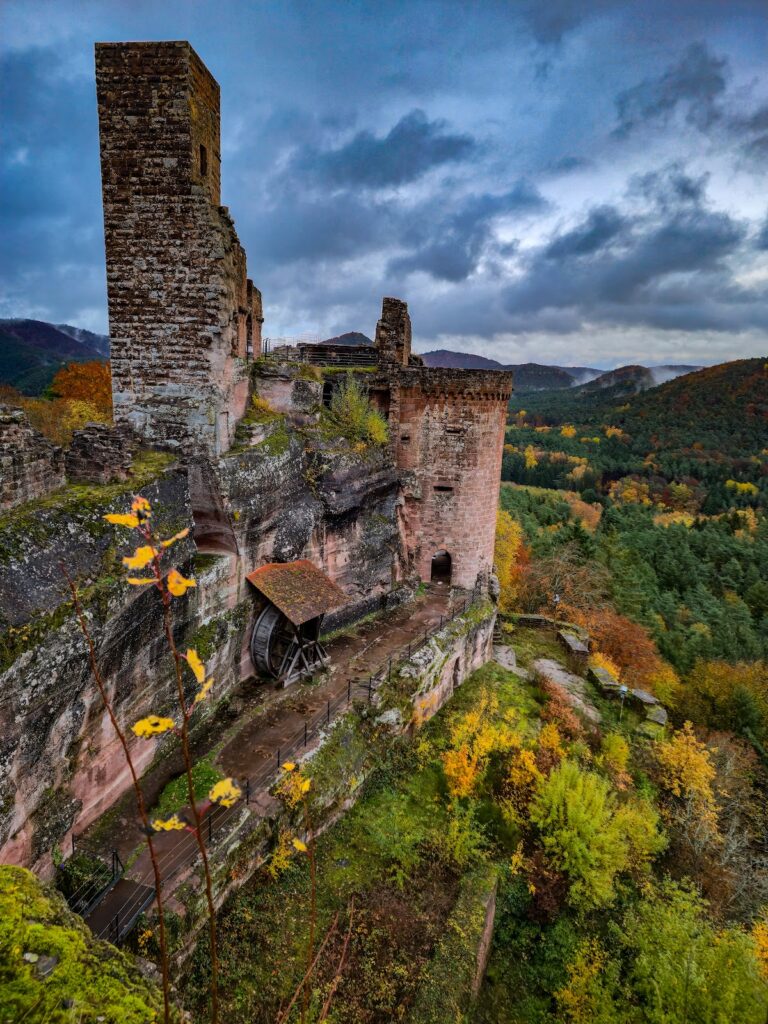
The most substantial surviving feature is the base of a large battery tower. It measures approximately 14 metres in diameter and originally stood about 14 metres high. Sandstone ashlar blocks form walls 3.20 metres thick, and some blocks retain lifting holes that may have been used with a three-legged lewis, a tripod-like device for raising heavy masonry.
Three embrasures, or openings for weapons, pierce the ground-floor wall, while four more occupy the first floor. They accommodated arquebuses, which were lighter early firearms operated by individual soldiers, and small guns. The broad roof platform could hold culverins, relatively long-barrelled firearms whose extended barrels improved range and accuracy.
Enclosing defenses and well
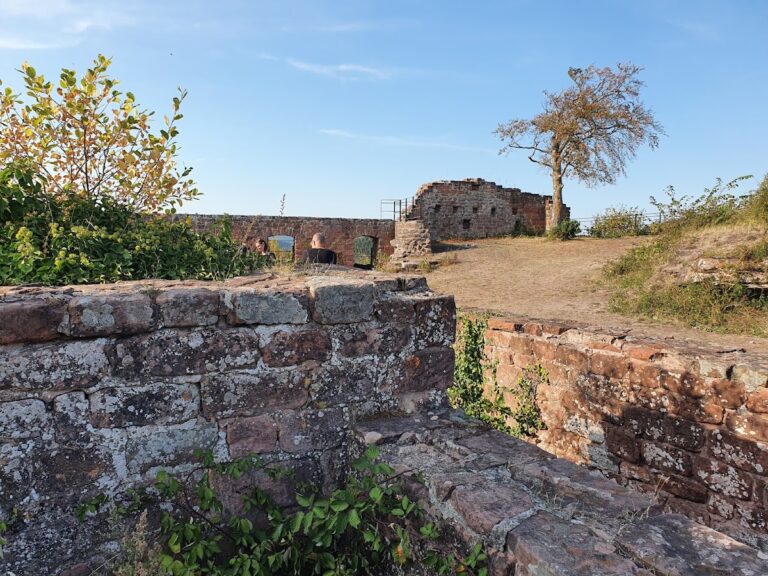
Remains of the enceinte, the enclosing defensive wall, lie north of the battery tower. A filled-in castle well stands immediately to the northeast. Together these features show the arrangement of the outwork around its principal artillery position and its provision for a fortified garrison.
Covered ditch
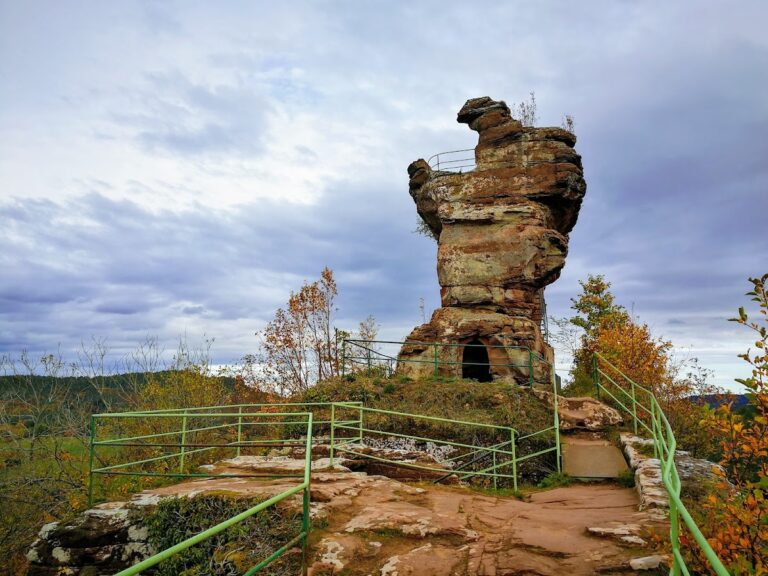
Near Little France are the remains of a ditch covered with stone slabs and concealed beneath earth and vegetation. The ditch has almost entirely collapsed. A tradition connects it with a concealed passage to Berwartstein, although that interpretation remains unsubstantiated.
Nearby sites